November 28, 2025
Analysis
After Boric
Assessing four years of Chile’s state-led development agenda

In April 2024, speaking to a crowd of the country’s most prominent business leaders, Chilean President Gabriel Boric stated that he was “elected to lead Chile into the future, not to restore the past.” This future would lay the foundations for a large-scale transformation of Chile’s exhausted export-oriented economic model, in place since the end of the Pinochet dictatorship in 1990.
In his first year of government, in 2022, Boric positioned lithium, copper, and green hydrogen as catalysts for technological progress, subjecting the resources to new commercial rules and renegotiating contracts with foreign actors and private firms. Boric’s team also pursued greater state participation in the management of strategic resources and increased public financing. But the recent victory of right-wing presidential candidate José Antonio Kast places the fate of this developmentalist turn into peril.
The Boric agenda (2022–2026) should be understood within a broader global context of state intervention. As Isabel Estévez and Thea Riofrancos have pointed out, industrial policy agendas are shaped by asymmetrical power dynamics.1Estevez, I., & Riofrancos, T. (2025). Global green industrial policy: Navigating power dynamics for a pro-working-class, pro-development green transformation. (<)em(>)Climate and Community Institute. (<)/em(>)https://climateandcommunity.org/research/global-green-industrial-policy While the United States and the European Union deploy massive subsidies for domestic industry, they restrict the ability of peripheral countries to implement similar tools. Indeed, Amir Lebdioui warns that the uneven industrial geography of decarbonization, inadequate climate finance, and green protectionism threaten to deepen development gaps between the North and South.2Lebdioui, A. (2024). (<)em(>)Survival of the greenest: Economic transformation in a climate-conscious world(<)/em(>). Cambridge University Press. https://doi.org/10.1017/9781009339414 This asymmetry reveals that the problem lies not just in which policies to adopt, but in the power relations that determine who can use them. These asymmetric structures are dynamic and constantly evolving. There are windows of opportunity for peripheral economies to scale up in global value chains.3Whitfield, L., & Wuttke, T. (2025). Opportunities for latecomer technological catch-up in the era of renewables capitalism: Possible pathways out of the periphery. (<)em(>)Development and Change. (<)/em(>)(<)a href='https://doi.org/10.1111/dech.70016'(>)https://doi.org/10.1111/dech.70016(<)/a(>)
The experience of the Boric government reveals the challenges of a pursuing a progressive trade and industrial program in the periphery, and it remains unclear what aspects of this program, if any, will remain under Kast’s newly formed government. The future of development in Chile not only confronts the constraints of the global economic hierarchy, but also the political defeat of a transformative domestic agenda.
Economic stagnation
Following the democratic transition, Chile deployed a growth regime driven by the expansion of primary exports, a boom in foreign investment in finance, mining, commodities, and infrastructure, and the control of domestic markets by national conglomerates. This regime generated a decade of growth in the 1990s, but it began to show clear signs of exhaustion by the 2000s. Exports were not breaking away from their dependence on raw materials, technological gaps widened, and the productive investment cycle was closing in.4French-Davis, R. and Diaz, A. (2019). “Productive investment in Chile’s economic development: evolution and challenges”. (<)em(>)CEPAL Review(<)/em(>), No. 127.
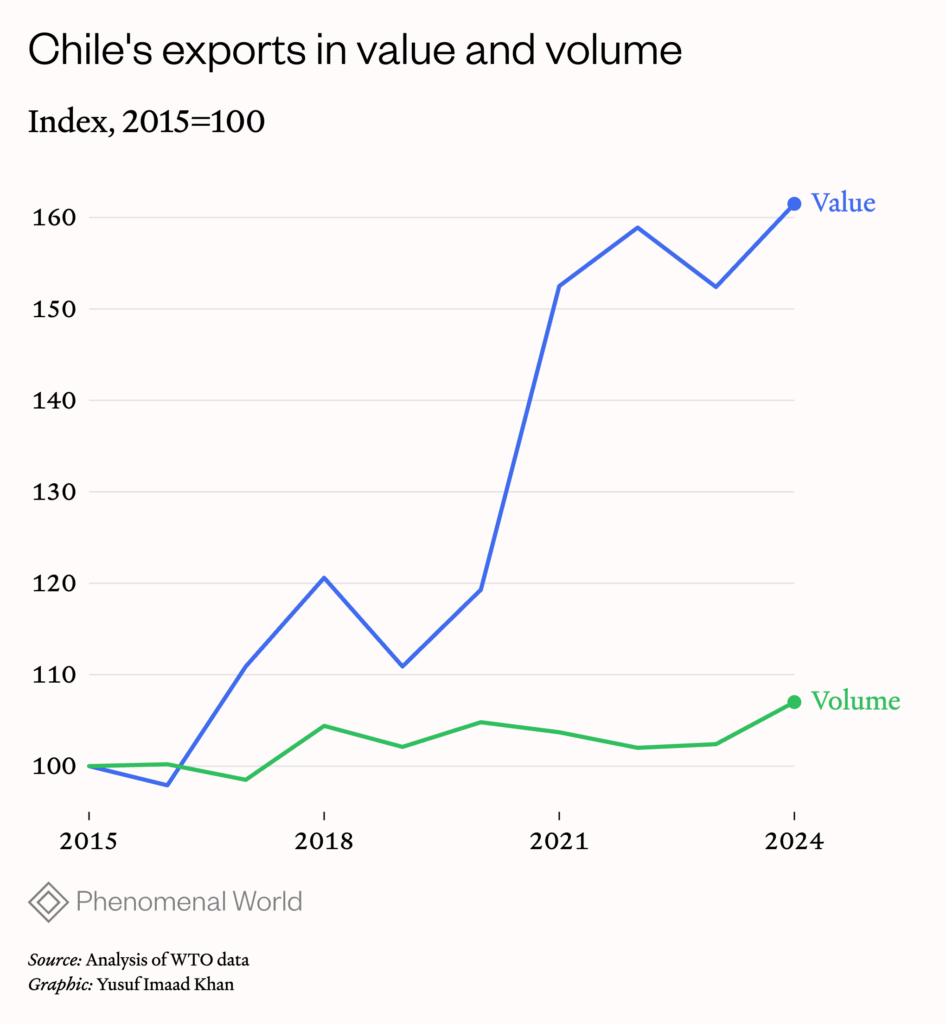
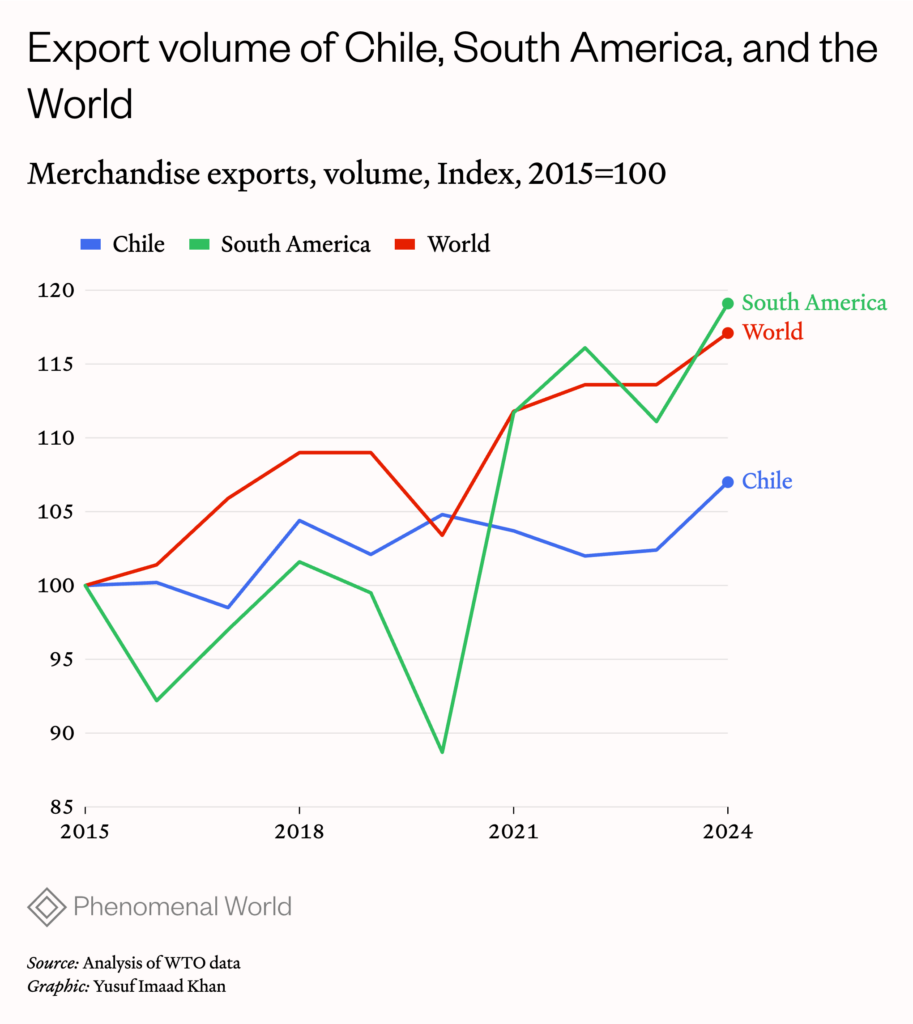
As in the rest of the region, the exogenous boom in commodity prices from 2003 to 2013—driven by Chinese demand—generated a positive shock in Chile. But this raw materials bonanza came to a halt in 2014, marking the end of a period in which improving terms of trade led to a kind of “Dutch disease”—strong exchange rate appreciation, stagnating levels of non-copper exports, and a decline in new exports.5 French-Davis, R. (2018). (<)em(>)Economic reforms in Chile (1973-2017): neoliberalism, growth with equity, inclusion(<)/em(>). Taurus; Sossdorf, F. (2024). Boom and bust of the Chilean export cycle. (<)em(>)Latin American Journal of Trade Policy, 6(<)/em(>)(18). https://doi.org/10.5354/0719-9368.2024.74309. https://doi.org/10.5354/0719-9368.2024.74309. Indeed, the last decade has seen economic stagnation and an increasingly precarious and indebted labor force in Chile. While exports grew at 10 percent per year between 1990 and 1999, their growth slowed to only 4.7 percent between 2000 and 2009, and 0.9 percent between 2010 and 2019. Even more revealing, while the value of exports grew 61.5 percent in the last decade—boosted by the price of copper—the volume of exports increased by a meager 7 percent. Since the pandemic, Chile has increased its export volume by 4.9 percent, compared to a 19.6 percent volume increase across South America and 8.1 percent increase worldwide.
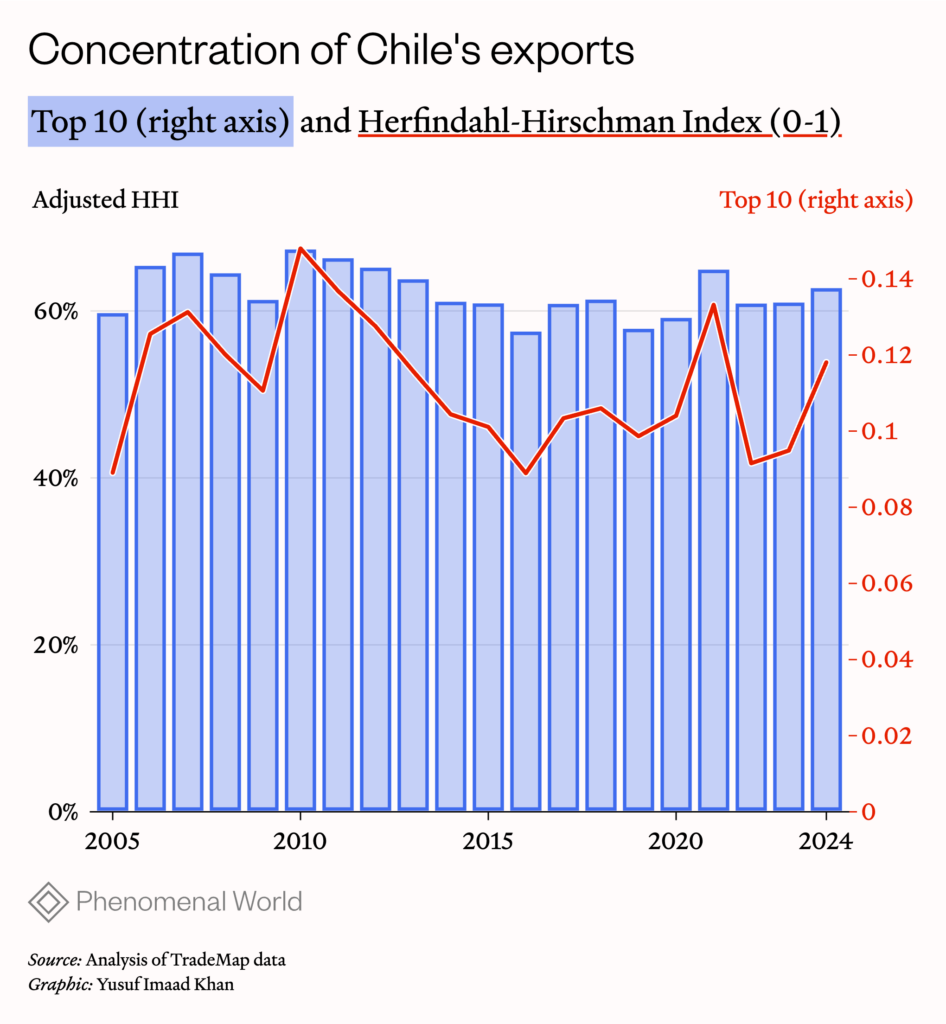
Chile’s export concentration has also risen significantly over the past decade. In 2024, the top ten products accounted for 62.9 percent of exports, versus 58 percent in 2019, reaching levels similar to the height of the commodity boom in 2013. The Herfindahl-Hirschman Index (HHI), a measure of market concentration, shows that after a brief post-pandemic improvement in 2022, concentration increased again in 2023. China and the United States concentrate 52.8 percent of exports, and the top ten destinations account for 81 percent of exports, and intra-regional trade fell from 18.1 percent of exports in 2015 to 13.8 percent in 2024, moving Chile away from the goal of greater regional integration.
The end of the commodity boom has led to a cycle of diminishing returns and intensifying environmental impacts. Chile’s inherited economic structure has made it impossible to resume a dynamic and sustainable growth rate in the long term. With this dilemma in mind, Boric’s left-wing coalition—the Frente Amplio (Broad Front)—proposed “a new development model to overcome our productive stagnation and face the climate crisis.”6Programa de Gobierno Apruebo Dignidad (2021), page 62. https://frenteampliochile.cl/wp-content/uploads/2024/06/3.-Programa-de-Gobierno-Apruebo-Dignidad-2022-2026.pdf This model would combine industrial policy with strategic and development-focused trade policy. Key to Boric’s program were renegotiated trade agreements, increased state management of lithium, and a proposal for a new development bank.
Transforming Chilean industry and trade
The Boric government built a new national strategy around lithium, starting with the renegotiation of the concessions of Chile’s main salt flats—Atacama and Maricunga—with the aim of creating a national lithium company that would allow the state to recover market power over the resource. A crucial agreement between the state-run Corporación de Fomento de la Producción (Corfo) and the private lithium companies of Sociedad Química y Minera de Chile (SQM) and Albermarle created a joint venture between Codelco, Chile’s state-owned copper company, and SQM to exploit the country’s largest salt flat, the Salar de Atacama.7SQM was fraudulently privatized during the dictatorship, and it is currently controlled by Julio Ponce Lerou (Augusto Pinochet’s son-in-law) with 32% and Tianqi Lithium Corp with 23.77%.
The state holds 50 + 1 percent of shares in the venture, granting greater state control. SQM will maintain the operation under current contracts with Corfo until 2030 and deliver profits to the Codelco; from 2031 onwards, the joint venture will operate under a new contract. This agreement effectively allowed the Boric administration to create a state-run venture without parliamentary approval, a difficult task given the ruling party’s legislative minority. Still, the agreement does not guarantee that the state will pursue a development strategy under future boards of directors. SQM has a strong clientelist network, making a joint venture a risky strategy. The venture can only function as a catalyst for technological progress if it seeks to promote both forward and backward linkages in lithium supply and processing.
The lithium strategy also includes new operating contracts with investors for the exploitation, production, and commercialization of lithium in small salt flats. The contracts require public-private partnerships and demand certain performance requirements and local content percentages. These operating contracts only apply to smaller salt flats, outside the main lithium reserves in Salar de Atacama and Maricunga. The strategy has also established the National Lithium Institute, a center for research and development dedicated to adding value to lithium extraction and processing. To support long-term capital financing, the government proposed the creation of a National Development Bank, with a board of directors including representatives of civil society, universities, unions, trade unions, sectoral ministries, and regional governments.8The body guarantees independence from the political cycle through boards of directors made up of members selected through the Senior Public Management System and presidential nominations approved by Congress. This bank would have enabled long-term financing for strategic projects, but the proposal ultimately failed.
The government also attempted to renegotiate trade agreements with the European Union (EU) and the Comprehensive and Progressive Agreement for Trans-Pacific Partnership (CPTPP), while simultaneously advocating for a turn towards greater Latin American regional integration. To support regional value chains and coalitions to improve negotiation power, the Boric government sought greater investments in research & development, proposing to double the state budget for science and technology to reach 1 percent of GDP.
The EU wanted to ensure a reliable supply of critical minerals from Latin America while restricting export taxes, preferential prices, and performance requirements for European investments in Chile. But EU-China competition and European dependency on Chilean lithium bolstered Chile’s leverage in the negotitations. Ultimately under pressure from opposition parties and the EU, the Boric government signed an “agreement in principle” at the end of 2022.9Dünhaupt, P., Gräf, H., Jiménez, V., & Jungmann, B. (2025). Industrial policy space in emerging economies: The case of Chile’s lithium industry and the energy and raw materials chapter in the EU-Chile free trade agreement (Working Paper No. 251/2025). Berlin School of Economics and Law, Institute for International Political Economy (IPE). European negotiators were pushed to soften their demands, allowing Chile to maintain a preferential pricing system for lithium. Despite this victory, the agreement limits the Chilean state’s ability to adapt to future policy challenges.10As the authors indicate, this was achieved through the expansion and convening on several occasions of the Interministerial Committee for International Economic Negotiations, the Subcommittee of Negotiators, as well as the formation of an Interministerial Working Group on Preferential Lithium Prices.
The CPTPP already faced significant obstacles to ratification in 2019, under the government of Sebastián Piñera. Recognizing that only marginal trade gains would flow into Chile, Boric’s Foreign Ministry agreed to the deal on the condition that that the investor-state dispute settlement (ISDS) mechanisms—which limited states’ abilities to impose trade and environmental restrictions on foreign capital—be eliminated.11Having already reached agreements with the ten countries, the new preferences focused on a small number of products not previously liberalized and, for the most part, without Chilean exports. Also see Undersecretariat of International Economic Relations (SUBREI). (2023). (<)em(>)Tariff and trade assessment of the CPTPP: An evidence-based analysis(<)/em(>). Santiago, Chile. Mexico, New Zealand, Malaysia, and the United Kingdom supported this proposal, but it was rejected by Japan and Canada—the two main investors of the CPTPP bloc in Chile.12The negotiation with the United Kingdom took place in parallel to Chile’s ratification of the CPTPP, where Chile took the opportunity in 2022 to request, as a condition for the UK’s entry into the bloc, the elimination of the bilateral IPPA, signed in an exchange of letters in January 2025. Mexico is committed to the delivery of the letter. However, with the change of cabinet in 2023, the new authority in the Chilean Foreign Ministry opted not to continue with the strategy.
But the turning point in trade negotiations was not the result of international disputes, but rather the rejection of a proposed new constitution in Chile, which sought to replace the country’s Pinochet-era constitution. In September 2022, Chileans voted against a constitution drafted by the Constitutional Convention, a body elected after the social uprisings of 2019. The defeat weakened the most progressive sector of Boric’s government coalition (Frente Amplio-Partido Comunista) and strengthened the centrist faction, Socialismo Democrático. The shifting forces in the ruling coalition led to an overhaul of the cabinet in March 2023, setting the stage for progressive defeat.
The first two years of the Boric government thus sought to remake trade relations and extend Chile’s political autonomy. Chilean policymakers argued that trade policy should align with industrial policy: these were interdependent arms of a coherent development strategy. But facing greater political pressure and lacking strategic leverage, the government reversed course. By 2023, the Boric government returned to a largely orthodox trade policy.
Course reversal
The second half of the Boric government was characterized by defeat, with the government returning to the strategies inherited from previous governments. With the governing coalition moving to the right, policies such as the National Development Bank were indefinitely stalled. In May 2024, a bill to create the Agencia de Financiamiento e Inversión para el Desarrollo (Financing and Investment Agency for Development, AFIDE) sought to address Chile’s challenges by securing long-term financing for innovation and economic diversification through private finance.
With an institutional architecture geared towards technological independence, AFIDE was designed as a corporation formed by the Chilean Treasury and Corfo.13AFIDE would operate along two complementary lines: a specialized technical advisory function that inherits the capabilities of Corfo’s Investment and Financing Management to assess project viability, and a wide range of financial instruments including loans (direct and second-tier), debt acquisition, investment in venture capital funds and guarantee instruments. AFIDE can act as a direct financier in the face of market failures or a source of private financing. Through direct and indirect financing, fund management, coordination, and strategic investment, the fund would effectively “derisk” private investment in strategic sectors, facilitating private investment without disciplinary mechanisms, and leaving the control of economic and financial infrastructures in the hands of conglomerates and foreign investors.14According to Gabor (2021), ‘(<)em(>)de-risking’ (<)/em(>)is the process by which the state creates a “safety net” for investors in development assets, assuming and transferring to its public balance sheet multiple types of risks, Thus, the “development as de-risking” paradigm socializes risks and privatizes profits, transferring fiscal costs to the state while protecting the profits of global finance capital, thus narrowing the political space for green developmental states and just climate transitions. See Gabor, D. (2021). The Wall Street Consensus. (<)em(>)Development and Change(<)/em(>), 52(3), 429-459. (<)a href='https://doi.org/10.1111/dech.12645'(>)https://doi.org/10.1111/dech.12645(<)/a(>) Without public direction, this form of financing limits the transformative potential of public investment.
AFIDE represented a departure from the participatory spirit of the government’s earlier industrial policy push. It no longer included a body of civil society representatives (as proposed alongside the National Development Bank) nor the participation of regional territories in decision-making processes. The result was a more centralized and technocratic institutional framework that, while maintaining the objectives of productive transformation, dispensed with the mechanisms of social consensus and intersectoral coordination that characterized the original programmatic vision. Of particular concern was the absence of trade policy as a development strategy—unlike the proposal for the National Development Bank, AFIDE did not include a comprehensive trade and export policy. Still, AFIDE was approved Chamber of Deputies in December 2024, though it remains in discussion in the Senate Finance Committee. With Kast’s victory in the national election, the AFIDE’s future again remains in limbo.
A disconnect between industrial and trade policies was also apparent in the government’s “Sustainable Productive Development Program,” created in 2023 and financed by lithium revenues. The program was meant to promote decarbonization, environmental resilience, and economic diversification with $360 million of public spending between 2023 and 2025. However, it excluded the export sector and international trade authorities from its governance. The program also utilized the logic of derisking, providing subsidies to private actors without disciplinary mechanisms. As a result, the program is likely to maintain current extractive patterns.
It is in the international arena that the Boric government’s reversal is most evident. The post-2023 agenda abandoned attempts to modernize or renegotiate agreements to safeguard Chile’s strategic autonomy. As important, the government proved unable to present an effective strategy in the face of Donald Trump’s unilateral tariff increases in 2025. The US tariff onslaught broke trade rules established by the World Trade Organization (WTO) and forced countries around the globe to renegotiate trade. The Boric government opted to accept the terms of the White House, instead of assuming a regional leadership role and coordinating a multilateral response. Though negotiations are still underway, they are likely to heavily favor the United States.15Nogales, D. (2025, September 15). Aranceles: Chile revela que ya se puso fin al proceso técnico y que ahora la Casa Blanca debe ver qué gravámenes aplica. (<)em(>)Pulso La Tercera. (<)/em(>)(<)a href='https://www.latercera.com/pulso/noticia/aranceles-chile-revela-que-ya-se-puso-fin-al-proceso-tecnico-y-que-ahora-la-casa-blanca-debe-ver-que-gravamenes-aplica/?utm_source=chatgpt.com'(>)https://www.latercera.com/pulso/noticia/aranceles-chile-revela-que-ya-se-puso-fin-al-proceso-tecnico-y-que-ahora-la-casa-blanca-debe-ver-que-gravamenes-aplica/(<)/a(>)
After Boric
Gonzalo Winter, the Frente Amplio’s candidate for the president, drew from Boric’s early trade and industrial policies in his platform.16Available at (<)a href='https://winterpresidente.cl/'(>)https://winterpresidente.cl/(<)/a(>) and https://drive.google.com/file/d/1_SUBQhNEeJKva4PPx1YxHqAjOdaDauVp/view He advocated for a robust export diversification agenda, increased public coordination of industry, a push to reform and overcome the ISDS mechanisms, and a multilateral approach to trade negotiations. But Winter lost handily in the primary in June 2025. By December, the second round victory of Republican candidate José Antonio Kast over Communist Party candidate Jeannette Jara indicates that an aggressive deregulatory agenda is on the horizon.
Kast’s program revolves around a central principle: growth is achieved by removing obstacles to private sector expansion. He proposes repealing regulations and instituting a regional “immediate action force” to speed up bureaucratic processes. Throughout the campaign, Kast failed to outline a coherent development strategy, instead only making generic references to Chile as an “agri-food power” and tourist site. More notably is the striking absence of a trade policy in his agenda. Beyond invoking “sovereign and pragmatic multilateralism,” Kast only mentions the intensive use of existing free trade agreements and the “active search for new markets,” with no details on coordination, export promotion, or targeted markets. In contrast, Jara proposed raising investment from 24 percent to 30 percent of GDP, increasing the coordinating role of the state in private investment, and creating a national lithium company.17Available at (<)a href='https://jeannettejara.cl/'(>)https://jeannettejara.cl/(<)/a(>) and https://drive.google.com/file/d/1Ppf6IZsmKQang337f5-q5IYaDn7ihcdE/view She also prioritized Latin American integration, including a convergence of the Pacific Alliance and Mercosur.
The differences between Jara and Kast’s programs reveal divergent visions for the role of the state in economic transformation. Kast’s victory demonstrates a return to classic orthodoxy, but the experience of the Boric government shows that those who prioritize austerity and fiscal produce can coexist in coalition with advocates of active industrial policy. This is a contradiction that the past four years has revealed, but not resolved.
Ultimately, Boric’s goal of transforming Chile’s economy remains stalled. On the one hand, his government was able to uplift the state as a key player in the management of lithium. Although the state’s participation in the joint venture remains a question under the new government, the creation of the venture itself marks a starting point for a longer-term industrial policy.18Note: On December 30, 2025, NovaAndino Lithium was (<)a href='https://www.gob.cl/noticias/nova-andino-litio-codelco-sqm-produccion-litio-salar-de-atacama/'(>)established(<)/a(>) as a public-private company under the joint venture of Codelco-SQM. The company held its first directors meeting on December 31. But when it came to trade and foreign policy, Boric conceded to the terms set by the Trump administration, leaving Chile isolated in asymmetric negotiations.
Other Latin American countries have seen greater success with interventionist industrial policies. Brazil is deploying the “Nova Indústria Brasil” with R$300 billion19About US$ 57 billion at the average exchange rate of November 2025. until 2026 to promote green industrialization, decarbonization, and technological sovereignty. Colombia has developed an industrial policy agenda focused on the “popular economy” with massive formalization and productive linkages. Honduras, whose government faces international lawsuits worth $14 billion for trying to dismantle inherited corrupt contracts, has led a coalition to challenge the ISDS system. These cases teach us that successful policy is dependent on both global structural conditions as well as the willingness of political actors to push forward path-breaking agendas.
Progressive governments will continue to face obstacles in reforming international trade policies and domestic export sectors, but the alternative is an austere and militaristic agenda led by the economies of the global North.20Ahumada, J.M.; Sossdorf, F. A progressive industrial policy for the global south: a Latin American perspective, at https://www.socialeurope.eu/a-progressive-industrial-policy-for-the-global-south-a-latin-american-perspective. Such a Trumpian vision is likely to find a key ally in Chile’s new president, foreshadowing a return to a privatized, dependent state of affairs.
Further Reading
Lithium Experiments
Chile’s mineral strategy and geopolitical realignment in the global energy transition
Gabriel Boric's government has revived industrial policy to upgrade Chile's role in the green transition. Yet serious obstacles remain.

Constitutional Odysseys
In the upcoming vote, a battle over Chile’s identity
On September 11, 1980—seven years after Augusto Pinochet seized power from democratically elected Salvador Allende in a brutal American-backed military coup—the dictatorship passed a constitution...

Bittersweet Tides
Chile, Brazil, and the future of the Latin American Left
The recent victories of left parties across Latin America—most recently the election of President Luiz Inácio Lula da Silva in Brazil—have prompted comparisons with the...