December 3, 2025
Analysis
Careless Profit
Spain's nursing homes in crisis
Elder care in Spain has been steadily deteriorating since the 2008 financial crash, and is now entering a state of crisis. One of the largest nursing home chains is under increasing pressure from residents’ groups and families, who have made a series of high-profile complaints about the poor quality of the service. Precarious workers in the sector, seeing their wages decline while profits are syphoned off to tax havens, have been taking to the streets to demand better conditions. The wider political implications could be significant.
The origins of the crisis can be traced back to the 1990s, when the Spanish welfare state moved towards a system of universal care by increasing residential services and outsourcing them to private firms. Rather than creating the kind of competitive market for which some had hoped, the result was greater concentration and financialization. As large multinationals and investment funds helped to expand the sector, the social and economic costs became clear. Responsibility for managing care was delegated from public to private bureaucracies, causing greater inefficiency and needless complexity. The lives of older people were placed at the mercy of the markets.
With such challenges now impossible to ignore, there is an urgent need to transform both the infrastructure and organization of nursing homes: shifting away from this broken model and creating spaces under democratic control, rooted in their local area, and capable of providing dignified conditions for both residents and caregivers. To open up this pathway towards “deprivatization,” we must also reevaluate the nature of the public-private bureaucracies which have become central to the sector—and, indeed, to states across the developed world.
Family and state
During the Franco era, social care was delegated to the family, with little state intervention and no financial remuneration. This model, which later became known as “familialism,” relied on breadwinner salaries that were high enough to support an entire household. For those without the resources to provide care, some forms of assistance were available—although the state mainly outsourced them to the religious entities along with small, for-profit managers. It reduced costs by relying on Church officials, with nuns playing a significant role, while these religious institutions in turn gained more revenue streams and political power from the arrangement. Social care thus remained in the informal sector, with scant regulation and heavy reliance on private and civil society structures.1The following two works can be consulted on the relationship between religious institutions, social care, and political power in Spain: I. B Herranz, “‘Sección Femenina’ y ‘Acción Católica:’ la movilización de las mujeres durante el franquismo,” (<)em(>)Gerónimo de Uztariz(<)/em(>) 21 (2005): 55-66; S. N. de Prado, “The role of the Church in shaping Francoism,” (<)em(>)La albolafia: journal of humanities and culture(<)/em(>) 1: 97-114.
Following the advent of democracy in 1975, this model began to change. Economically, industrial restructuring contributed to unemployment and wage stagnation, which worsened after the introduction of the euro and the real estate crisis of 2008. Politically, the demands of feminist movements and the incorporation of women into the labor market—both out of material necessity and in order to gain rights that hinged on participation in the productive economy—dealt the final blow to the male breadwinner model. The female labor force participation rate rose decade by decade: from 23 percent in 1976 to 35 percent in 1990, and then from 41 percent in 2000 to 54 in 2023. Yet the types of employment on offer were uneven. Women disproportionately worked in segmented service sectors such as care, cleaning, and education, which were characterized by lower wages, irregular working hours, and temporary contracts.2Although women have had a lower level of union membership than men, the situation seems to have been evening out in recent years, partly as a result of demands for better working conditions. See, for example, Alemán et al.,“Women’s leadership through the CAE unions: facilitators, barriers, and challenges,” (<)em(>)Basque Institute for Women(<)/em(>) (2022). As a result, both the unpaid labor force and the family income available for social care decreased significantly.
At the same time, though, the Francoist practice of outsourcing care to the family was never fully overturned, which contributed to a growing care deficit in households and an increasing burden on women. On the one hand, many middle-income women were forced to work double shifts—both waged labor and unwaged domestic labor—which limited their opportunities for professional development and access to better jobs. On the other hand, hundreds of thousands of migrant workers, mainly from Latin America and Eastern Europe, stepped in to cover caring responsibilities, working under precarious conditions and often as live-in employees. Such migratory flows became a key factor in the country’s social reproduction.3M. León, “Migration and care work in Spain: The domestic sector revisited,” (<)em(>)Social Policy and Society (<)/em(>)9, no.3 (2010): 409-418.
Pressure meanwhile grew on regional and local administrations to provide care services—thanks in part to the activities of feminist campaigners, pensioners’ groups, and, most notably, people with disabilities. Between the 1990s and 2008, Spain thus experienced a marked expansion in social care services, including nursing homes for the elderly. There was sustained growth in both the number of places—with an average of 8,100 new beds per year between 1988 and 2011—and employment in the sector, with 7,300 new jobs per year between 2000 and 2010.4The number of places has been calculated using data from the CSIC’s Envejecimiento en Red database and data in Sancho-Castiello and Rodríguez-Rodriguez’s article, “Aging and social protection of dependency in Spain. Twenty years of history and a look to the future,” (<)em(>)Psychosocial Intervention(<)/em(>) 10, no.3 (2001): 259-275. The number of workers for 2023 has been obtained from the census carried out by the IMSERSO in 2024, and to calculate the number of workers for 2000 and 2010, the number of places for each year has been multiplied by the ratio of workers per bed in 2023. The data on the number of beds in 2000 and 2010 from Envejecimiento en Red have been corrected according to the difference ratio between the IMSERSO census of 2023 and the Envejecimiento en Red data for the same year.
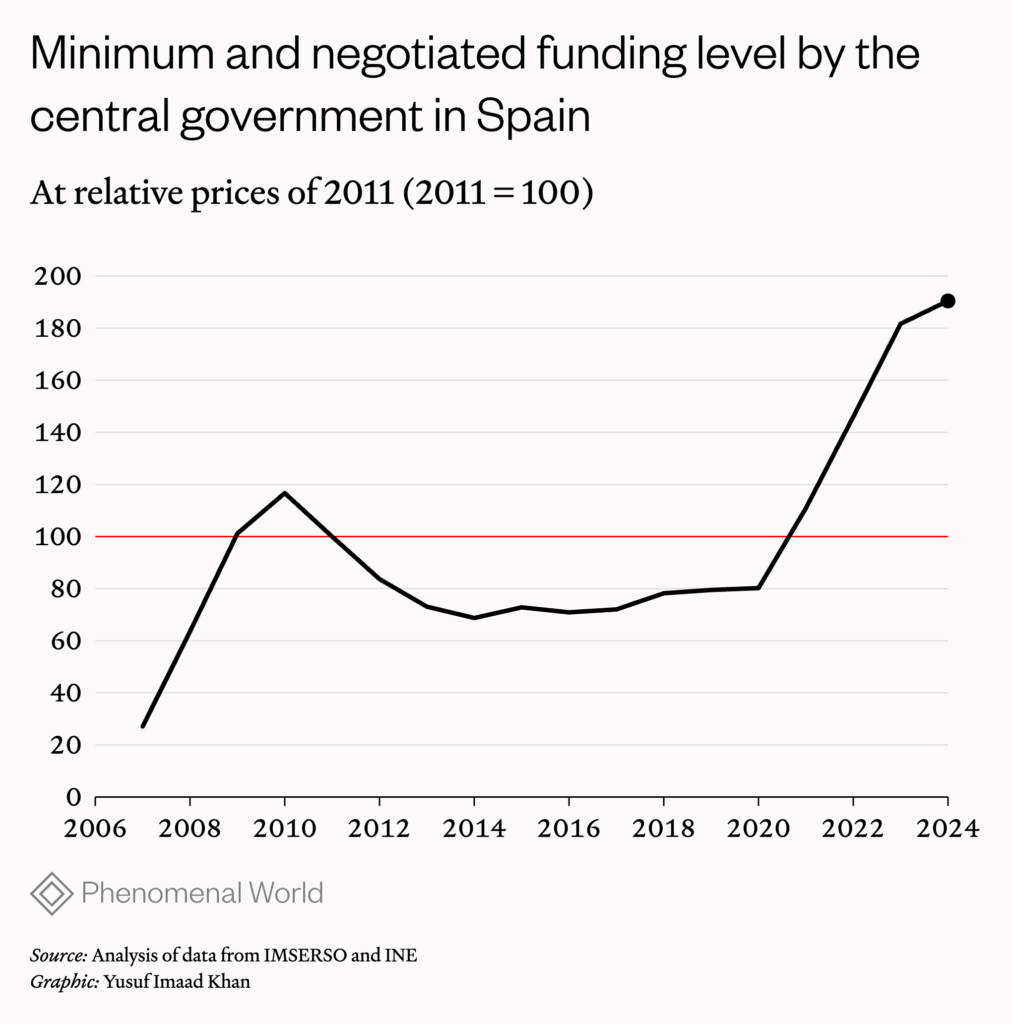
The turning point came in 2007, when the ruling Spanish Socialist Workers’ Party (PSOE) passed the Personal Autonomy and Dependency Care Act (LAPAD), which recognized social care as a right for people with officially recognized dependency. With that, the state assumed a central role in caregiving. It was now obliged to support not only the poorest households but also those in the middle class. Of course, the legislation fell short of making care a genuinely universal right: state provision was subject to significant co-payments, which were determined according to household income, while low financial benefits for informal care within the family implicitly reaffirmed the familialist model. But the LAPAD nonetheless represented a historic advance in establishing minimum funding guaranteed by the central government. Its passage meant that older people, regardless of their income level, could now apply for a public residential place or a voucher for a private place in accredited centers.
And yet, during this period, the expansion of care services mapped onto the growing commercialization of the sector, through the proliferation of for-profit entities which acted as key allies of regional administrations. While the state continued to maintain around 25 percent of the total number of nursing home places, it typically delegated their management to private actors. The process of outsourcing and the significant presence of the ‘third sector’ were carried over from the previous model. Savings banks found a new business niche in the residential sector and became the financial arm for its expansion.5Manuel Rico, (<)em(>)Shame: The scandal of nursing homes (<)/em(>)(Barcelona: Planeta, 2021), 191.
Financialized care
In the aftermath of 2008, the welfare state was targeted for deep cuts, which led to a drastic reduction in the financial responsibilities of both the central government and regional administrations. The state budget began to fall in 2010 and did not recover until 2021. Despite the promise it appeared to hold, the LAPAD was born into conditions of severe austerity, which included a freeze on public sector wages for more than a decade, a contraction of various cash transfers, and long waiting lists to access underfunded services. As unemployment rose and property values declined, people struggled to make enough private income to pay for services, putting further pressure on public administrations.
Between 2011 and 2022, the residential care sector saw its growth halved, falling to around 4,500 public jobs and 2,600 people employed per year. It also began to see an increased standardization of services and infrastructure. The freezing of public prices prompted a search for economies of scale to increase the economic sustainability (and profitability) of the centers. The average size of nursing homes increased. Whereas in 2006, places in centers with more than 100 residents accounted for 46 percent of the total, by 2022 this proportion had risen to 54 percent.6Data obtained from (<)a href='http://envejecimiento.csic.es/'(>)envejecimiento.csic.es(<)/a(>)
In line with the increase in services, the higher value of investments, and the growing complexity of management, big business began to play an even more active role. This was exacerbated when the real estate bubble burst in 2008, bringing private construction and public works to a halt, and thus encouraging both construction companies and real-estate investment funds to take a greater interest in the residential sector. Savings banks, heavily indebted by the real estate crisis, were meanwhile forced to merge with large banks and sell assets to investment funds at bargain prices.7Rico, (<)em(>)Shame(<)/em(>). 193. This influx of big capital led to aggressive strategies to expand services and, above all, to obtain public contracts.
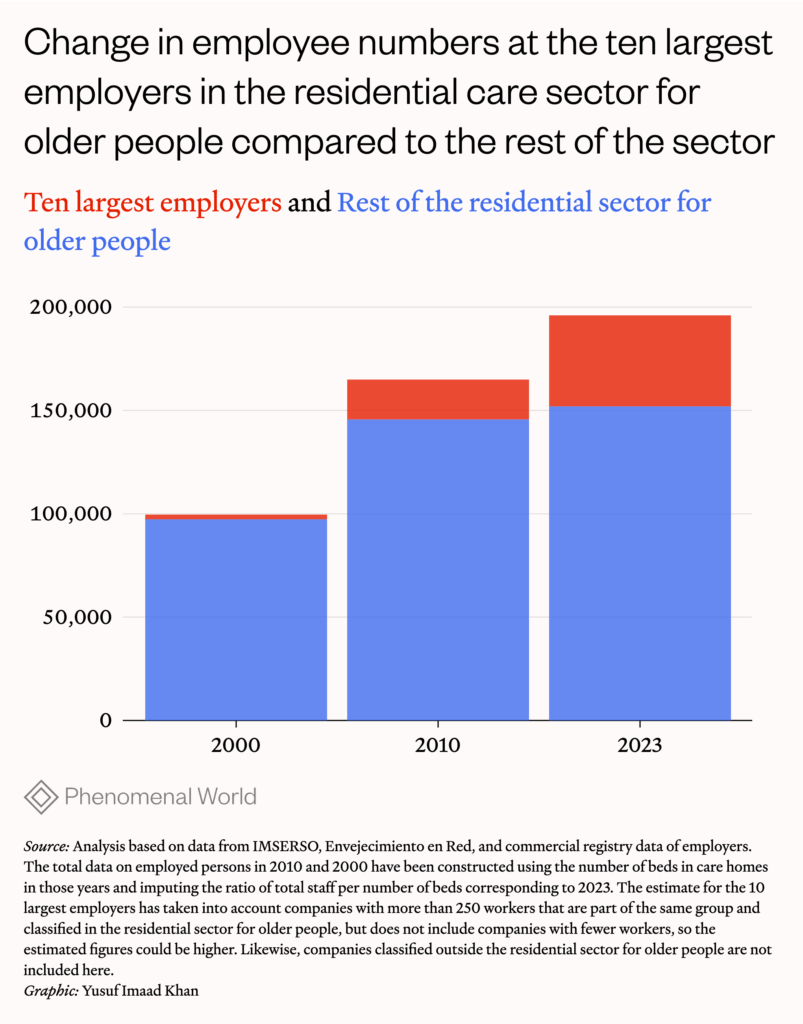
The result has been an increasing concentration in the ownership of nursing homes. Between 2000 and 2023, the ten largest private employers in the residential sector grew from 2 percent of total employment to 23 percent. While these ten companies accounted for 30 percent of total employment growth in the sector between 2000 and 2010, they accounted for 71.5 percent between 2010 and 2023. The figures in terms of residential places and turnover also reflect this trend, in which the sector’s growth is led mainly by companies with the most market power. In 2020, 17 large operators controlled around 21 percent of beds, while in 2023 the top ten operators accounted for 33.2 percent of turnover: a stark contrast to 2009, for example, when the figure stood at 25 percent.8DBK, (<)em(>)Nursing homes for the elderly(<)/em(>), 2024, available at (<)a href='https://www.dbk.es/es/detalle-nota/residencias-tercera-edad-2024'(>)dbk.es/es/detalle-nota/residencias-tercera-edad-2024(<)/a(>)
Today, ownership of nursing homes is generally dominated by international finance capital. The five largest multinationals in Spain are linked to investment funds and other financial vehicles,9The most interesting research in this regard is that of Rico, whose book (<)em(>)Shame(<)/em(>) explains the origins, owners, and strategies of the main residential bed managers in Spain. DomusVi (18,500 beds) is a company belonging to the Spanish firm (<)em(>)Geriavi(<)/em(>), which in turn is a subsidiary of the large French conglomerate of nursing homes owned by Yves Journel, which entered Spain in 2010 making major acquisitions. In 2017, the British fund Intermediate Capital Group, based in the tax haven of Jersey, acquired a majority stake in DomusVi, becoming its main shareholder. Emeis (8,000 beds) is a multinational formerly known as (<)em(>)Orpea(<)/em(>), of French origin, which has made major purchases in Spain since its entry in 2006. On account of its debt problems, it was taken over in 2023 and the French public fund Caisse des Dépôts et Consignations became the majority shareholder, leading a consortium of institutional investors that provided capital to save the company. Ballesol (7,500 beds), owned by (<)em(>)Santa Lucía(<)/em(>), is an insurance company. Vitalia (7,000 beds), controlled since 2017 by the investment fund CVC Capital Partners, has a corporate structure that passes through low-tax countries such as the Netherlands, Luxembourg, and Jersey. Amavir (7,000 beds) has been majority owned since 2017 by the investment company controlled by the Mulliez family, which manages business assets in various sectors, such as the Auchan supermarket chain and the Decathlon company. whose purpose is to raise money from investors (pensioners, insurance companies, family wealth, etc.) to invest in assets that generate returns. These funds invest in shares (sometimes majority stakes), provide liquidity to management companies, or engage in “buy and hold” or “buy and rent” strategies. The latter involve acquiring real estate assets in the residential sector and renting them to private companies—sometimes to the same multinationals in which they have stakes.
Anatomy of a fund
To show how these dynamics work, we can examine the residential services company DomusVI. The investment fund PAI Partners bought it for €639 million in 2014, then sold it to Intermediate Capital Group (ICG) for €2.4 billion, generating a capital gain of around €500 million.10Rico, (<)em(>)Shame(<)/em(>), 161. IGC bought 55.5 percent of DomusVI as part of a direct investment strategy to buy, revalue, and sell assets in the short term. DomusVI then either sold or rented some of its residences to Threestones Capital Management, a fund based in Luxembourg with assets valued at €2 billion.
As part of their efforts to attract investors, the funds regularly create new investment instruments. In this case, Threestones Capital Management launched the Eurocare IV SICAV, an open-ended investment company that seeks to invest €500 million in the residential sector in Europe. Such investment instruments are particularly profitable when we consider the tax deductions they receive compared to the amounts they would be expected to pay as a normal company through corporate income tax.
One of the main priorities for the funds is to secure a reliable flow of cash. Elder care facilitates this, both because of the role of public institutions in financing it—public places can account for up to 42 percent of the total turnover—and because of aggressive cost-cutting strategies in a sector with little inspection and few penalties. In addition, business owners can reduce their tax burden for as long as they are managing the services. The parent company can charge fees to subsidiaries and burden them with debt, as if the latter were providing services to the former, while the main investors can locate their tax domicile in favorable tax jurisdictions.
In the case of DomusVi, the ICG investment fund imposes a debt burden with interest of up to 11 percent on the parent company, which means that a large part of the profits must be used to pay this interest. Nor does ICG pay tax on dividend distributions in Luxembourg, where it is domiciled. With such an arrangement in place, the company that manages nursing homes can operate at a loss, both due to the debt incurred in the purchase of DomusVi and the new debt generated subsequently, which can relieve them of tax responsibilities.
Before 2008, non-profit organizations could achieve similar margins, but after the crash their profitability fell thanks to the freeze on public prices and competitive pressure from large companies. Meanwhile, despite the advance of finance capital, religious entities have maintained a prominent position in the residential sector, accounting for around 11 percent of places. They are no strangers to financial strategies, often adopting a “buy and rent” approach in which they acquire assets but leave management in the hands of companies like DomusVi. The Church can thus retain its patrimonial power while displacing the increasingly difficult task of management.
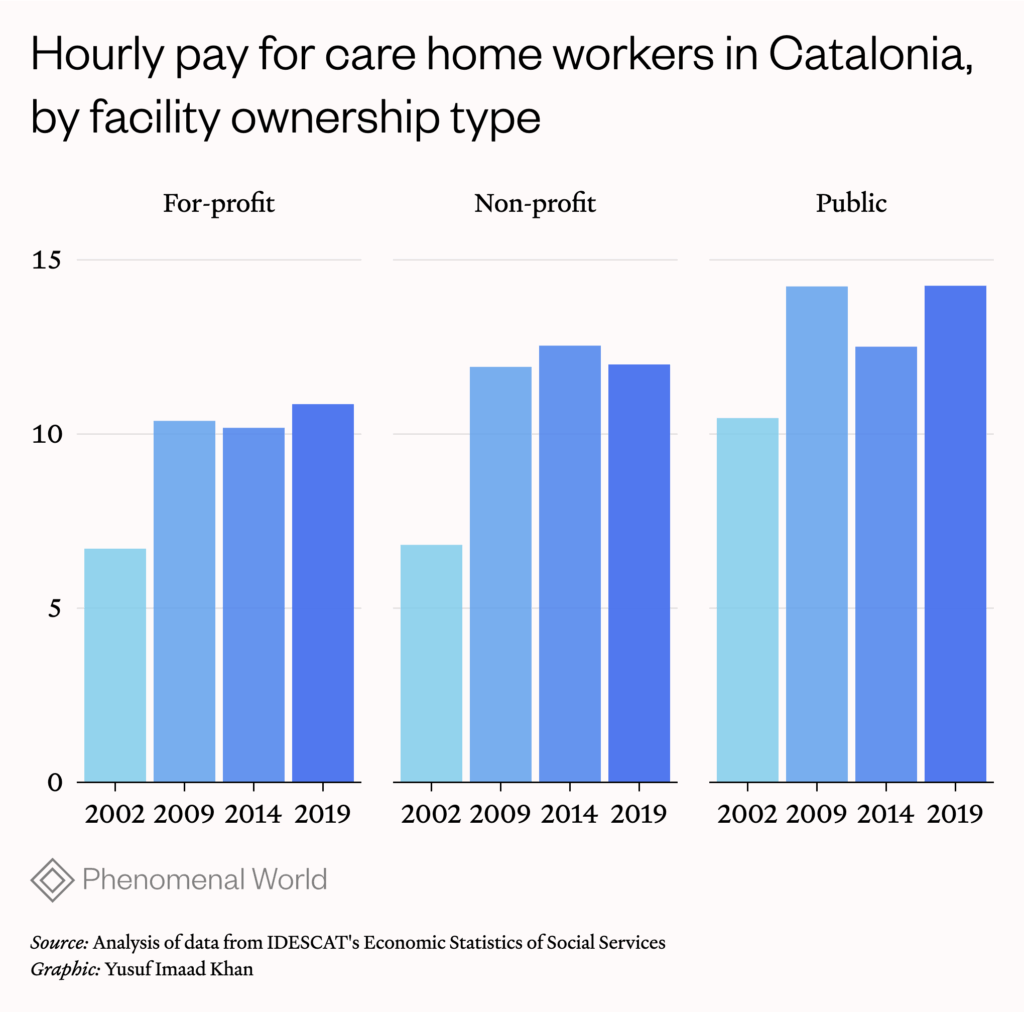
These strategies based on rent extraction have broader consequences. In care work, the pursuit of profit maps directly onto worse working conditions. According to data from the survey in Catalonia, for-profit entities are the worst payers in the sector, with hourly wages 25 percent lower than in the public sector and 15 percent lower than the non-profit sector. Between 2009 and 2019, for-profit entities increased the total wage bill per hour worked by just 4.6 percent, compared to cumulative inflation in Catalonia of 15.3 percent: a real-terms fall in the total wage bill of 10.7 percent.11In the case of large business groups, the situation could be even worse if, as Rico points out, they seek to reduce personnel costs by up to 50 percent of total costs, which can only be achieved by drastically reducing wages. The deterioration of working conditions also leads to precarity and low job retention,12According to the same survey, the turnover rate for care workers stood at around 25 percent in 2019, which means that in just four years, the entire workforce in a nursing home would have been replaced. which has direct effects on the quality of care, preventing bonds of trust from forming between residents and carers.
The new bureaucracy
The case of nursing homes in Spain illustrates the extent to which public-private partnerships act as the Trojan horse of neoliberalism.13 Faranak Miraftab, “Public-private partnerships: The Trojan horse of neoliberal development?” (<)em(>)Journal of Planning Education and Research (<)/em(>)24, no.1 (2004): 89-101 The financing and organization of services must balance both the demands of public regulation—such as the establishment of minimum hygiene standards or staff-to-resident ratios—and those of big capital. Decisions depend as much on public regulations as on the imperatives of financial managers. Labor relations, investment, and the technologies and infrastructure promoted in the care sector are both the causes and consequences of this institutional configuration.
The ongoing outsourcing of public care services to private entities should be understood, in this context, as a strategy to discipline labor, which is essential to keeping costs low in a sector where staffing is the major expense. Despite rhetoric about the need to recognize the value of care work, few governments have been able or willing to transform the large public procurement machines which treat professional caregivers with an iron fist. Especially for homes with more than 100 beds, large bureaucracies must control labor processes to generate returns—creating a deeply hierarchical management model.
The residential sector also relies on large administrative and financing capacity. In the private market, empty beds or late payments represent a significant loss of income, which must be recouped with liquidity reserves or cheap credit. Although public bed contracts guarantee relatively secure cash flow, there is also a risk of late payments, with low public prices compounding the difficulties of financial management and cost minimization. Moreover, with new care ceters requiring huge quantities of investment, the only players capable of financing them are private financial entities and the Church, which can deploy the strategies of capital gains and asset revaluation outlined above. In the absence of an empowered public sector, then, bureaucracy and speculation come to dominate.
To improve quality and retention, this public-private bureaucracy cannot simply be subjected to further liberalization. These bureaucracies spring up precisely because the sector cannot function as a “normal” competitive market. It is doubtful that private companies could remain sufficiently profitable without reaching full occupancy, given the prices and purchasing power of the current population—which means that “market choice” is an illusion. The limited supply of beds puts pressure on people to use whichever service is available, and households have little means to discriminate between providers, since such institutions are highly opaque and there are few public sources of information on them. Nor can older people move between facilities as if they were hotels; changes of this kind would be highly destabilizing, especially for people suffering from dementia or cognitive impairments. Most of them do not want to be treated as “consumers” in the traditional sense.14John Clarke and Janet Newman, “What’s in a Name? New Labour’s Citizen-Consumers and the Remaking of Public Services,” (<)em(>)Cultural Studies(<)/em(>) 21, no.4-5 (2007): 738-757.
Rather than trying in vain to create a competitive market, we could instead strive to make care more democratic. At present, vital decisions are made by managers whose overriding purpose is to achieve profitability and meet standardized quality criteria. Unlike fully public bureaucracies, where people can at least appeal to the public interest and challenge mismanagement by political means, private ones diffuse responsibility across the corporate structure, with the owners of capital protected from accountability. Their profits are sustained by precarious female workers, whose influence over the system is negligible.
Companies that operate in the sector are also forced to compete with the rents generated in other industries such as real estate—which means that their business strategies are necessarily short-termist, reacting to fluctuations in the markets. The task of building long-term infrastructure or innovative care models is subordinated to that of reducing personnel or food costs. With the fortunes of nursing homes tied to financial cycles, facilities face the constant threat of disinvestment or supplier bankruptcy. This, rather than the needs of residents, becomes the determining factor.
After profit
How to change course? The first step would be to restore the welfare state’s responsibility for the sector. Since 2019, the PSOE-led government has moved in this direction: providing more funding and unfreezing public prices. Yet it is doubtful that this price increase alone will lead to greater investment, improved working conditions, and better quality services. In the current outsourced and privatized system, increased public participation should be accompanied by systems that guarantee adequate investment and wage increases, either through public financing or across the board through labor agreements. There should also be strict profit limits for nursing homes with a minimum number of public beds and maximum salaries for those that manage public nursing homes. As part of this package, the state could begin to play an active role in creating public companies, which are virtually non-existent at present.
The care of older people in Spain could even be better protected through greater decentralization and coordination of services at the municipal level, with services like at-home care and cooperative housing that enable better aging within the household. Here we can look at two encouraging case studies: Denmark and Barcelona. Despite growing marketization in Denmark since the 1980s, the public and community sector remains dominant there, as a result of at least four factors: the greater weight of municipal home care services, which offer fewer opportunities for financial returns; the existence of a pre-existing network of medium-sized public nursing homes, often partly owned by the residents; unfragmented trade unions with real bargaining power; and a stronger culture of care, caused by women entering the labor market in the 1970s.
In the case of Barcelona, a new model for managing the Home Care Service (SAD) has been promoted since 2017 based on territorial proximity: teams of 10-12 workers provide care for 50-60 people in a small geographical area, according to service schedules based on the daily needs of users (rather than on a standardized working day).15Sara Moreno-Colom, “Building community from the public sphere: the case of the Superilles Socials,” (<)em(>)Revista Española de Sociología (<)/em(>)30, no.2 (2021): a27. Municipal territorialization also means that nursing homes can be transformed into smaller centers, organized into cohabitation units with high resident participation and greater community involvement. The Spanish government’s recent Deinstitutionalization Strategy appears to recognize this fact, with its movement toward limiting the creation of large nursing homes, promoting the establishment of cohabitation units and improving quality.
There are still doubts about the state’s ability to enforce such regulations, though, particularly given its lack of control over the existing system and the hundreds of centers that claim they lack the capacity to invest. To improve the outlook in such places, there must be a concerted effort to reduce informality and precarity. Leaving care to families and their purchasing power puts downward pressure on wages and vocational training, which in turn affects the most formalized sector. To solve this problem, we need a new social pact that guarantees not only livable wages, but also adequate training and socially valued career paths. Reducing the feminization of care while offering adequate recognition and protection to migrant workers are challenges in this regard.
Such obstacles can only be overcome by uniting and strengthening the various organizations that are currently fighting for a better model of care, from trade unions to mutual support networks. The feminist strike held in the Basque Country in 2023 shows a potential path forward: rallying large numbers to defend the collective right to care and demand a more accountable system, with the public sector at its core. The encroachment of large capital on the care sector has not happened in a vacuum. It reflects the dynamics of concentration and financialization that have long afflicted other essential areas, such as banking, energy, and food. While it is necessary to reduce the scope of such problems with greater regulation, we must also set out a positive alternative, based on equal access to the services on which we depend, and a stronger community role in shaping them.
Further Reading

Growing Pains
Spain’s search for a new growth model
How can a Sánchez administration that enacts a successful progressive agenda—and a PSOE party that retains and even increases its share of voters while handling...
The Welfare State and Its Discontents
The Seville model of investible development
Ajay Banga, the World Bank Group’s president, has a favorite line: “Poverty is a state of mind.” It was in his speech at the IMF/World...

Feminist Theory, Gender Inequity, and Basic Income
An interview with Almaz Zelleke
Feminist and women's movements in the mid-20th century developed demands for an unconditional basic income that emerged out of concrete experiences with the welfare state....