August 14, 2025
Analysis
Coordinating Tamil Nadu
How India’s southernmost state transformed into a global manufacturing hub
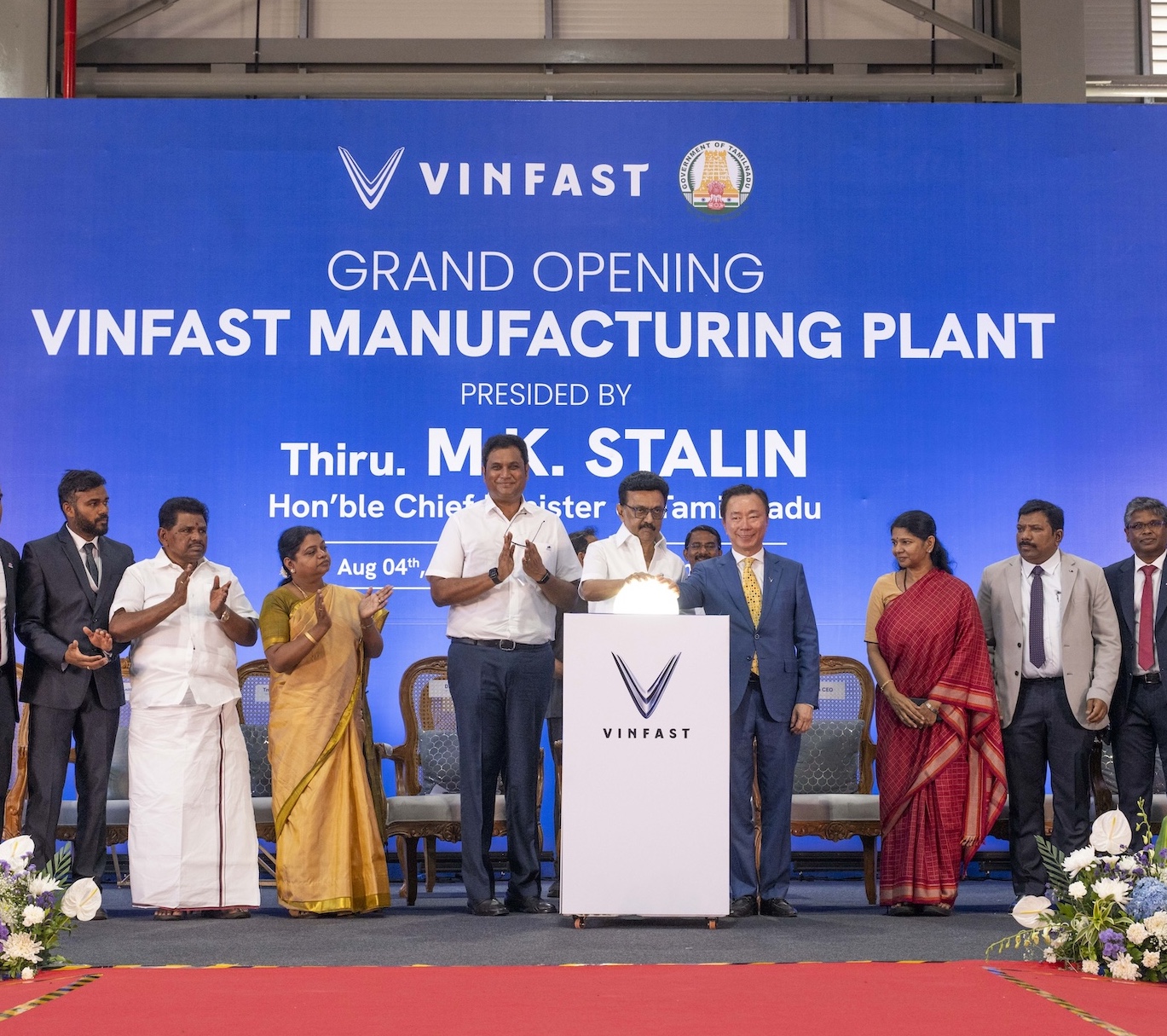
In a world of geopolitical realignments, Apple has been pursuing a “China plus one” strategy. As the company, like other global corporations, aims to shift its supplier-base away from China, India has emerged as an apparent beneficiary. Over the last few years, a sizable base of Apple suppliers has sprung up in India and a large share of these are based in Tamil Nadu. Apple is not alone in finding the southernmost state in India attractive.
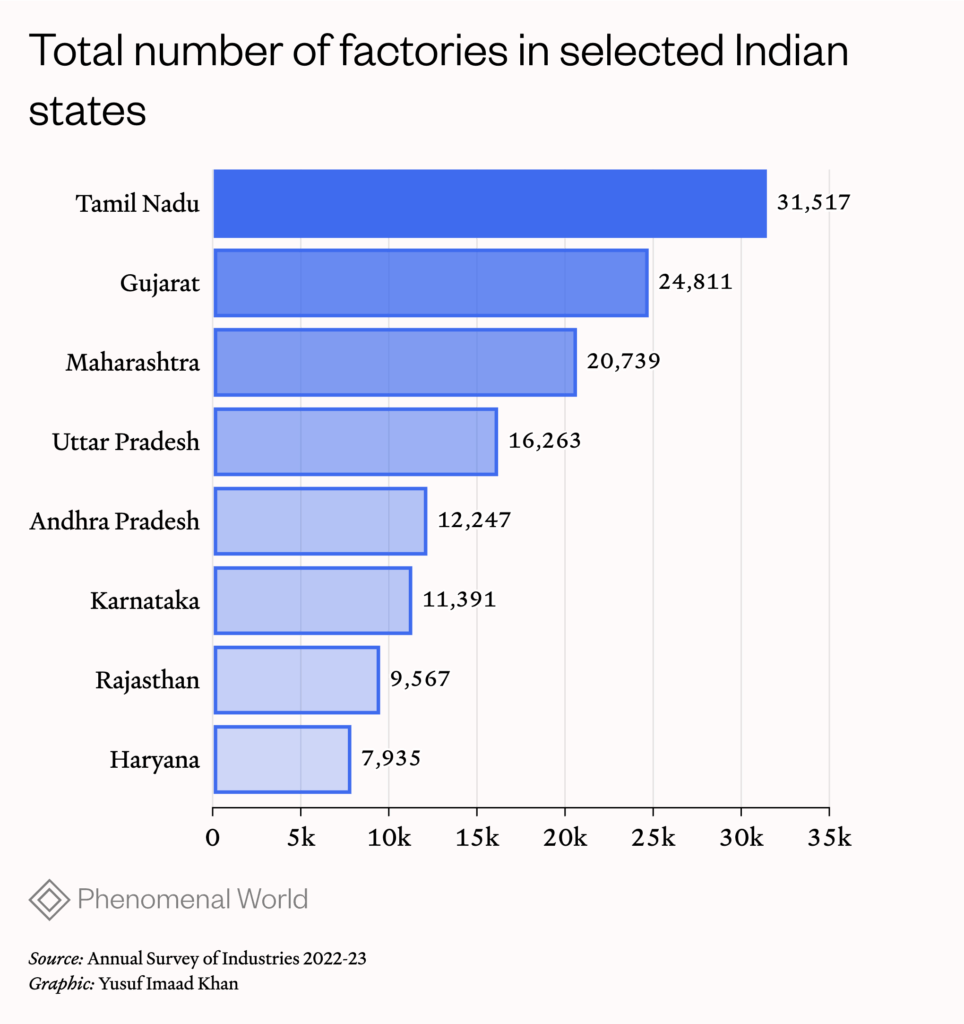
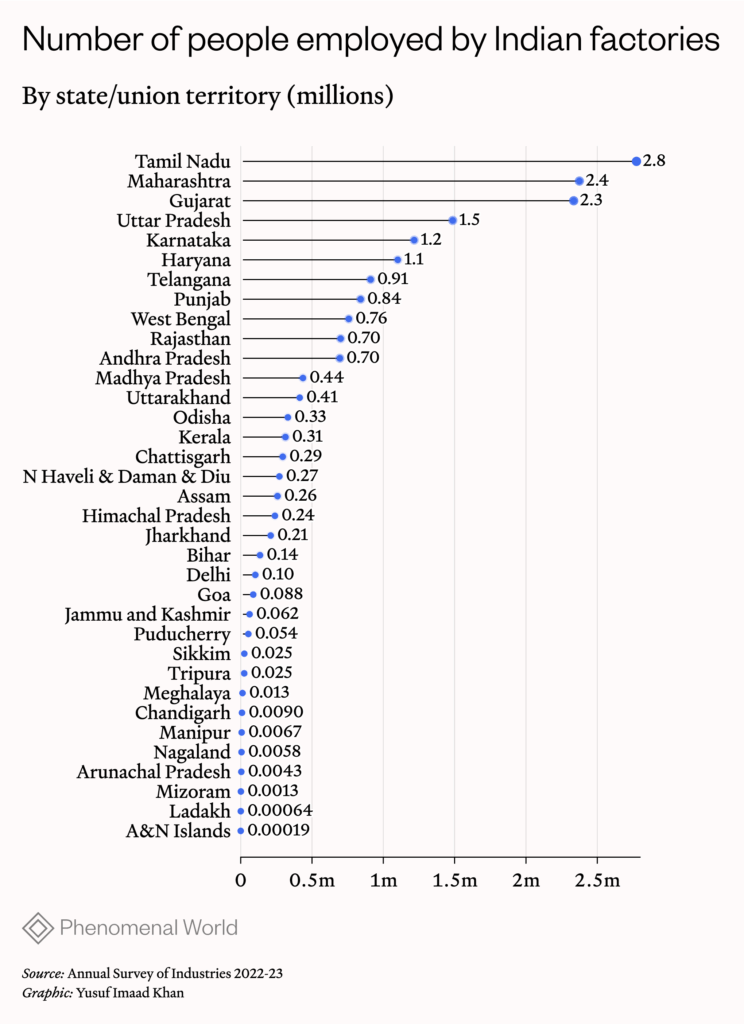
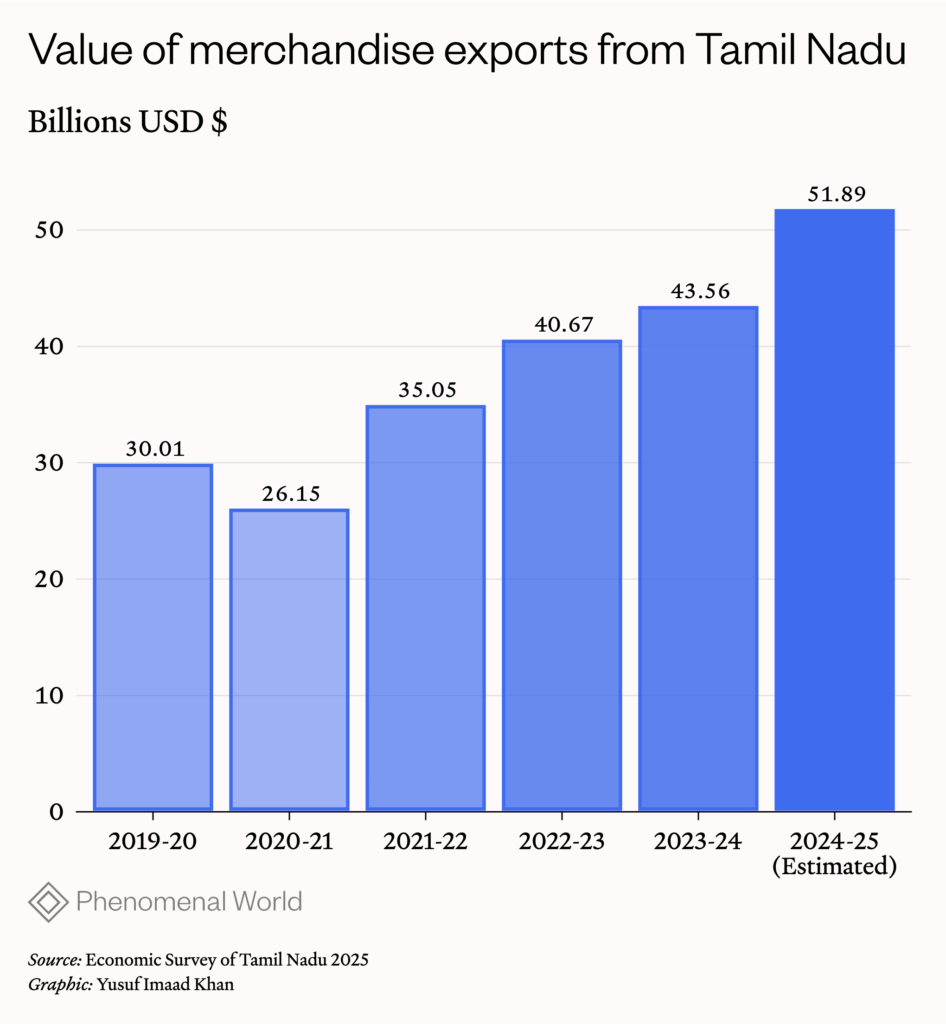
While there remains a debate around the role of manufacturing versus services in India’s economic trajectory, a disaggregated state-level analysis shows signs of resilience and momentum in India’s manufacturing story, shedding light on its distinct subnational geography. Amid India’s grand ambitions for manufacturing growth in the twenty-first century, Tamil Nadu stands out as an outlier. Estimates show that the share of manufacturing in Tamil Nadu’s Gross State Value Addition (GSVA) stands at over 24 percent. Tamil Nadu’s manufacturing prowess is also evident in its share of factories in the country. The Annual Survey of Industries 2022–23 shows that the state is home to over 31,517 factories, accounting for around 16 percent of the national total. Tamil Nadu ranks first in the number of factories in the country, with Gujarat in second, and Maharashtra in third. Out of a total factory employment of 18.5 million, the state accounts for one out of every seven manufacturing jobs in the country.
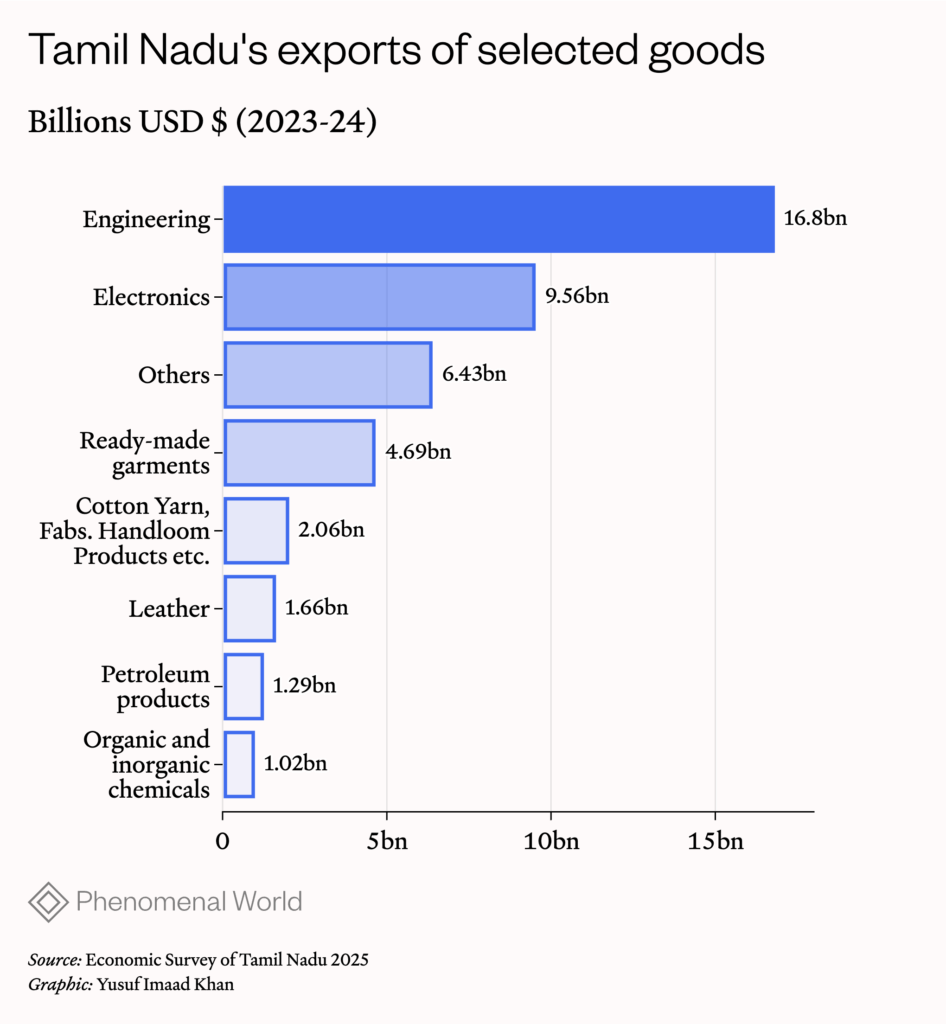
Tamil Nadu’s industrial transformation is also apparent from the manufacturing clusters that have evolved to specialize in specific sectors to achieve economies of scale and agglomeration effects. The state primarily exports high value electronics and engineering goods, alongside goods such as readymade garments, handloom products, and leather. The automobile cluster in Chennai, the readymade garments and textiles cluster in Tirupur, the steel and power loom cluster in Salem, the automotive and electronics cluster in Hosur, the fireworks cluster in Sivakasi, to name a few have developed on the back of industrial policies that have prioritized sector-specific manufacturing.
The role of industrial policies in shaping the southern state as a manufacturing powerhouse can be traced back at least to 1992 when Tamil Nadu developed its first state-level industrial policy in the aftermath of India’s economic liberalization of 1991. This was followed by state industrial policies in 2003, 2014, and 2021 which together created the conditions for the consolidation of Tamil Nadu’s status as a preferred manufacturing destination. Tamil Nadu continues to actively deploy a range of industrial policies concerning electronics hardware manufacturing, R&D, EVs, semiconductors, and other advanced electronics, all of which play a key role in deepening the manufacturing ecosystem in the state. These are further embedded in a strategy of long-term planning and coordination that has proved essential to the state’s increasingly global manufacturing role today, bearing major implications for India and manufacturing potential across the global South.
Tamil Nadu in India’s manufacturing puzzle
During a period in which nations are taking an increasingly inward turn, the role of manufacturing in the economic trajectories of the global South has received renewed attention. Export-oriented manufacturing has been central in trajectories of late industrialization in the post-war period, as evidenced by the experience of the East Asian Miracle. The contemporary evidence, however, is underwhelming. Dani Rodrik’s seminal work on premature deindustrialization shows that for a large number of developing countries, manufacturing growth is shrinking at income levels much lower than when advanced economies began to deindustrialize. India faces a distinct dilemma between manufacturing and services in charting its economic trajectory. Despite the pressures from labor-displacing technological advancements in the manufacturing sector, the rationale for facilitating productive capacity in manufacturing is self-evident. Amid rising geopolitical risks, manufacturing allows India an opportunity to diversify exports, localize supply chains, reduce dependence on input and capital goods imports, address an expanding domestic consumer base, generate employment, and pursue green transition goals.
This is an aspect that has received significant attention at the highest levels of governance in the country through industrial policies targeted at facilitating manufacturing capacity. The Production Linked Incentive (PLI) Scheme launched in 2020 remains India’s most ambitious industrial policy that targets specific sectors through financial subsidies between 4–6 percent of incremental sales, contingent on a range of other conditionalities. The basket of sectors under the PLI scheme has increased rapidly from three in 2020 to fourteen today. With a total outlay of over $24 Billion, the government’s grand ambitions for supporting manufacturing growth in the economy are apparent. The PLI scheme can also be seen as the successor of the Make in India program, launched in 2014 with the aim of driving foreign direct investment inflows and developing India as a manufacturing hub .
In India’s push towards a manufacturing focused economic trajectory, Tamil Nadu positions itself as the ideal case. This leads us to ask: What are the institutional drivers of Tamil Nadu’s manufacturing transformation? How does the state coordinate its industrial policies in a federal democratic setting? Federal democratic polities like India bring unique constraints and synergies when it comes to the deployment of industrial policies. A key element of this is the divergence in fiscal space for industrial policies and their disciplining and facilitation mechanisms at the federal and the subnational level. Fiscal space for industrial policies is often consolidated at the federal level but given the subnational geographies of manufacturing, their actual coordination and facilitation happens through state-level agencies. It is thus pertinent that industrial policies in federal democratic settings have a coherent subnational strategy across these two dimensions. The institutional drivers of industrial policy at the state level must be resilient in order to overcome these constraints.
The literature on developmental states often attributes the success of industrial policy interventions to a particular kind of coordination helmed by a central coordinating agency. This coordination tilts on addressing two types of constraints: institutional and structural. Institutional constraints can be categorized as low state capacity, issues of bureaucratic capture, and rent-seeking. Structural constraints pertain to weak coordination between factors of production, weak backward and forward linkages upstream and downstream of supply chains, low levels of productivity, and poor quality of infrastructure, which lead to high transaction costs and turnaround costs. The need for a central coordinating agency to address these twin constraints is central towards any successful deployment of industrial policy. In Tamil Nadu’s case, this role is played by the Department of Industries, Investment Promotion, and Commerce (DIIPC).
DIIPC functions as the central coordinating agency for industrial policy design and investment facilitation related to large-scale, capital-intensive, and strategic industrial sectors in Tamil Nadu. It explicitly excludes Micro, Small, and Medium Enterprises (MSMEs), which fall under the purview of a separate MSME Department. The department operates under the political leadership of the Minister for Industries and is administratively overseen by the Secretary to Government, who is a member of the Indian Administrative Service. It oversees and coordinates a network of functionally specialized nodal agencies that operate under its administrative purview, each tasked with specific mandates to support industrial growth and facilitate manufacturing activity.
The central element of DIIPC’s industrial policy approach is Industrial Parks (IPs) and Sector Specific Economic Zones (SSEZs). These are coordinated primarily through the State Industries Promotion Corporation of Tamil Nadu (SIPCOT), a key nodal agency under DIIPC. Established in 1971 to support the growth of medium and large-scale industries in Tamil Nadu, SIPCOT is primarily responsible for setting up industrial parks and coordinating infrastructure facilities within these SSEZs. Another state governmental agency, Tamil Nadu Industrial Development Corporation (TIDCO), established in 1965, is responsible for coordinating the development of industrial corridors in the state. It is important to note that the early 1960s was a period when quite a few Indian states had passed legislative acts of industrial development to propel their developmental trajectories. Both these agencies were set up in the background of the Tamil Nadu Industrial Development Act of 1965 to deploy a state-level vision of industrial development in Tamil Nadu.
Tamil Nadu’s investment facilitation agency, aptly named Guidance, was set up in 1992 and has been the first stop for attracting and coordinating investments across the state. The proactive role of the state in establishing a dedicated investment facilitation agency after India’s economic liberalization in 1991 is a window into Tamil Nadu’s strategic long-term vision of industrial policy. Guidance provides the necessary support for investors and businesses through the lifecycle of industrial projects in the state. The key responsibilities of Guidance include investor outreach, project clearance support, and the management of the Tamil Nadu Single Window Portal, an innovative one stop mechanism for coordinating all the necessary clearances and approvals for investors. Tamil Nadu Industrial Investment Corporation (TIIC), another nodal agency under DIIPC, is responsible for providing and coordinating term and working capital finance for approved industrial projects.
Tamil Nadu’s approach to industrial policy is rooted in its unique political economy. The emergence of a specific kind of political elite has successfully managed to superimpose a welfare state over an industrial developmental state. In the aftermath of India’s economic liberalization, two sets of political elites have dominated the state’s politics while prioritizing the development of an industrial and business friendly ecosystem to ensure that the demands on its welfare state can be addressed by fiscal consolidation from enhanced economic activity. This also ensures that a base level of policy continuity, which is not contingent on incumbents returning to power. Political elites across parties have sought to provide businesses an environment which can create what sociologist Peter Evans once famously termed, a “joint project,” where the state and the non-state stakeholders can come together to facilitate industrial transformation. This state-capital relation has been central to Tamil Nadu’s industrial transformation.

Tamil Nadu’s impressive manufacturing landscape is not recent and has long involved the role of political leaders and bureaucrats. For instance, Chennai’s automobile cluster, which has earned it the moniker of the Detroit of India, can trace its roots to the joint venture between Ford and Mahindra to set up a manufacturing plant in Maraimalai Nagar in 1995 when the political leadership and the bureaucratic setup took it upon themselves to bring the investment to the state. The development and the transformation of the Chennai Automobile Corridor since demonstrates how economies of scale and agglomeration effects have been achieved in the state’s manufacturing sector. Successive political leaderships have further shaped this momentum to fuel industry. Tamil Nadu’s ability to attract Apple investments among others under the current political leadership draws from a historically coordinated approach to state industrial policy.
Tamil Nadu’s MITI
The role of DIIPC in Tamil Nadu’s manufacturing trajectory recalls now-canonical insights about industrial policy first associated with the role played by the Ministry of International Trade and Industry (MITI) I in administering Japan’s post-war developmental state. Chalmers Johnson, in his seminal book MITI and the Japanese Miracle: The Growth of Industrial Policy 1952–1975, argues that the emergence and consolidation of a specific type of economic bureaucracy which aligned neither with the binaries of fully bureaucratized command economies or mixed market economies was central in this transformation. The Japanese developmental state essentially declined to participate in the state versus market binary, a political and economic zeitgeist which ran concurrent to the post-war and the Cold War era and continues to do so. Instead, it prioritized a shared project between the state and the private sector. Arisawa Hiromi, one of the key contributors to the study of Japan’s economic history, argued in the 1930s that the roots of Japan’s industrial transformation must revolve around a particular kind of managed economy where the state played a critical role in coordinating economic activity. In the post war era, industrial policies coordinated by MITI built on such ideas of a managed economy.
The dismantling of the zaibatsu corporate groups during the US occupation of Japan after World War II had provided the preconditions for what we call “institutional Schumpeterianism”—a distinct form of “creative destruction” produced through state action—which was coordinated primarily by MITI in post-war Japan. Established in May 1949 after an overhaul of the erstwhile Ministry of Commerce and Industry (MCI) and the Board of Trade (BOT), MITI played a central role in coordinating various aspects of industrial development in Japan including revitalizing the dismantled zaibatsus, coordinating low-cost development finance primarily through the newly established Japan Development Bank (JDB), coordinating the establishment of industrial parks and provision of necessary infrastructural support, and a range of financial subsidies and protections to nurture specific industries to build productive capacity.
Alongside the overhaul of the institutions of post-war Japanese economic planning and the establishment of MITI in 1949, internal bureaus within MITI were organized to focus on trade promotion, investment coordination, and sectoral focus. In addition to these internal bureaus, MITI also worked in close coordination with other ministries in the government and in certain cases had the institutional mandate to actively direct specific aspects it deemed important for its industrial policies. Although the JDB was under the administrative jurisdiction of the Ministry of Finance, the MITI played a major role in directing the bank’s functions, speaking to the broad institutional mandate of the agency. This combination of institutional autonomy and economic bureaucracy was central to MITI’s operations and its ability to administer industrial policies in post-war Japan.
MITI’s ability to address the twin structural and institutional constraints to industrial policy provide a blueprint of institutional design for policy coordination in other scenarios. The DIIPC plays a similar role in Tamil Nadu. In the state, the boards of SIPCOT, TIDCO, Guidance Tamil Nadu, and TIIC are all chaired by the Secretary to Government for Industries, ensuring strategic coherence and unified decision-making. Senior officials from finance and other key departments serve across these boards, fostering inter-agency coordination. These agencies complement each other in investment facilitation and infrastructure development for industrial projects. This integrated governance model enables streamlined execution of industrial policies in the state.
A key institutional mechanism supporting Tamil Nadu’s investment facilitation framework is the high-powered Inter-departmental Committee, also chaired by the Secretary to Government for Industries. This committee comprises senior officials from departments such as finance, energy, environment, and labor, and is responsible for evaluating and recommending strategic investment proposals to the State Cabinet for the approval of incentives and subsidies. In parallel, the State Single Window Committee constituted under the 2017 Tamil Nadu Business Facilitation Rules reviews and approves composite applications for clearances from various departments. Together, these mechanisms ensure integrated, time-bound decision-making that enables faster approvals and improved ease of doing business across the state. These processes are supported by a digital governance layer managed by Guidance Tamil Nadu through its Tamil Nadu Single Window Portal, which is a one-stop portal for investors to electronically secure all business-related approvals, licenses, clearances, and “No Objection Certificates” in a time-bound, transparent, and hassle-free manner.
DIIPC has also institutionalized further mechanisms such as the Memorandum of Understanding Monitoring Committee which diligently tracks investment progress and addresses implementation bottlenecks. Engagement with trade bodies and industry associations reinforces a collaborative, facilitative model of governance that aligns public objectives with private investment goals. The role of DIIPC and its nodal agencies is central towards shaping a manufacturing ecosystem in the state around this industrial policy vision of SSEZs.
It is no exaggeration to suggest that DIIPC functions as a contemporary MITI at India’s subnational level. DIIPC’s coordinating mechanisms enable the Tamil Nadu state government to embed itself in an ecosystem of strategic industrial players in the private market. The industrial focus of these linkages consequently nurtures a developmental model around manufacturing that upends expectations about the possibilities for manufacturing growth in middle-income contexts.
The industrial horizon
Tamil Nadu’s manufacturing transformation is even more impressive when considering the state’s economic conditions around the time of liberalization. In the early 1990s, Tamil Nadu lagged behind states like Maharashtra and Gujarat—historically the engines of India’s economic growth—in investment and industrial development. It is through coherent industrial policies helmed by DIIPC and its nodal agencies that Tamil Nadu has been able to achieve its current status as a preferred manufacturing destination in India.
Tamil Nadu’s position as a global manufacturing behemoth also provides compelling evidence to show that successful industrial policies in federal democratic settings are often those that are deployed at a disaggregated, subnational level with well-established institutional coordination between public and private stakeholders. The state appears ideally placed to further leverage this position going forward as it pushes to become a trillion dollar state. Tamil Nadu’s experience is of critical significance for other subnational geographies looking for potential strategies to deploy industrial policies. A key lesson is to focus on centering institutional coordination in their industrial policy design.
Further Reading

Sectoral Strategy
Free trade and the resurgence of industrial policy in Africa
Industrial policy in Africa is back. Beginning last January, Nigeria moved forward with the second phase of its “Sugar Master Plan,” a flagship industrial policy...

A New Labor Regime
The BJP's new labor reforms, the construction industry, and the mounting challenges for India’s trade unions
Since coming to power in 2014, India’s right-wing government led by Prime Minister Narendra Modi has introduced sweeping reforms aimed at strengthening the union government...
Global BYD
The international expansion of Chinese electric vehicles
Amid the intensifying retreat of American hegemony, an alternative geo-economic and geopolitical arrangement is coming into view: a battery-powered globalization with Chinese characteristics. Chinese EV...