December 6, 2025
Analysis
COP30 Without the USA
Climate cooperation, forest funds, and the tentative move toward green industrialization
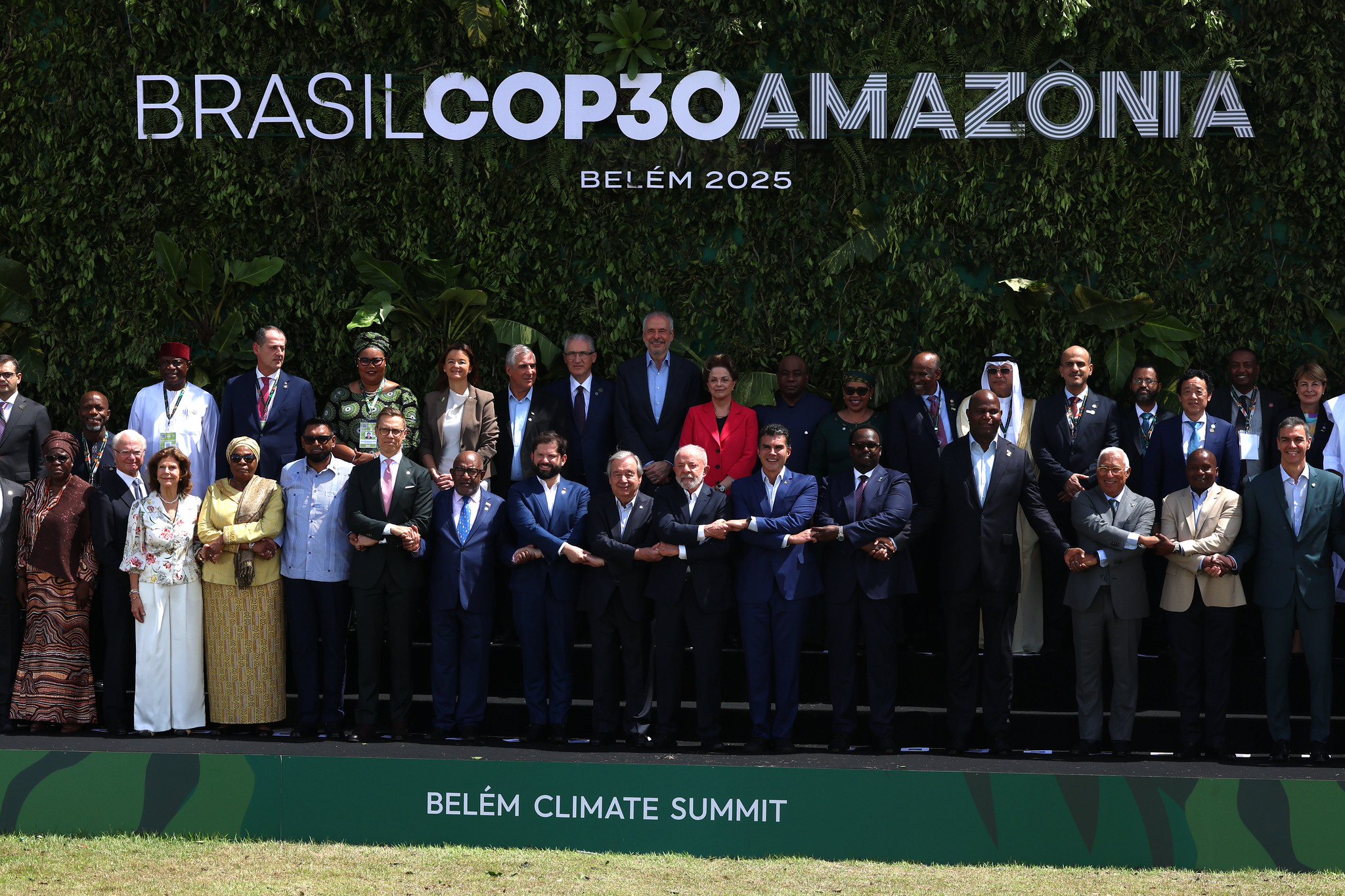
At the Polycrisis, we’ve been charting the shifting relationship between climate policy and geopolitics. We have been especially interested in two shifts. The first is the mainstream recognition that action on climate means meaningful action on development goals. The second is the emerging understanding that climate is about industrialization. Until recently, multilateral climate politics have been based on transfers of money and technology from industrialized to less developed countries, and on stable relations between the US and China. This has been upended. What will take its place?
Previous editions of the Polycrisis have spotlit the way that money is sloshing out of poor countries and into the coffers of rich ones. We’ve also focused on the “new nonalignment,” where large, capable and regionally powerful countries like Brazil are setting agendas for the entire world. Elsewhere we have looked at China’s new role as the leader of future technology. For this edition, we asked Rio-based journalist Catherine Osborn, who writes the weekly Latin America brief at Foreign Policy, to assess the UN Climate Conference in Brazil.
This is an updated version of an article that first appeared in Foreign Policy.
Last month, the humid Amazonian rainforest city of Belém, Brazil was alive with all the usual signs of a United Nations climate summit except one: a US negotiating team. Tens of thousands of participants from more than 190 countries and dozens of Indigenous groups staged two weeks of meetings, protests, and negotiations during this year’s summit, known as COP30. Though no US diplomats were present, a handful of conference-goers weaved through the crowds with white-and-green “Make Science Great Again” hats. California Governor Gavin Newsom made a defiant appearance.
This year’s conference was the first since Donald Trump returned to the White House and triggered the United States’ second exit from the 2015 Paris Agreement. This time, Trump had gone beyond withdrawing from international climate diplomacy and was actively working to undermine it. Sanctions threats in October against envoys from countries on the verge of reaching a landmark deal to limit global shipping pollution succeeded in blocking the agreement.
The threat of potential US sabotage hung over Belém as countries negotiated if and how they would speed up climate action. Trump’s pressure offered potential political cover to delegations that were already dragging their feet on climate issues for any number of reasons. Saudi Arabia, for example, had moved in lockstep with the United States to torpedo the shipping pollution deal.
Against this adverse political backdrop, a key pillar of Brazil’s approach to COP30 was what some climate strategists have called “coalitions of the doing.” Rather than waiting for absolute consensus among UN member states, Brazil tried to move in smaller groups to push action forward and emphasize how climate action can lead to economic development. By conventional metrics of COP summits, this one yielded incremental progress rather than any big breakthrough—showing the UN climate regime is surviving, but only barely.
Forest fund
Since their inception in the 1990s, UN climate conferences have aimed to compile an annual set of decisions that require the unanimous consent of more than 190 countries, plus the European Union. These yearly agreements have famously committed countries to work toward limiting global warming to 1.5 degrees Celsius (about 2.7 degrees Fahrenheit) above preindustrial levels, an agreement reached in Paris in 2015, and to transition away from fossil fuels, agreed upon in Dubai in 2023.
But many targets set at past conferences have not been met. As a result—and given geopolitical headwinds—Brazilian officials said that Belém should focus more on implementing existing goals than on setting new unanimous targets.
To address unmet climate pledges, Brazilian officials focused extra energy on countries that are eager to engage. This is a growing trend at COP summits: Because the unanimous agreements can be vague and cautious, in recent years, countries have united in smaller groups to set more ambitious targets. These include pledges to end deforestation and reduce heat-trapping methane emissions by 30 percent (compared to 2020 levels) by the end of this decade.
For COP30, Brasília helped craft a plan for a new investment fund to protect tropical forests that had received at least $6.7 billion in pledges by the end of November. Brazil and the United Kingdom announced a program to help seven countries track and reduce so-called super pollutants such as methane. And Brazil rallied at least sixteen countries and the EU to join a group devoted to collaborating on carbon markets.
With the forest fund, Brazil overcame a potential obstacle from the United States. The fund’s technical supervision is due to be carried out by the World Bank, where Washington is the largest shareholder. Earlier this year, US Treasury Secretary Scott Bessent called for the bank to deprioritize some of its climate-related work. If the United States wanted to block the bank’s participation in the forest fund, it likely could have.
“The World Bank is a multilateral institution, and many of its members emphatically supported the idea,” senior Brazilian Finance Ministry official Rafael Dubeux said. The project’s backers carefully emphasized that it was focused on forests rather than climate change more broadly. The fund got the green light.
The Brazilian summit hosts also emphasized the economic dividends of climate action. They are far from alone in this approach. UN Secretary-General António Guterres said in July that countries clinging to fossil fuels are “missing the greatest economic opportunity of the 21st century.” Finnish President Alexander Stubb echoed this language in Belém, calling climate investments a “growth and prosperity plan.”
Globally, investments in clean energy this year are on track to be double those in fossil fuels, according to the International Energy Agency. But the trend is uneven across the world. China dominates global production of green technologies such as solar panels, batteries, and wind turbines, far outpacing the United States. Although the adoption of these products is speeding decarbonization across the developing world, without transfer of the underlying technologies, countries might miss the opportunity to develop green industries at home.
Labor organizers in Brazil are worried about importing green technologies rather than building them domestically, said Deyvid Bacelar, the general coordinator at the Brazilian Unified Federation of Oil Workers. Though some oil workers might one day get clean energy jobs due to decarbonization, Bacelar pointed to union research that found that in jobs such as installing imported solar panels, “the pay is lower, and the benefits are worse.”
Though Brazil is rich in many of the raw ingredients for the energy transition, that does not guarantee decent work, Bacelar warned: “We hope the government works so there are green industries in Brazil with well-paying jobs, instead of our country’s role being only selling raw materials.”
At COP30, Brazil called for green dividends to be shared among countries. Several top officials in the Luiz Inácio Lula da Silva administration had already crafted national policies to try to address these concerns. (Lula is a former union leader.) Furthermore, the state government of Bahia, home to a BYD plant, secured commitments from the Chinese automotive giant to build a local research center, use Brazilian components in its vehicles, and train local workers—using the prospect of access to the large Brazilian market to bargain for a higher-value slice of China’s massive green overseas investments.
Until now, green industrialization has been less prominent in the COP agenda. Lula highlighted the importance of technology transfers in speeches ahead of the Belém conference. And on its fifth day, Brazil and a dozen other countries including Indonesia, Germany, South Africa, South Korea, and the United Kingdom pledged to create a secretariat for cooperation on green industrialization, saying in a joint declaration that the process must “address, rather than deepen global inequalities.”
The declaration also pledged to work to align countries’ standards about which goods count as low carbon. That can benefit both developed and developing countries, said Linda Kalcher, the executive director at European climate consultancy Strategic Perspectives: “Not only does it help the Europeans import material that meets their standard, it also helps them diversify away from one single supplier. … Most importantly, it builds value chains in other countries.”
Roadmaps?
Confirming climate advocates’ pre-conference worries about the bleak state of multilateralism—and climate cooperation in particular—COP30’s negotiated decision included only limited steps forward, with much of the noteworthy news occurring on the sidelines.
One of the main accomplishments in the summit decision was a commitment for countries to triple the amount of money globally available for climate adaptation by 2035. A decision on this topic was broadly expected, and had been seen as an indicator of whether the UN climate regime as enshrined in the Paris Agreement—cooperation by 190+ countries—was still producing results.
Climate adaptation funding often goes to projects without a quick and straightforward financial profit. These include sea walls to prevent flooding and irrigation systems to help farmers cope with droughts. “The private sector will not spend a lot of money on [climate] adaptation, full stop,” Kalcher said. That’s why years of UN talks have formalized the requirement for governments, especially in richer countries, to help pay. If climate diplomacy is reduced merely to small-group coalitions of the doing, poor countries may be left stranded.
On other topics, and for more ambitious countries, the COP30 decision fell short. In a surprise move, Lula at the start of the conference called for economic roadmaps away from fossil fuel dependence after years of reluctance to endorse the idea. Including this concept in the summit decision would advance a vague 2023 COP outcome on the need for countries to transition away from fossil fuels. Lula’s comments prompted a frantic push to codify the topic, which won support from more than eighty countries but ultimately failed.
While the US absence in Belém offered other actors the chance to show leadership—be they China, the European Union, or Brazil itself—some veteran climate hands came away from the summit with a feeling that “the wheels came off,” in the words of former UN climate boss Yvo de Boer.
For others, the conference was simply a sign of the difficult geopolitical times. And many countries vowed to work outside the summit to keep advancing topics discussed there. Brazil pledged to publish ideas for roadmaps away from fossil fuels over the course of the next year, and Colombia and the Netherlands announced they will host a conference on the topic in April.
The debate on roadmaps is moving forward much like the debate on equitable green industrialization: through a coalition of the doing rather than via a unanimous decision. And ultimately, by elevating issues such as technology transfer in Belém, Brazil flexed its influence as a middle power on the world stage.
The climate conference in the jungle made clear that the global energy transition is moving forward without the White House. The open questions are how fast it will go—and which countries will benefit.
Further Reading
Governing the Climate
An interview with Navroz Dubash on COP28, the history of international climate diplomacy, and the developmentalist turn in climate politics
Uneven Channels
Climate diplomacy and the global financial architecture
Money and the Climate Crisis
COP27 and financing the green transition
Further Reading

Governing the Climate
An interview with Navroz Dubash on COP28, the history of international climate diplomacy, and the developmentalist turn in climate politics
An interview with Navroz Dubash on COP28, the history of international climate diplomacy, and the developmentalist turn in climate politics

Uneven Channels
Climate diplomacy and the global financial architecture
This year’s Conference of the Parties (COP), opening October 31, is hosted by the United Kingdom, whose agenda-setting privilege as host has made private finance...

Money and the Climate Crisis
COP27 and financing the green transition
The conclusion of COP27 reflected persisting uncertainties around coordinated global action towards decarbonization. Major agreements—including the establishment of a loss and damage fund—were reached, but...