October 16, 2025
Analysis
The State and Software Capital
Digital public infrastructure and the promise of India’s online consumer market
Over the past fifteen years, India has emerged as a laboratory for incubating a new model of mass digitalization. This public-private approach to building software platforms for administrative and commercial functions is today promoted around the world as “Digital Public Infrastructure.” Positioned as an alternative to US, Chinese, and European tech, this approach is being embraced by dozens of governments around the world. Yet this model reflects the unique conditions of India in the 2010s, when the government and software capital joined hands to throw open state digital systems to the private sector.
The centerpiece of this model, the Aadhaar digital identification project, was launched in 2009 with the promise of eradicating corruption and democratizing state-citizen relations. Following a breakneck rollout, in which enrollment with Aadhaar became a requirement for individuals accessing state social services, the technology was gradually exposed to commercial use as a tool for creating a new market of digital mass consumption. Today, over 1.3 billion Indians hold Aadhaar numbers, making it the world’s largest biometric identification program. While Aadhaar’s rollout and use in the administration have been relatively well studied, less attention has been paid to its transformations in the decade following its launch, when it became fused to the growth of India’s consumer software sector.
This transformation was a contingent response to crises of neoliberal globalization.1Hemangini Gupta, (<)em(>)Experimental Times: Startup Capitalism and Feminist Futures in India(<)/em(>),. University of California Press, 2025. In the late 2000s, the entry of multinational corporations and cloud computing placed new pressures on India’s export-oriented software outsourcing industry, which had developed in the 1990s. For prominent software capitalists, a pivot to startup sales geared to the domestic market promised a way forward. Since 2014, these interests have been strategically aligned with those of a government that combined protectionist economic policy with a forceful embrace of technology. Digital systems promoted through government mandate, which were originally internal to the state, were remade to serve commercial interests.
In India, this process has divided the responsibility for providing and using digital infrastructures: the state funds and promotes platforms for administrative purposes, which the private sector uses to access domestic markets and make profits. These platforms and policies promise to transform a vast population of Indians into digital consumers while forging a new alignment between the state and software capital.
The software export model
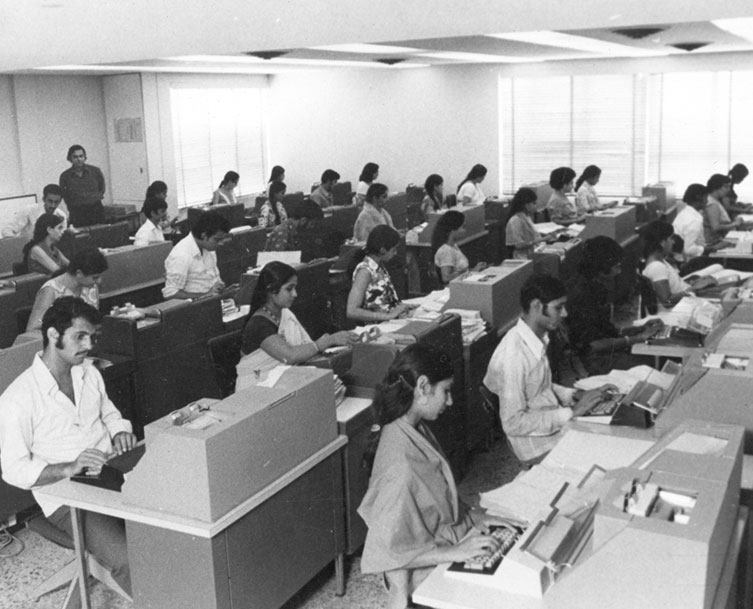
The Digital Public Infrastructure model is rooted in the Indian state and capitalists’ responses to structural shifts in the global software industry. Following the state’s failure to incubate a hardware manufacturing industry in the 1980s, the Indian information technology (IT) industry over the last forty-odd years has been dominated by software service exports. Indian software companies have specialized in routine tasks in the global division of labor: creating and maintaining systems for business processes like human resources, accounting, ticketing, and logistics. Indians performed these services at a fraction of the price demanded by their Western colleagues. In this setup, Indian software companies provide skilled labor to engineer and service back-end systems for large government and corporate clients in the West. Since the country’s economic liberalization in 1991, this industry has been a major driver of national economic growth.
Engaging in labor cost arbitrage, Indian firms were competitive because they mediated between cheap and well-trained software engineering labor and US and European markets. The techniques of mediation reflected the available technologies. Until the early 1990s, in a setup known as “bodyshopping,” Indian firms sent engineers to the West, where they worked in-person on their clients’ computer systems, a costly transnational movement of people that significantly limited growth. In 1991, in what would be hailed as a masterstroke of the country’s economic liberalization, India’s Department of Electronics set up free trade zones for software, known as Software Technology Parks, and began building satellite uplinks, an infrastructure that enabled Indian labor to remotely work on Western systems, a much cheaper arrangement. The first uplink opened in 1993; by the end of the decade, satellite use had exploded.2Dinesh C. Sharma, (<)em(>)The Outsourcer: The Story of India’s IT Revolution(<)/em(>), History of Computing (Cambridge, Massachusetts: The MIT Press, 2015). Supported by an enabling policy environment and steady demand from Western companies all too eager to outsource, the industry grew rapidly.
What resulted was a powerful industry employing a small population of skilled professionals. In 2010, software exports made up almost a fifth of total exports and contributed 6.4 percent of GDP but employed only 2.3 million Indians, or 0.6 percent of the workforce. Software companies like TCS, Infosys, Wipro and HCL—many of which are based in Bangalore—were central to the rise of a new consumer middle class. The sector’s industry body, the National Association of Software Services Companies (NASSCOM), became a major actor in national policymaking. “Software capital” emerged as a major force in the Indian economy and society.3Carol Upadhya, (<)em(>)Reengineering India: Work, Capital, and Class in an Offshore Economy(<)/em(>), First edition (New Delhi, India: Oxford University Press, 2016).
Capital divided
Recognizing the opportunity of Indian labor, global services giants like IBM, Accenture, EDS, and Cap Gemini rapidly scaled up operations in India throughout the 2000s. IBM alone grew from 5,000 employees in India in 2002 to 73,000 in 2007 and 130,000 in 2010.4Jyoti Saraswati, (<)em(>)Dot.Compradors Power and Policy in the Development of the Indian Software Industry(<)/em(>) (London: Pluto, 2012). Ignoring the longstanding practice of not poaching employees, the multinationals hired the best talent, driving up wages, chipping away at their Indian competitors’ profits. These global giants inserted themselves into the policy-making apparatus: by the mid-2000s, they came to dominate NASSCOM.5Saraswati, 2012.
Another threat to domestic software capital was the rise of “cloud computing,” a then-novel paradigm driven by Big Tech firms like Google, Microsoft, and Amazon. In traditional computing, such as the satellite uplink-based model, storage and processing take place on local computers linked to one another through networks. With faster and more ubiquitous networking, storage and processing shifted to large off-site servers on the “cloud” and local machines were relegated to access points.6Devika Narayan, “Decoding Disruption,” (<)em(>)Economic and Political Weekly(<)/em(>) 52, no. 22 (June 2, 2017), https://www.epw.in/journal/2017/22/commentary/decoding-disruption.html. The shift to the cloud placed additional pressure on Indian companies’ market niche. While each unique in-house client system needs a cohort of engineers to build, maintain, and customize, cloud computing commoditizes components, requiring far less labor. Indeed, the downsizing of IT labor may have been a key objective of the turn to the cloud.7Narayan, 2017.
Faced with rising costs and shrinking demand, the sector began to transform. Influenced by global giants, “NASSCOM changed from lobbying foreign governments on behalf of Indian software services firms to lobbying the Indian government on behalf of foreign firms.”8Jyoti Saraswati, (<)em(>)Dot.Compradors Power and Policy in the Development of the Indian Software Industry(<)/em(>) (London: Pluto, 2012). The industry body secured concessions for foreign firms, causing Indian outposts of Western firms to increase in number from 700 in 2010 to over 1000 in 2015 and over 1500 by 2023.9(<)a href='https://media.zinnov.com/wp-content/uploads/2023/08/zinnov_gcc_4.0_report.pdf'(>)https://media.zinnov.com/wp-content/uploads/2023/08/zinnov_gcc_4.0_report.pdf(<)/a(>) In the 2010s, these subsidiaries ventured beyond software and business services into high-paying, high-skill areas, such as R&D and product development.10Yuko Aoyama and Balaji and Parthasarathy, “Research and Development Facilities of Multinational Enterprises in India,” (<)em(>)Eurasian Geography and Economics(<)/em(>) 53, no. 6 (November 1, 2012): 713–30, https://doi.org/10.2747/1539-7216.53.6.713. The Indian services exporters, by contrast, doubled down on their labor cost arbitrage model, avoiding investments in R&D and sinking further down the value chain. Dynamism and transformation have made the services-export industry’s business cycles particularly volatile.11Balaji Parthasarathy, “The Political Economy of the Computer Software Industry in Bangalore, India,” in (<)em(>)ICTs and Indian Economic Development: Economy, Work, Regulation(<)/em(>) (SAGE Publications India, 2005), 199–230, https://books.google.com/books?hl=en&lr=&id=2o6HAwAAQBAJ&oi=fnd&pg=PA199&dq=info:HQcJ5uX-0G0J:scholar.google.com&ots=T_jc89S30u&sig=no_SoNs8uo0O1t337wIzeDMH8yc. Facing the threat of generative AI today, with layoffs and wages down, the business media is once again proclaiming the death of the Indian services exports majors.
Given this instability, one cohort of Indian software capitalists announced a break from the export-led model altogether. In February 2013, newspapers announced the formation of the Indian Software Production Industry Roundtable (iSPIRT), a new thinktank that represented an insurgent fraction of software capitalists within NASSCOM. Though they downplayed their differences, these self-consciously nationalist entrepreneurs sought to cultivate a new industry in domestic “software products” that could create new opportunities for Indian software capital.12Bharat Goenka et al., “2014 iSPIRT Annual Letter” (Indian Software Product Industry Roundtable, 2014).
At the time, iSPIRT’s theory of change hinged on so-called “public goods” that would make a domestic product market possible: “Truly successful product companies build private value on top of public goods. There would be no Google but for Stanford University, no Cisco but for DARPA and no RedHat but for … Linux.” Such public goods were “created by self-organizing communities that are inspired by the open source movement.”13iSPIRT. (<)em(>)Rewriting the Script of a Nation(<)/em(>). Bangalore, 2013. iSPIRT would turn India into a “product nation” by fostering an environment conducive to the emergence of such public goods. There were major obstacles ahead, however. In 2013, only 12.3 percent of Indians were online.
Aadhaar: from welfare to banking
As the software industry experienced upheaval, Nandan Nilekani, billionaire cofounder of IT giant Infosys, was appointed the founding chairman of the Unique Identification Development Authority of India (UIDAI), a new organization set up by the Congress government in 2009 to plan and implement a new digital identity system: Aadhaar. Nilekani had long had ambitions to digitally transform the state. In his vision, digital technology would tackle corruption and leakages in India’s vast public service delivery systems, which provide a lifeline for hundreds of millions of Indians.
Although pitched as voluntary, in practice Aadhaar became mandatory as social welfare agencies stopped providing alternative ways for recipients to access benefits. Hundreds of millions enrolled and Aadhaar scaled rapidly after its 2009 launch. By September 2011, 100 million Aadhaars had been issued; in 2016, the billionth person was enrolled into the database. The system, which imposed stringent technical requirements on a massively diverse country, inevitably came up against snags; at this scale, every mismatch, malfunction, or oversight could result in massive exclusions from social welfare. In one state, for example, researchers found that over 1.5 million people lost access to food rations at some point during Aadhaar’s rollout.14Karthik Muralidharan, Paul Niehaus, and Sandip Sukhtankar, “Identity Verification Standards in Welfare Programs: Experimental Evidence from India,” Working Paper, Working Paper Series (National Bureau of Economic Research, February 2020), https://doi.org/10.3386/w26744. In the most severe cases, exclusions led to deaths from starvation.15“Aadhaar Linked To Half The Reported Starvation Deaths Since 2015, Say Researchers,” (<)em(>)HuffPost(<)/em(>), September 26, 2018, https://www.huffingtonpost.in/2018/09/25/aadhaar-linked-to-half-the-reported-starvation-deaths-since-2015-say-researchers_a_23539768/.
From the beginning, UIDAI had contracted out Aadhaar’s internal functions to private vendors, but it only gradually opened it out to broad commercial use. Aadhaar always suffered from mission creep. Alongside the promise to reduce leakages in public service delivery, Aadhaar was imagined as a tool for achieving “financial inclusion,” promoted by the Reserve Bank of India (RBI) and international actors as a means of poverty alleviation. It was under the banner of financial inclusion that Aadhaar’s identification services were first made accessible to banks.16Aadhaar also altered the meaning and goals of financial inclusion. Financial inclusion shifted from referring to a comprehensive bundle of services that included savings accounts, credit cards, and checking accounts to a narrow focus on identity authentication and digital payments. Scholar and RBI financial inclusion advisor MS Sriram has argued that this redefinition made Aadhaar indispensable but ignored several more pressing issues in extending banking to the poor. MS Sriram, “Identity for Inclusion: Moving beyond Aadhaar,” Economic and Political Weekly 49, no. 28 (2014): 148–54. In 2013, after consultations with the banking industry, the UIDAI rolled out a design update that Nilekani described as “go[ing] back to the drawing board” to enable third party companies to use Aadhaar to digitally authenticate identity and residence.17Nilekani, Nandan, and Viral Shah. (<)em(>)Rebooting India: Realizing a Billion Aspirations(<)/em(>). Allen Lane, 2015. This new function was known as Aadhaar e-KYC or electronic Know Your Customer. In 2014, the RBI recommended that with this new function (known as electronic Know Your Customer), Aadhaar could serve as valid proof of identity and address in a banking system subject to strict compliance. Now, Aadhaar began facilitating customer acquisition for private sector banks, with the expressed goal of promoting financial inclusion.
IndiaStack and commercialization at scale
In May 2014, the Bharatiya Janata Party (BJP) won a landslide in the national election. Aadhaar had originated in the Congress party agenda of the 2000s, and the BJP had originally opposed the project. Running on a strong anti-corruption platform, however, once in power the new government embraced the digital ID for its potential to tackle corruption and inefficiency within the bureaucracy.18Shankkar Aiyar, Aadhaar: A Biometric History of India’s 12-Digit Revolution (Chennai, [India]: Westland Publications Ltd, 2017); Aakash Solanki, “Management of Performance and Performance of Management: Getting to Work on Time in the Indian Bureaucracy,” South Asia: Journal of South Asian Studies 42, no. 3 (May 4, 2019): 588–605, https://doi.org/10.1080/00856401.2019.1603262. As part of the flagship “Digital India” initiative, use of the technology rapidly expanded. The new government doubled down on making Aadhaar mandatory to access public services while opening it to the private sector.
After banking, Aadhaar was opened to telecommunications, a sector with similarly stringent identity verification rules. As part of the launch of Digital India, the Prime Minister’s Office recommended the digitalization of mobile subscriber verification. By March 2015, the Department of Telecommunications partnered with mobile company Vodafone on a pilot to use the Aadhaar database to identify customers.19Justin Lee, “Indian Telcos Hope to Use Aadhaar Biometric Database for Faster Subscriber Verification | Biometric Update,” (<)em(>)Biometricupdate.Com(<)/em(>) (blog), September 2, 2015, https://www.biometricupdate.com/201509/indian-telcos-hope-to-use-aadhaar-biometric-database-for-faster-subscriber-verification; PTI, “Vodafone Starts Aadhaar-Based Verification of Subscribers in Kolkata,” (<)em(>)Business Today(<)/em(>), March 13, 2015, https://www.businesstoday.in/industry/telecom/story/vodafone-india-starts-aadhaar-based-verification-in-kolkata-142021-2015-03-13. In 2016, Aadhaar-based registration was made available for all major telecommunications companies.20Danish Khan, “Bharti Airtel, Vodafone, Idea to Issue New Mobile Connections Using Aadhaar eKYC – ET Telecom,” (<)em(>)ETTelecom.Com(<)/em(>), August 16, 2016, http://telecom.economictimes.indiatimes.com/news/bharti-airtel-vodafone-idea-to-issue-new-mobile-connections-using-aadhaar-ekyc/53725899. A major beneficiary of the push for the use of Aadhaar in telecom was Reliance Jio, a new mobile network launched in 2016 by India’s richest man Mukesh Ambani. Ambani repeatedly attributed Jio’s success in customer acquisition to Aadhaar, which enabled it to quickly obtain new users through digital customer verification.21“Mukesh Ambani Praises Nandan Nilekani’s ‘Phenomenal’ Work on Aadhaar; Says It Will Go down in History,” (<)em(>)Financialexpress(<)/em(>) (blog), October 19, 2016, https://www.financialexpress.com/india-news/mukesh-ambani-praises-nandan-nilekanis-phenomenal-work-on-aadhaar-says-it-will-go-down-in-history/424185/; IANS, “Mukesh Ambani Praises Aadhar, Says It Helped Jio Get Consumers Faster,” (<)em(>)India Today(<)/em(>), February 16, 2017, https://www.indiatoday.in/technology/news/story/reliance-jio-crosses-100-million-customers-mukesh-ambani-960949-2017-02-16. Ambani may have even played a role in convincing Modi to take up Aadhaar, which he had previously campaigned against because it had been an opposition project: “One knowledgeable observer speculated that, although Nandan Nilekani had contested the south Bangalore parliamentary seat as a candidate of the Congress party (he lost to his BJP rival in the election), this did not prevent a meeting with Prime Minister Narendra Modi, especially if a common friend, such as the multi-billionaire Indian business magnate Mukesh Ambani, had arranged it.” Vijay Sathe, “Managing Massive Change: India’s Aadhaar, the World’s Most Ambitious ID Project (Innovations Case Narrative: Project Aadhaar),” (<)em(>)Innovations: Technology, Governance, Globalization(<)/em(>) 9, no. 1–2 (January 1, 2014): 85–111, https://doi.org/10.1162/inov_a_00204. At its height, the company was enrolling one million customers a day.22Block, 2019. Aadhaar’s exposure to commercial use was growing but regulatory approval for private access was still limited to a handful of large companies in two sectors.
Sensing an opportunity, iSPIRT, the software thinktank, became involved in the commercialization of Aadhaar. As part of the Digital India initiative in May 2015, all e-governance initiatives were required to publish “open application programming interfaces,” enabling government agencies to share data with each other and with private companies. iSPIRT rebranded this as “IndiaStack” and began evangelizing it to the startup industry, showcasing how various government systems, including Aadhaar, could be programmatically accessed by entrepreneurs at scale.23Ministry of Communications & Information Technology, “Policy on Open Application Programming Interfaces (APIs) for Government of India,” May 19, 2015.
While the necessary technical capacities had been built and a branding campaign was under way, Aadhaar had to be legislatively remade into a platform that could be programmatically accessed at scale by the private sector. In 2016, the Parliament passed an Aadhaar Act as a “money bill,” a legislative instrument usually reserved for routine financial matters, bypassing the body’s upper chamber where the BJP lacked a majority. The law allowed Aadhaar authentication to be used by any private actor for any purpose notified by the government. Now, private companies of all sorts had a statutory basis to access Aadhaar, with public documentation showing software engineers how to integrate it into their programs. Security apps used it to run background checks on domestic workers. Fintech apps could use it to rapidly identify new customers. In the wake of the new law, almost overnight, a new industry of intermediaries emerged to facilitate private sector access to Aadhaar; many were run or funded by iSPIRT insiders.24Aria Thaker, “The New Oil: Aadhaar’s Mixing of Public Risk and Private Profit,” (<)em(>)The Caravan(<)/em(>), May 1, 2018, https://caravanmagazine.in/reportage/aadhaar-mixing-public-risk-private-profit.
Another centerpiece of the digitalization of India’s economy was the 2016 launch of the Unified Payments Interface (UPI). In the works since 2012, when Nilekani chaired a task force on an Aadhaar-based payments system, the new mobile phone-based payments platform was built and maintained by the National Payments Corporation of India, a private not-for-profit company jointly owned by the RBI and a consortium of banks. The organization had previously developed systems for Aadhaar-based government-to-citizen welfare payments, paving the way for a payments system for broad public use. Notably the organization serves as both an infrastructure provider and a quasi-regulator, largely evading public oversight and accountability.25Smriti Parsheera, “India’s Policy Responses to Big Tech: And an Eye on the Rise of ‘Alt Big Tech,’” SSRN Scholarly Paper (Rochester, NY, December 14, 2022), https://papers.ssrn.com/abstract=4343996. This strategy is replicated in other organizations that run DPIs, like the Open Network for Digital Commerce and the DigiYatra Foundation, as part of a strategy developed in 2011 by the Technology Advisory Group on Unique Projects, headed by Nandan Nilekani. This structure also means that the organization is not subject to India’s Right to Information laws as well as policy that recommends open sourcing all e-government projects. Nandan Nilekani et al., “Report of the Technology Advisory Group for Unique Projects” (New Delhi: Ministry of Finance, January 31, 2011). After its launch, iSPIRT evangelized the new platform, incorporating it into IndiaStack and portraying it as a crucial tool for financial inclusion.26Sunil Abraham, “Unified Payment Interface: Towards Greater Cyber Sovereignty,” ORF Issue Brief (Observer Research Foundation, July 2020), https://www.orfonline.org/wp-content/uploads/2020/07/ORF_IssueBrief_380_Unified-Payments.pdf.
Digital India
The new government not only opened Aadhaar to the private sector, it also compelled its continued adoption and use. The 2016 Aadhaar Act was central to this. Despite multiple Supreme Court orders, in 2013, 2014 and 2015, affirming Aadhaar’s voluntary nature, Aadhaar became ever more entrenched in everyday life. The law enabled agencies to mandate its use for everything from secondary school exams to senior citizen railway discounts to the National Rural Employment Guarantee Act—a lifeline for millions of Indians seeking work.
But the most dramatic step towards the wide-scale adoption of IndiaStack related not to Aadhaar but to the government’s promotion of UPI. In November 2016, with the stated goal of cracking down on corruption, the government instituted an overnight ban on Rs 500 and Rs 1000 currency notes, removing 86 percent of currency value from circulation. Millions of Indians were suddenly in hardship without access to cash. Yet demonetization accelerated digital finance, the widespread use of UPI and the rise of a “cashless society,” creating by fiat a domestic consumer base for software products.27Cyril Fouillet, Isabelle Guérin, and Jean-Michel Servet, “Demonetization and Digitalization: The Indian Government’s Hidden Agenda,” (<)em(>)Telecommunications Policy(<)/em(>) 45, no. 2 (March 1, 2021): 102079, https://doi.org/10.1016/j.telpol.2020.102079. Two months after the ban, digital payment transaction volumes saw a sixfold increase. The RBI hailed the transition as “a structural break in the volume and value of retail electronic payments, coinciding with the onset of demonetization.”28https://rbidocs.rbi.org.in/rdocs/Publications/PDFs/03CH_290720243D31CB65DF034EDA9BCD04356B4DFAE8.PDF Today, UPI processes over 650 million transactions per day, more than the worldwide volumes of Visa or Mastercard.
The trajectory of IndiaStack was also shaped by challenges from civil society. In a landmark 2018 ruling, acting on a case brought by a broad coalition of civil society actors, the Supreme Court struck down all commercial use of Aadhaar as unconstitutional. While this fell short of the petitioners’ demands, it put a halt to the emerging IndiaStack industry. Yet a series of legislative amendments provided a workaround.29Jitendra Singh, “Leaked Audio Reveals iSpirt and Khosla Labs Knew about Aadhaar Amendment Bill,” Entrackr, January 7, 2019, https://entrackr.com/2019/01/ispirt-khosla-labs-aadhaar-amendment/. By 2021, large-scale use of Aadhaar by banks, and telecommunication companies was back on track.30Jyoti Panday, “India Stack: Public-Private Roads to Data Sovereignty” (Internet Governance Project, 2023), https://www.internetgovernance.org/research/india-stack-public-private-roads-to-data-sovereignty/. https://www.medianama.com/2021/09/223-aadhaar-for-telecoms-reintroduced/ A recent amendment passed in January 2025 further expanded the use of Aadhaar to private sector services that promote “ease of living,” a verbiage that effectively opens the door for any use.31Himanshi Lohchab, “Aadhaar Amendment for Private Sector Does Not Violate SC Order: Ashwini Vaishnaw,” (<)em(>)The Economic Times(<)/em(>), February 5, 2025, https://economictimes.indiatimes.com/tech/technology/aadhaar-amendment-for-private-sector-does-not-violate-sc-order/articleshow/117924405.cms?from=mdr.
In effect, a dual movement was taking place: the compelling of widespread and rapid adoption of Aadhaar and UPI as well as ever greater exposure to commercial use. For iSPIRT, “public goods”, still central to the organization’s theory of change, were no longer understood as the products of “self-organizing communities that are inspired by the open source movement.” Rather, “public goods” now referred to IndiaStack platforms built collaboratively by the state and the software industry.32Goenka et al., “2014 iSPIRT Annual Letter.” A far cry from the collaborative spirit of open source, these platforms were imposed not only on Indians who sought to participate in government programs but in virtually all market transactions—that is, in economic life altogether.
Citizen as customer
With the growth and development of IndiaStack, startups can now access over one billion Indians who just a few years earlier were scarcely imaginable as a market. Aadhaar has reduced the costs for banks, telecommunications companies, and startups to acquire new customers; according to unsourced but widely circulated calculations, the cost of onboarding a customer for a bank fell from $0.12 to $0.06 after Aadhaar. At the time, The Economist reported these savings might expand a loan company’s target market from the richest 15 million Indians to over 500 million Indians. UPI, subsidized by the state from 2018 onwards, allowed companies to make and receive payments from citizens without any fees. The import of new cheap mobile phones from China and a massive drop in mobile data rates—caused by the entry of Reliance Jio, itself facilitated partly by Aadhaar—supported these radical shifts.
In software capitalist slide decks, the citizen became congruent with the customer; the national population is reborn as a “Total Addressable Market.” As Aadhaar moved from the terrain of state-citizen relations to industry-consumer relations, iSPIRT’s imagined demand for software products shifted—from medium-sized businesses (such as regional hospitals) to the private affairs of the most impoverished individuals. A fictional vegetable vendor named Rajni, ubiquitous in Digital India’s advertising, became an exemplar of the potential of the new approach. With the new technologies of IndiaStack, Rajni no longer had to depend on local moneylenders; instead she could track her transactions, earn and pay in digital cash, and borrow at lower interest rates from fintech startups to enterprise her way out of poverty.33N. S. Ramnath, “Aadhaar 2.0: Creating India’s Digital Infrastructure,” Mint, June 28, 2016, sec. politics, https://www.livemint.com/Politics/afjuy0dHgS4beFggSTVddP/Aadhaar-20-Creating-Indias-digital-infrastructure.html; Regina Mihindukulasuriya, “‘All about Helping Rajni’ — Tech Gurus at iSPIRT Quietly Power India’s Digital Revolution,” ThePrint, June 25, 2022, https://theprint.in/india/all-about-helping-rajni-tech-gurus-at-ispirt-quietly-power-indias-digital-revolution/1007652/. In this fiction, private innovation delivered through state-funded digital infrastructures empowers the poor and develops the nation. This is a transformation in the means and the ends of economic development. “Financial inclusion,” pitched as a strategy for growing businesses while supporting the poor, operates today as an alternative to developmental aspirations of mass industrial employment that we have inherited from the twentieth century.34Toby Carroll, “‘Access to Finance’ and the Death of Development in the Asia-Pacific.” (<)em(>)Journal of Contemporary Asia(<)/em(>) 45, no. 1 (2015): 139–66. (<)a href='https://doi.org/10.1080/00472336.2014.907927'(>)https://doi.org/10.1080/00472336.2014.907927(<)/a(>).(<)br(>) In the future, as customers, citizens will pay for their own development.
This dream has yet to come to fruition. Recognizing the structural limitations of the “poverty market,” investment in the startup sector has largely focused on the demands of rich urban Indians. The current boom in the startup sector is in Quick Commerce, which uses technology—including IndiaStack—to exploit labor to deliver groceries and other consumer goods to rich urban Indians in under ten minutes. Today, mass digitalization is mediating between India’s relatively small urban software capitalist sector and the vast subsistence sector while exacerbating the divide between the two. The poorest one billion Indians are, according to a recent venture capital report, “unmonetizable.”35Sajith Pai, Anurag Pagaria, and Nachammai Savithri, “Indus Valley Annual Report 2024,” Blume. This is not the “product nation” that iSPIRT set out to build. Yet the mass market of 1.4 billion digital consumers remains a shared dream of the state and capital, orienting strategies and investments for the future.
India’s Digital Public Infrastructure was born from a unique articulation of forces in the 2000s: a remarkable alignment between a powerful state, a skilled software industry, and incipient capital in finance and consumer-facing startups in one of the most unequal countries in the world. The Indian script of mass digitalization is now being taken up by governments from Latin America to Africa as a path to inclusive development. Its promoters — from the Gates Foundation to the UN to the World Bank — tout the Indian model as a win-win scenario for the private and public sector. Yet as it is grafted into contexts very different from India, it is unclear whether it will take root, and what fruit it will bear.
I thank Harshwardhan Pushkin Sharma for their invaluable assistance in the preparation of this article.
Further Reading

Indian Big Business
The evolution of India’s corporate sector from 2000 to 2020
“The systemic, long-term nexus between the political elites and big business will not go away anytime soon,” wrote journalist M. K. Venu in 2015. Writing...

Semi-Politics
Intel and the future of US chipmaking
Since the late 1970s, cutting edge semiconductors have figured at the heart of the political economy of the United States. Often called the “crude oil...

The Techno-Patrimonial Welfare State
An interview with Yamini Aiyar on the BJP’s “new welfarism” in India
The success of the Bharatiya Janata Party (BJP) over the last decade of Indian politics, and its frontrunner status in this year’s parliamentary elections, has...