October 24, 2025
Analysis
Economic Resilience
Iran’s economy in the aftermath of the June bombing
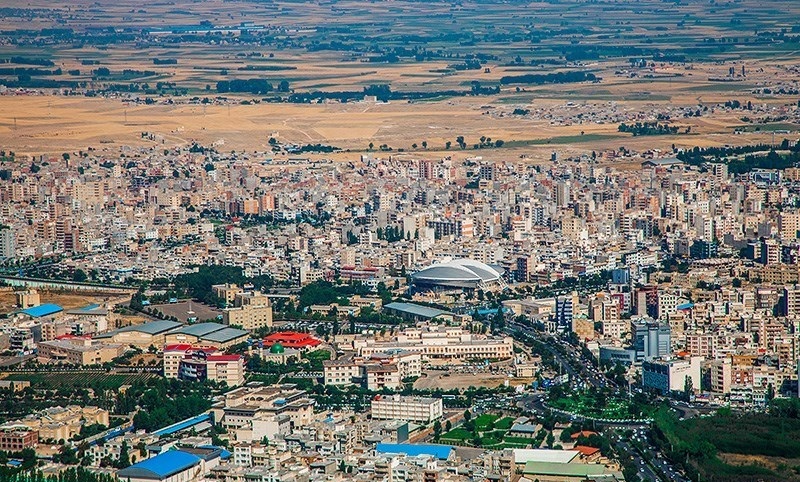
When Israel launched its attack on Iran on June 13 of this year, its stated aim—backed by its ever-touted “right to self-defense”—was to undo Tehran’s nuclear program. In fact, it targeted both military and non-military sites, including hospitals, TV stations, prisons, civilian apartment buildings, and basic energy infrastructure. Nine days later, Israel had succeeded in drawing Washington into the war; it promptly deployed a fleet of its B2 heavy bombers, dropping hundreds of thousands of pounds of munitions. A total of 1,060 people—40 percent of these civilians—were killed, and almost 5,800 people were injured.
The twelve-day bombardment caused significant damage, but for the most part the country’s economy survived intact. Not only did the domestic supply of goods and services remain largely stable (a testament to the country’s domestic production capabilities, grassroots solidarity, and the effectiveness of government interventions), the longer-term consequences seem to so far be minimal as well. Years of international isolation and sanctions have prompted Iran to structure its economy in such a way as to insulate itself. Though it remains exposed to further interruption, Iran’s economy has so proven itself resilient. What explains its buoyancy?
Solidarity and decentralization
In the first instance, Iran’s resilience in the face of Israel’s assault owes much to the grassroots efforts of its people, who rallied together to keep the economy moving amid the bombardment. Factory managers and workers vowed to maintain operations. “The lives of our workers are a priority,” maintained one manager. “Production continues, but with human-centeredness and prudence.” Truck drivers, who had recently ended their strikes, played a significant role in transporting goods and keeping stores stocked.
In many neighborhoods, shopkeepers imposed voluntary rationing on essential goods to curb hoarding and ensure fair distribution. Some merchants went so far as to sell certain staples at cost, hanging banners on their storefronts proclaiming “Goods sold at purchase price!” These community-driven initiatives, coupled with reduced consumption, helped stabilize markets.
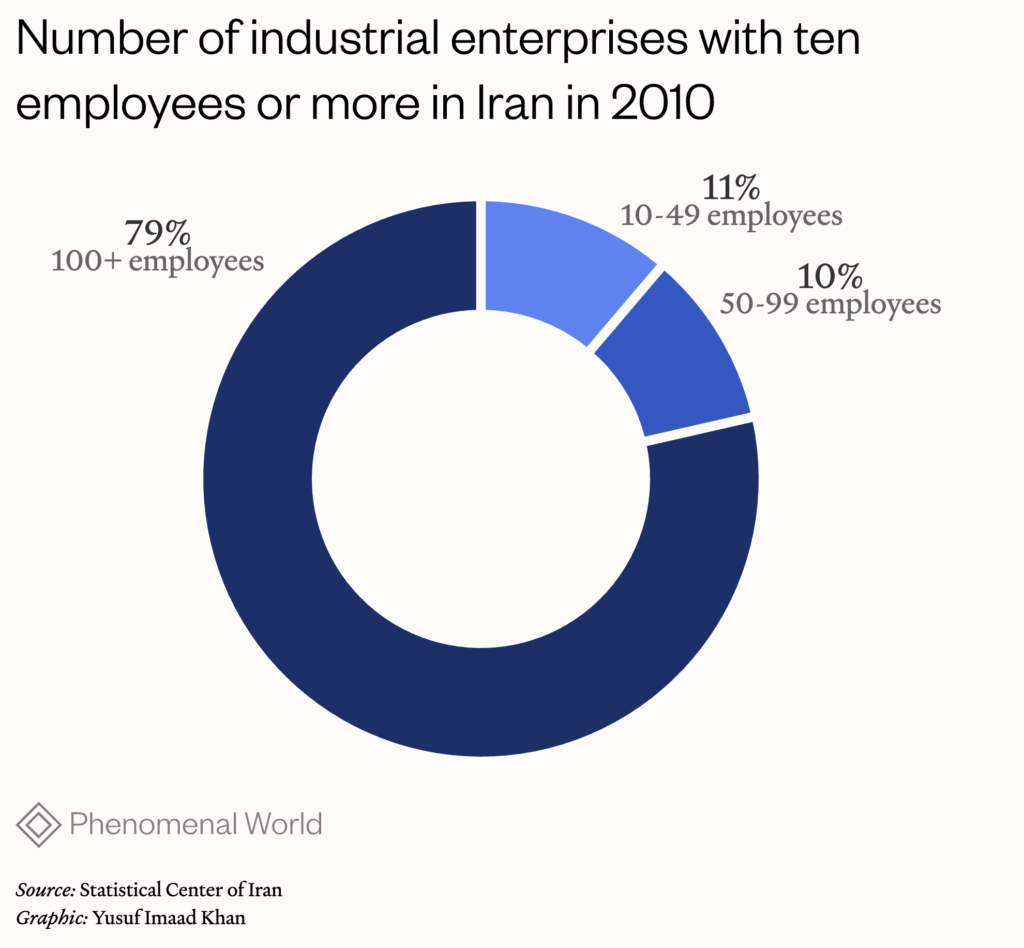
Beyond this, key to Iran’s economic resilience is the fact of its decentralization. It is dominated by small and medium-sized enterprises (SMEs) and informal producers. Over 500 industrial parks are scattered across the country, housing thousands of SMEs that collectively form the backbone of domestic production. This broad geographic distribution of industry—mirrored by equally dispersed small retail shops and micro-level distribution channels—allows goods and services to keep flowing even during crises. When one region or supplier is disrupted, many others can continue operating, preventing a total breakdown of supply. While such decentralization can sacrifice some efficiency, it provides resilience by eliminating single points of failure in the nation’s economic system.
Self-reliance under sanctions
Another pillar of Iran’s wartime resilience is the country’s self-reliant manufacturing base, which has been cultivated over decades of sanctions and import substitution. In the wake of the 1979 revolution, “self-sufficiency” became a guiding economic principle. The decades-long, US-led sanctions regime—which began as early as 1996 with the Iran and Libya Sanctions Act led—had reinforced the government’s commitment to this self-sufficiency and, with it, a diverse industrial base. Iranian factories today produce a diverse range of products, including food, pharmaceuticals, textiles, home appliances, and automobiles. These industries generally lack global competitiveness and cater almost entirely to the domestic market, but their ability to meet local demand across a broad range of goods has proven crucial for the country’s economic resilience.
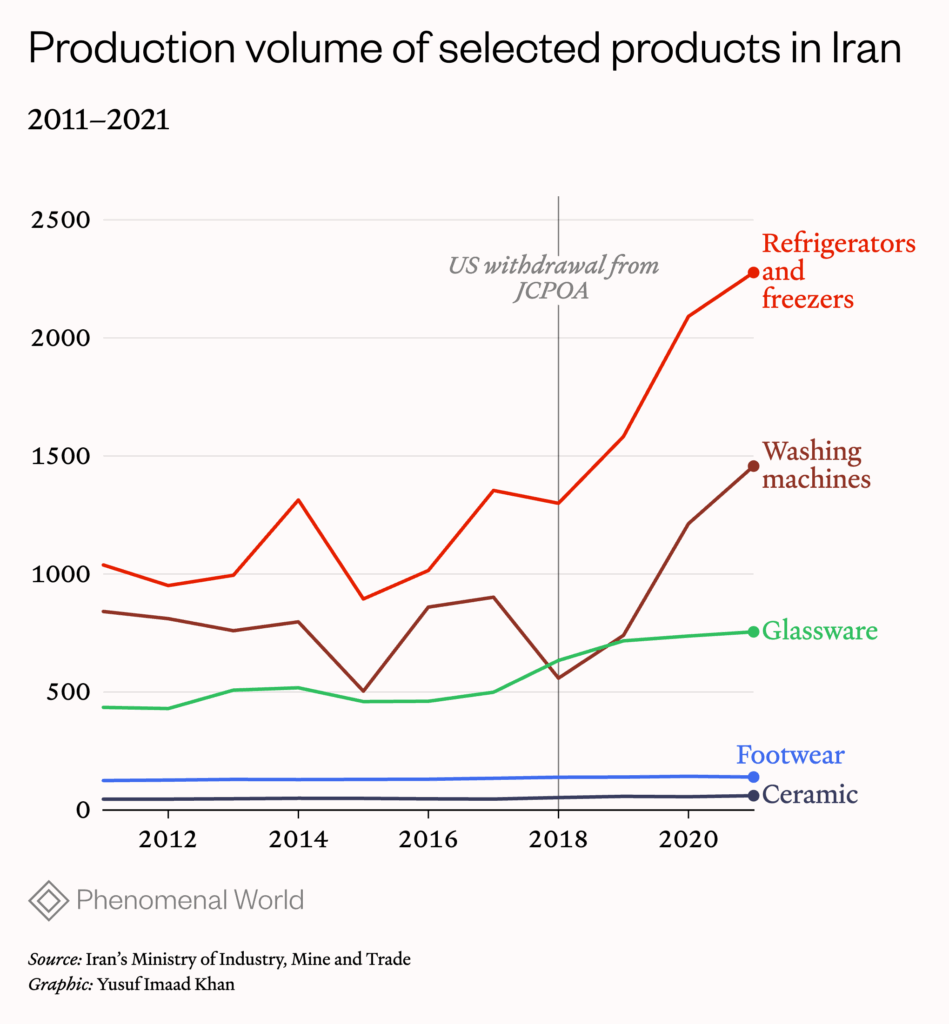
In time, this inward orientation deepened. As the Obama administration tightened sanctions on Tehran in 2010, Iran’s Supreme Leader announced a set of policies for what he termed the Resistance Economy (Eghtesad-e Moghavemati); each promoted local production and sought to reduce dependency on imports. Implementation was limited at first, but when the Trump administration withdrew from the nuclear deal in 2018 and reimposed sanctions, Iran responded decisively. It banned the import of more than 1,300 goods to conserve hard‑currency reserves and to encourage domestic producers to increase localization and reduce reliance on foreign partners. Trump’s threats of secondary sanctions also drove many foreign companies out of the country, handing a much larger share of the market of 90 million consumers to local firms. Domestic producers—some of which had previously been minor players or mere assembly contractors—seized the opportunity to expand their output and localize imported parts.
This so-called forced protectionism soon yielded tangible results in various industries. Take apparel: national newspaper Farhikhtegan reported that before 2018, some twenty-eight foreign clothing brands were active in Iran’s retail market—including one popular Turkish chain with fourteen stores in Tehran alone. After sanctions drove these brands out, local brands rushed in to fill the void. New domestic manufacturers emerged and existing ones rapidly expanded, opening dozens of outlets across the country. Some launched over fifty branches, a scale of expansion previously unseen in Iran’s retail sector.
Another example is home appliances. The Iranian market was formerly dominated by imported Korean electronics, but this sector, too, has seen domestic companies gain a much larger share—80 percent since 2018. Iranian manufacturers now produce over 20 million appliances annually, from white goods to small appliances, in an effort to meet local demand (although producers still rely on imported components for advanced electronics such as televisions). The rapid proliferation of many small domestic brands in this arena has raised concerns about the quality of products and a lack of scale. The same decentralized, hyper-competitive market structure that boosts resilience can hinder efficiency and technological advancement in the long run.
The automotive industry—a cornerstone of Iran’s manufacturing sector—initially suffered more than most from the 2018 sanctions shock. Annual car output plunged from 1.5 million vehicles in 2017 to under 800,000 in 2018 as foreign partners withdrew and critical imported components became scarce. (More than half of the cars produced in 2018 were left unfinished on assembly lines due to missing parts.) Over the next few years, however, Iran’s automakers slowly rebuilt capacity by developing domestic substitutes for key parts and reorganizing supply chains. By the early 2020s, local car production had rebounded to roughly one million units per year—still below the pre-sanctions peak, but a testament to the industry’s adaptive recovery under isolation.
State intervention and macroeconomic stability
For all its shortcomings, the Iranian government undertook key and effective emergency measures that helped maintain stability. With decades of experience managing sanctions and distributing goods (a legacy from the Iran–Iraq War era), the government leveraged its existing infrastructure to ensure the availability of essentials. Domestic production was ramped up, distribution channels reinforced, and government departments—including border and customs offices—remained operational. The Iran Customs Administration (IRICA) ensured that land borders remained open and that imports and exports continued as normal.
This meant that despite the turmoil, basic price stability was maintained in the short run. Iran’s consumer price index for July (which captured the tail end of the fighting) was up 3.5 percent from the previous month—only marginally above the 3.3 percent month-on-month inflation recorded in June before the war. In other words, the war itself did not spur a dramatic price spike for everyday goods.
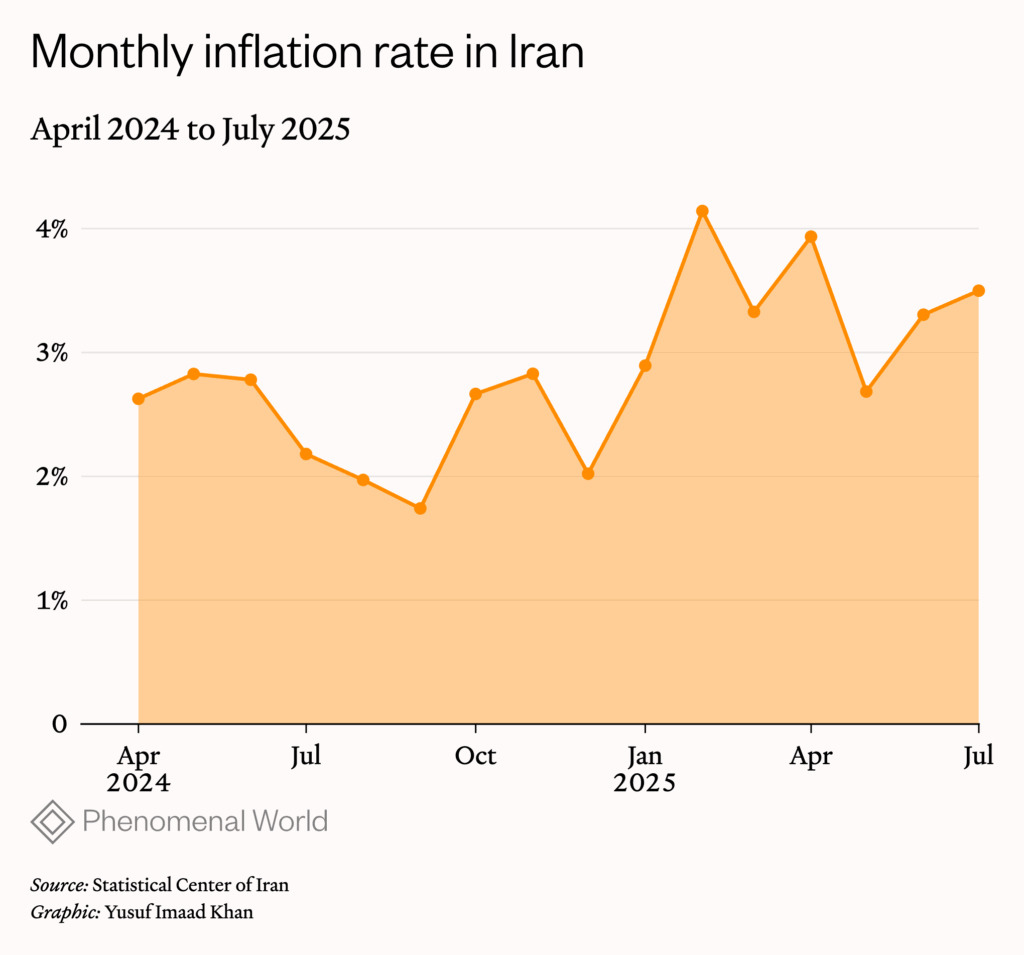
This relatively mild impact on prices must be understood in context. Iran has been grappling with entrenched inflation of around 40 percent per year, a byproduct of sanctions and its fiscal deficit. The central bank’s strict contractionary stance alone has not subdued these price pressures. Meaningful cuts to government spending have proven politically difficult under sanctions, limiting the effectiveness of anti-inflation policies. Thus, even as emergency measures kept wartime inflation in check, the underlying challenge of stabilizing the economy remains.
Vulnerablities
For all its resilience, however, Iran’s economy is not immune from risk. For one, it is not entirely self-sufficient; the country still relies on imports for certain high-tech goods and medicines. Israel targeted several civilian medical facilities across Iran, including Hakim Children’s Hospital in Tehran, Farabi Hospital in Kermanshah, the Qasr-e-Shirin Welfare Center, and the Tehran Red Crescent Society Center—a clear violation of international humanitarian law, which explicitly safeguards healthcare infrastructure, even during times of conflict. Combined with a rise in injuries and disruptions to drug imports, they have placed significant pressure on Iran’s healthcare system.
Israel’s targeted strikes on industrial parks and manufacturing plants, as well as cyber attacks on banking infrastructure further threaten stability. Two major Iranian banks, Sepah and Pasargad, suffered cyber intrusions that temporarily disrupted online services and account access, leading to temporary disruptions in their online services, including people losing access to their accounts. Both have since restored operations, but these attacks are part of what appears to be a coordinated effort to undermine daily life and potentially ignite social unrest.
Beyond this, the broader economy faces a more nagging aftershock: depressed consumer demand. Many families curtailed spending during the conflict, both out of caution and because of disruptions to daily life. Reports indicate that Iran is entering its eighteenth month of recession; if this subdued demand continues, it could erode business revenues and make it difficult for factories to keep operating at capacity. Prolonged uncertainty or sporadic clashes could push some firms into unsustainable losses. To avert a wave of bankruptcies and job cuts, economists have urged the government to roll out emergency financial relief—much like the support programs used during the Covid-19 pandemic—to help vulnerable households and enterprises weather the post-conflict slump.
The crisis has also forced a shift in the government’s economic priorities. Iran’s recently appointed Minister of Economy, Seyed Ali Madanizadeh, has effectively put his long-term reform agenda on hold to focus on immediate stabilization. Tasked with taming inflation and keeping supply chains intact amid the turmoil, Madanizadeh has emphasized pragmatic interventions over structural overhauls. He noted that thanks to “special measures and inter-agency coordination,” the volume of essential imports in the week of June 14–20 reached 980,000 tons—a 53 percent jump from the prior week—ensuring that food and other basics remained available despite the conflict. Such efforts illustrate how maintaining economic resilience has become the paramount goal, temporarily superseding other development objectives.
Outlook
By late June, a ceasefire had brought the fighting to a halt, allowing the economy to begin charting a path toward recovery. Residents who had fled major cities trickled back, and Tehran—the country’s commercial hub—saw life gradually return to its bazaars, offices, and factories. The government announced several compensation packages for businesses (such as deferred loan and tax payments) and individuals. Although some businesses were able to access the aid, in many cases the funds languished within bureaucratic channels, dampening the overall effect. Officials are still strategizing as to how to secure vital goods should hostilities flare up again. Iran’s geography offers some advantages in this respect: the nation shares land borders with seven countries and has maritime access to several more, providing multiple potential trade partners and supply routes. Tapping these alternative channels, if necessary, could help Iran mitigate the impact of any future blockade or supply shock.
Yet the future remains uncertain. The immense losses suffered in this short conflict underscore the urgent need for a durable peace and for structural reforms to address the vulnerabilities that the war has laid bare. In the face of the latest bombardment, Iran’s economy has proven itself resilient, but the economic development that would help it to flourish requires more than an end to military warfare. It needs an end to the economic warfare, in the form of sanctions, waged by the US, Europe, and beyond.
Further Reading
Adaptation in the Sanctioned Economy
Domestic manufacturing, overcapacity, and the limits of Iran’s economic resilience
Coercion and Inequality
The distributional effects of sanctions in Iran
Who Benefits From Sanctions?
On “How Sanctions Work: Iran and the Impact of Economic Warfare” by Narges Bajoghli, Vali Nasr, Djavad Salehi-Isfahani, and Ali Vaez
Further Reading

Adaptation in the Sanctioned Economy
Domestic manufacturing, overcapacity, and the limits of Iran’s economic resilience
The oil boom of the late 2000s created significant headwinds for Iranian manufacturers. As the value of oil exports surged, the Iranian rial appreciated, real...

Coercion and Inequality
The distributional effects of sanctions in Iran
“Plumbing” is an oft-used metaphor for understanding how sanctions work. Sanctions are intended to stop the flow of money to the targeted government; reserves are...

Who Benefits From Sanctions?
On “How Sanctions Work: Iran and the Impact of Economic Warfare” by Narges Bajoghli, Vali Nasr, Djavad Salehi-Isfahani, and Ali Vaez
Sanctions against Iran amount to some of the harshest and longest-running restrictions in the world. Dating back to the 1979 revolution that overthrew one of...