July 17, 2025
Analysis
Fentanyl, Avocados, and Tariffs
Transformations in the drug economy
Donald Trump’s return to the presidency of the United States has rekindled a regional debate around fentanyl. The lethality of the illicit substance has put the world on high alert, but the rise of the drug has also threatened the United States’ trade relationship with Mexico and Canada. The Trump administration has already accused Mexican cartels of being primarily responsible for fentanyl trafficking, and Canada of harboring clandestine laboratories operated by these organizations. It is important to consider that the United States’ recently 25 percent tariffs on all Mexican and Canadian imports not covered by the Free Trade Agreement (USMCA), as well as a 10 percent tariff on energy products, have the stated intention of pressuring both countries to crack down on fentanyl trafficking and undocumented migration.
The introduction of fentanyl into the illegal drug market in the United States has had significant economic repercussions in both countries. Because of its high potency, ease of trafficking, and low cost, fentanyl has altered drug consumption and trafficking patterns, resulting in a global restructuring of the illegal market. The growing presence of illegal fentanyl, in conjunction with supply-focused policies, has shifted the production of this substance from China to Mexico, reduced the rents derived from other drugs such as heroin, and contributed to the diversification of the criminal activities of Mexican cartels.
Globally, opioid use has led to an alarming increase in overdose deaths. In 2019, around 600,000 deaths were linked to drug use, of which approximately a quarter were due to opioids. In recent years, this crisis has intensified due to the increased use of these substances to treat chronic pain and the illegal proliferation of synthetic opioids. The United States is the country most affected by non-prescription fentanyl abuse, accounting for 98.8 percent of reported global seizures in 2022.1CDC (2025). (<)em(>)Wide-ranging Online Data for Epidemiologic Research (<)/em(>)(CDC Wonder) Between 2010 and 2022 alone, overdose deaths in the US grew by 519 percent, surpassing 100,000 in the last year. This accelerated increase is attributed to the growing use of synthetic opioids (primarily fentanyl), responsible for 68.4 percent of overdose deaths in 2022. In response, the United States has undertaken a series of measures focused primarily on curbing supply, while neglecting the causes of demand. This strategy has not only been ineffective, but it has also had consequences in Mexico.
While the Trump administration is right to point to the central role of Mexican cartels in the fentanyl crisis, its diagnosis focuses primarily on external actors and ignores domestic policies that could address the increase in demand. The use of tariffs as a punitive measure diverts attention from the causes of the fentanyl crisis and makes it more difficult to coordinate cross-border public policies to target transnational criminal organizations.
The opioid crisis
The rise in fentanyl overdose deaths in the United States is part of the opioid epidemic, a story that can be divided into three stages. The first wave began in the late 1990s, driven by an increase in the prescription of opioid painkillers. During this period, the US pharmaceutical industry actively promoted opioid use to treat pain, minimizing their risks and encouraging physicians to prescribe them.2Van Zee, A. (2009). The promotion and marketing of OxyContin: Commercial triumph, public health tragedy. (<)em(>)American Journal of Public Health(<)/em(>), 99(2): 221-227. Opioids also became cheaper: between 2001 and 2010, the uninsured price of prescription (out-of-pocket) opioids fell by 81 percent. Prescription opioid overdose deaths doubled in that period (see the figure below).
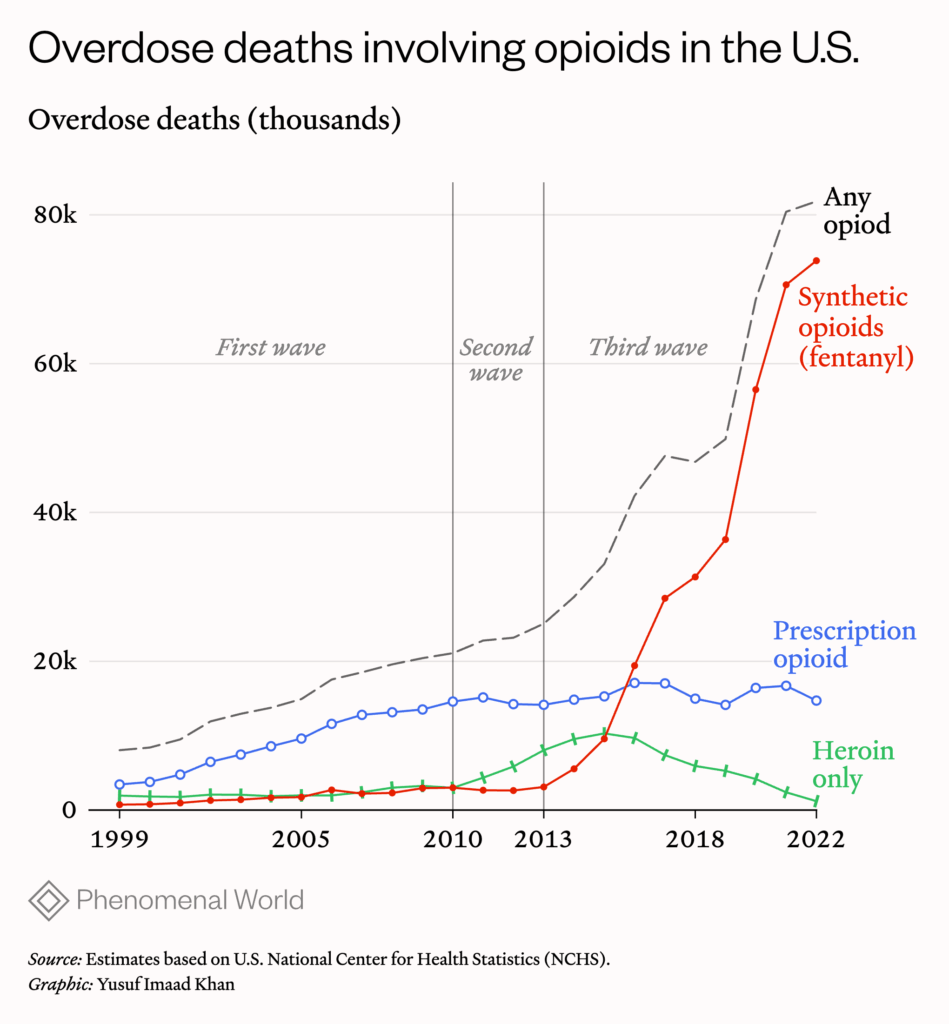
Faced with the increase in lethal overdoses from prescription opioids, the US government implemented a series of reforms to restrict their supply, including strict Prescription Drug Monitoring Programs (PDMPs) and the reformulation of extended-release pills like OxyContin. While these measures succeeded in reducing prescription opioid deaths—for example, by 9 percent following the implementation of PDMP—they also led to an increase in demand for illicit opioids.3Meinhofer, A. (2018) “Prescription Drug Monitoring Programs: The Role of Asymmetric Information on Drug Availability and Abuse.” (<)em(>)American Journal of Health Economics(<)/em(>), 4 (4): 504-526.Many users migrated to heroin, due to its greater availability and lower cost. Between 2002 and 2011, 79.5 percent of new heroin users reported previous non-medical use of prescription opioid, while only 1 percent of those using prescription opioids reported previous heroin use.4Muhuri, P. K., Gfroerer, J. C., y Davies, M. C. (2013). “CBHSQ data review,” (<)em(>)Center for Behavioral Health Statistics and Quality(<)/em(>), SAMHSA, 1:17. Heroin overdose deaths subsequently increased dramatically between 2010 and 2013. This phenomenon, known as the second opioid wave, was an indirect consequence of public policies focused solely on restricting supply, without considering its impact on users or establishing comprehensive strategies to care for those who developed dependence.
Starting in 2013, overdose deaths began to increase dramatically. The main culprit: fentanyl, a synthetic opioid fifty to 100 times more potent than morphine and twenty to forty times more potent than heroin. Although this drug has great advantages in the treatment of severe pain, its increasing availability on the illegal market makes it the central cause of the current crisis. In 2013, only 12.4 percent of opioid overdose deaths had traces of fentanyl; by 2022, this proportion had skyrocketed to 90.2 percent.5CDC, 2025.
The rapid increase in fentanyl deaths is explained by a combination of factors including its high lethality, ease of smuggling, and changes in supply and demand patterns stemming from its low cost. Its high potency triggers the possibility of a lethal overdose, and because the amount required for each dose is minimal, it can be transported in powder or tablet form, making it easier to traffic than other opioids.
Due to its low cost, high potency, and ease of acquisition, fentanyl became an attractive substitute for both consumers and traffickers. For the former, it represented a cheaper alternative to prescription opioids and heroin: while an 80 milligram OxyContin tablet can cost as much as $80 on the black market, and a 0.1-gram bag of heroin sells for $20, a fentanyl tablet costs as little as $3. As for traffickers, fentanyl offered them the opportunity to reduce costs and increase their profit margins on the sale of drugs such as heroin.
At the retail level, heroin is usually sold at a fixed price, regardless of the demand or purity of the product, so profit margins are adjusted by changing its composition.6Hoffer, L. and Alam, S. J. (2013). “Copping” in heroin markets: The hidden information costs of.Indirect sales and why they matter. In (<)em(>)International Conference on Social Computing, Behavioral-Cultural Modeling, and Prediction(<)/em(>), pages 83-92. Springer. Mixing heroin with fentanyl allowed traffickers to reduce costs more significantly, while maintaining—and even intensifying—the effects perceived by the user. Since its presence is imperceptible to the naked eye, users may consume heroin adulterated with fentanyl without knowing it, which has contributed to the increase in the number of overdoses.
From China to Mexico
At the beginning of the third wave, China was the main source of illicit fentanyl consumed in the United States. This synthetic opioid was shipped directly by mail from China or via Mexico and Canada, from where it entered the country by land, hidden in vehicles or in trucks carrying legal merchandise across border crossings. In the early years of fentanyl’s incursion into the illegal market, Mexican cartels served primarily as middlemen rather than producers; between 2016 and 2018, 97 percent of fentanyl seized in the United States was of Chinese origin. There is also no evidence that the cartels were primarily responsible for mixing heroin with fentanyl. In 2019, laboratory analysis conducted on heroin seizures at the southern border indicates that the vast majority of samples contained no adulterants or trace amounts of fentanyl. Evidence suggests that, at the wholesale level, cartels preferred to traffic both substances separately. It is in the US market where they cut heroin with fentanyl for final sale.7Dudley, S., Bonello, D., Lopez-Aranda, J., Moreno, M., Clavel, T., Kjelstad, B., and Restrepo, J. J.(2019). Mexico’s role in the deadly rise of Fentanyl. (<)em(>)Wilson Center(<)/em(>).
The transition from traffickers to manufacturers occurred in the Mexican cartels, most likely, in response to a series of measures imposed by the Chinese government to limit fentanyl trafficking. Despite the fact that the Chinese government considers the US accusations to be unfounded, the Xi Jinping administration has adopted various policies to control fentanyl and its analogues in response to the growing diplomatic pressure exerted by Washington. For example, at the 2018 G-20 summit, China announced measures to ban the sale, production, and export of fentanyl without a special license, as well as the inclusion of fentanyl analogues in the list of controlled substances.8Felbab-Brown, V. (2022). China and synthetic drugs control: Fentanyl, methamphetamines, and precursors. Alongside these measures, the government strengthened its control of the postal service and created specialized laboratories and units dedicated to investigating fentanyl trafficking. While the Chinese government’s actions were successful in reducing direct shipments of fentanyl by mail, they did not reduce its availability.9 Felbab-Brown, V., 2022. On the contrary, this allowed new competitors to enter the market. Fentanyl production soon shifted from China to Mexico.
As of 2019, the DEA has identified Mexico as the new fentanyl epicenter, with cartels such as the Sinaloa Cartel and the Jalisco Cartel-New Generation (CJNG) as the main producers. These groups not only managed to consolidate their control over trafficking corridors to the United States, but also developed the capacity to synthesize fentanyl locally in clandestine laboratories, using precursor chemicals from China as inputs.
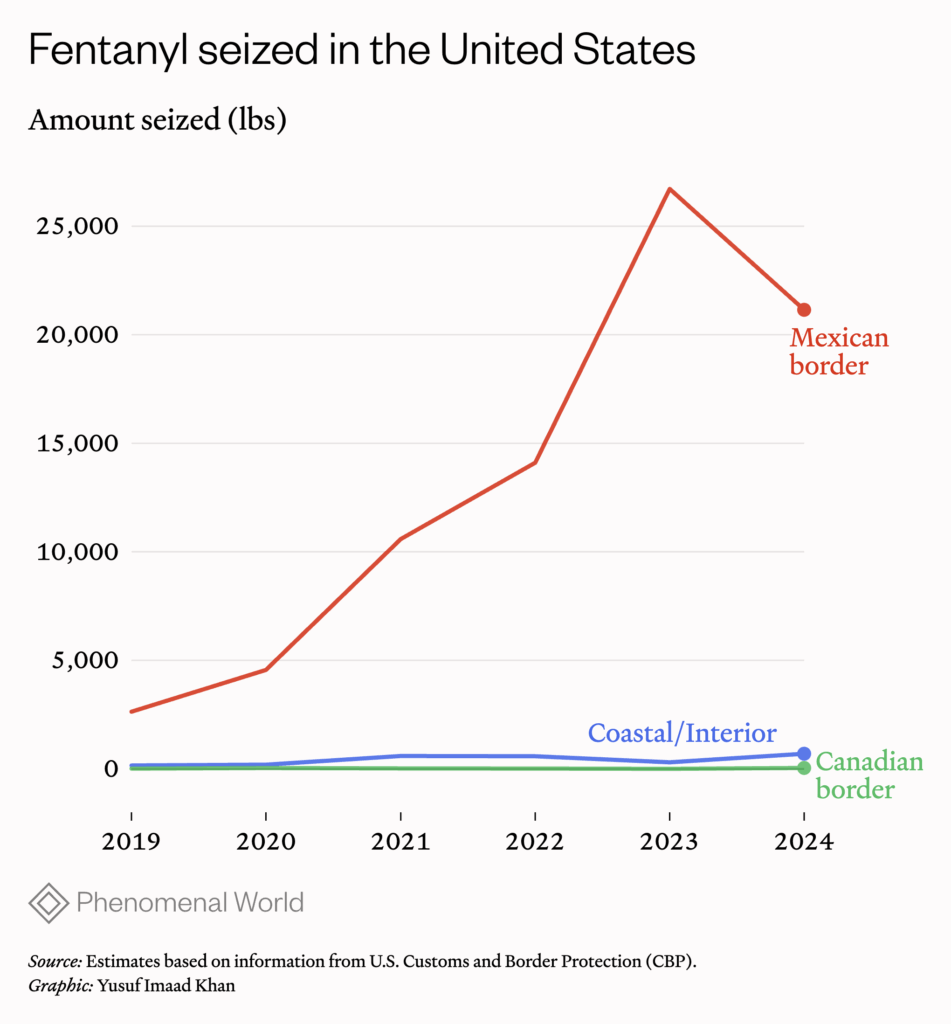
Figure 2 shows how fentanyl seizures at the US-Mexico border increased by more than 900 percent between 2019 and 2023. While this notable increase can be attributed in part to tighter border enforcement, the magnitude suggests that the main cause is the expansion of fentanyl production by Mexican cartels.
Criminal diversification
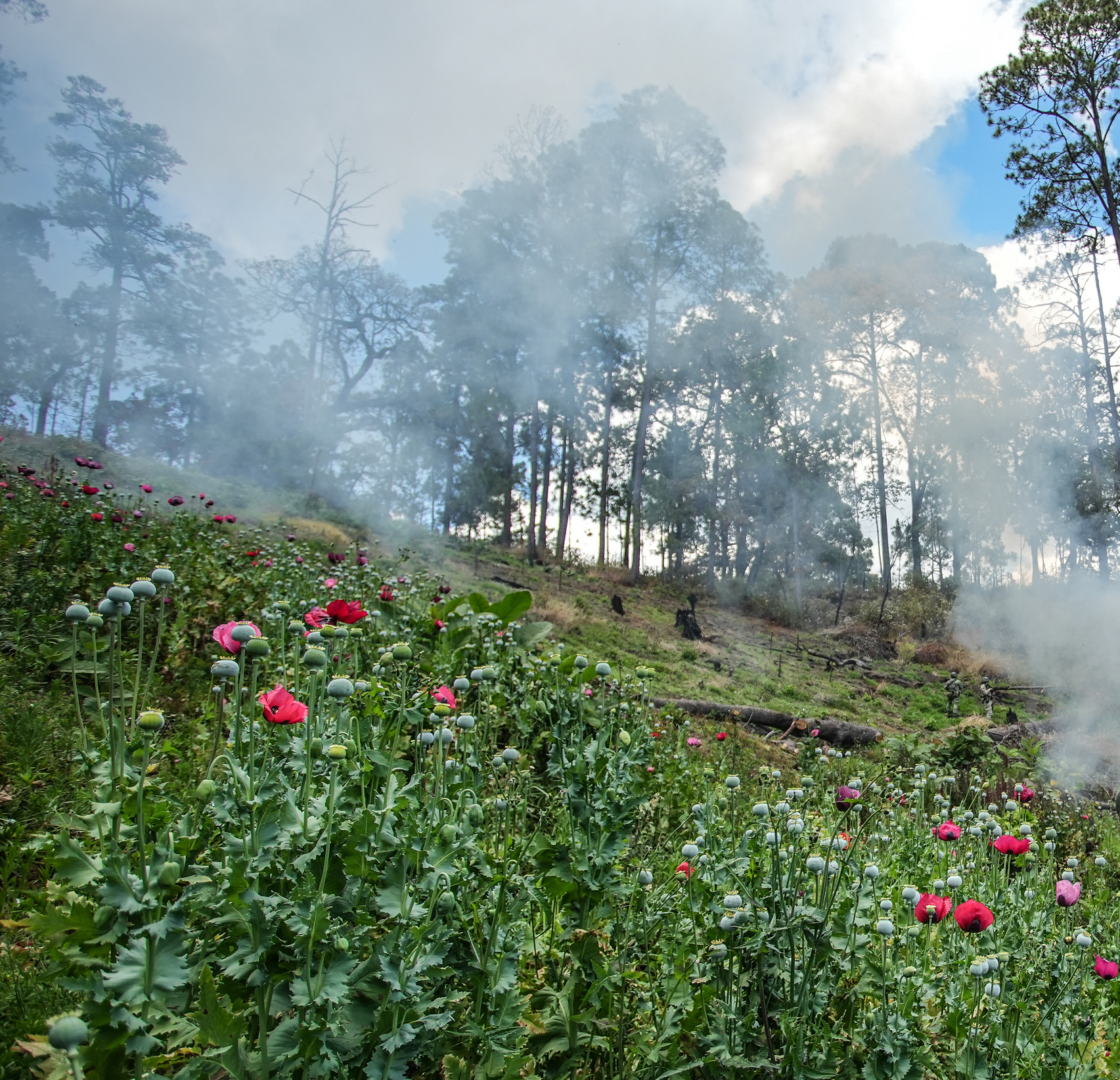
The expansion of fentanyl resulted in a recomposition of the drug market, altering not only the behavior of consumers in the US, but also the criminal strategies of Mexican cartels, with harsh consequences for the Mexican population. Fentanyl, being much cheaper and more potent than other drugs, reduced demand for traditional drugs such as heroin. This had a substantial impact on Mexico, the main supplier of heroin to the United States, responsible for approximately 90 percent of the heroin consumed in that country. This has harmed poppy farmers, who in 2019 reported a drop in opium prices of between 50 and 80 percent compared to 2017.10Le Cour Grandmaison, R., Morris, N., and Smith, B. (2019). The last harvest? From the US fentanyl boom to the Mexican opium crisis. Journal of Illicit Economies and Development, 1(3):312–329. Marginalized communities whose livelihoods depended on this crop were forced to migrate as a result11 Semple, K. (2019). Mexican opium prices plummet, driving poppy farmers to migrate. (<)em(>)New York Times.(<)/em(>)—between 2017 and 2020, the area under poppy cultivation decreased by 47 percent.12ONDCP (2021). The Office of National Drug Control Policy announces the third consecutive year of reduction in poppy cultivation and potential heroin production in Mexico. (<)em(>)The White House(<)/em(>).
Likewise, the drop in heroin profitability modified the behavior of Mexican cartels. While organizations such as the Sinaloa Cartel and the CJNG were able to adapt quickly by diversifying into fentanyl production, other criminal groups that relied heavily on the heroin business sought new sources of income. One of the strategies adopted was the extortion of legal sectors. Thus, the avocado sector— with exports exceeding $2.5 billion annually since 2016—became an attractive target for cartels.13 Own estimates based on information from SAGARPA. One factor that facilitated the cartels’ expansion into the avocado sector was the geographic proximity between the main poppy and avocado producing areas. For example, Michoacán, the main avocado producing and exporting state, borders Guerrero, responsible for more than 60 percent of national poppy production.14 Le Cour Grandmaison, R., Morris, N., and Smith, B, 2019. This geographic proximity—a result of the similar agro-climatic requirements for both crops—allowed the cartels to diversify their activities from heroin production to extortion of a sector that, in the last decade, experienced rapid growth as a result of increasing global demand.15De Haro, I. (2025). Avocados: Mexico’s green gold, drug cartel violence, and the US opioid crisis. (<)em(>)World Development(<)/em(>), (<)em(>)191(<)/em(>), 106942.
As a consequence of this diversification strategy, the avocado sector has suffered millions of dollars in losses due to product theft, as well as “derecho de piso” or rent charges against farmers, packers, and transporters. In the municipality of Tancítaro alone—the main avocado producer in the country—the local government estimated that, in 2014, the Knights Templar cartel obtained approximately $150 million annually in extortion from the avocado sector.16José de Córdoba, “The violent gang wars behind your Super Bowl guacamole,” (<)em(>)The Wall Street Journal(<)/em(>) (2014). https://www.wsj.com/articles/SB10001424052702303277704579349283584121344 This corresponds to almost 10 percent of the total value of avocado exports in that year. On average, seven to ten avocado trucks are stolen every week in the state of Michoacán, resulting in annual losses of up to $5 million.
Criminal diversification has also changed the patterns of cartel violence in Mexico. The reduction in demand for heroin increased the rate of homicides and violent robberies in municipalities with avocado cultivation; farm workers are often victims. In contrast, municipalities known for poppy production experienced a decrease in violence, both in the number of homicides and violent robberies.17 De Haro, 2025.
Despite the changes in violence levels, there is no evidence that cartels—including those previously involved in heroin trafficking—have shifted from poppy to avocado areas. Instead, the increase in violence in avocado municipalities appears to be driven by robbery and extortion by criminal groups already operating in the region, rather than by territorial disputes. Expansion into new areas implies high costs for the cartels, as it requires human resources and capital to compete with other groups. Although income from the avocado sector may help compensate for the loss of heroin revenue, these gains do not seem to justify the risk and investment involved in expanding into new areas under the control of other actors.18De Haro, 2025.
This pattern of diversification is evidence of a structural transformation in the cartels’ business model, modifying the use of violence to secure rents from legal activities. Thus, the fentanyl boom has contributed, albeit indirectly, to the increase in violence in areas conducive to avocado cultivation.
Public policies and international cooperation
The opioid crisis has highlighted the failures of strategies focused exclusively on supply reduction and the prosecution of criminal groups. While restricting the availability of synthetic opioids in illegal markets is essential, the experience of the first two waves of the epidemic shows that these measures alone are insufficient. The emergence of substances even more potent than fentanyl—such as carfentanil, up to 100 times stronger than fentanyl—and the remarkable capacity of criminal organizations to adapt to changing circumstances, speaks to the urgency of adopting comprehensive public policies that take into account the shifting behaviors of consumers and distributors.
This urgency becomes even greater when considering the limits of medical solutions. Although naloxone continues to be the main antidote to reverse the effects of an overdose, its efficacy decreases in the face of synthetic opioids of greater potency and duration, and a medical response now requires multiple higher doses.19Carpenter, J., Murray, B. P., Atti, S., Moran, T. P., Yancey, A., and Morgan, B. (2020). Naloxone dosing after opioid overdose in the era of illicitly manufactured fentanyl. (<)em(>)Journal of Medical Toxicology(<)/em(>), 16:41 48. In such an evolving context, it is essential to move toward a comprehensive approach that combines effective access to treatment for drug users with policies aimed at strengthening the health system and the social welfare of those at risk of addiction.
At the international level, the epidemic has generated diplomatic and trade tensions through the imposition of tariffs on China, Mexico, and Canada. These actions reflect a punitive logic that externalizes responsibilities and prioritizes political and economic interests over regional cooperation. In the case of China, the tariff war breaks with years of cooperation in the fight against fentanyl. A return to cooperation would be necessary to limit the flow of drug precursors from China to Mexico. The imposition of tariffs on Canada remains questionable given the minimal amount of fentanyl trafficked across the US-Canada border, which accounted for less than 0.2 percent of fentanyl seizures in 2024.20Own estimates based on information obtained from CBP. Meanwhile, in Mexico, the tariff track has been accompanied by the designation of cartels as terrorist organizations. This action would not only allow the United States to block financial flows to Mexico, but it could also be used to justify military and spy operations in Mexican territory.21Leire Ventas, “El gobierno de Trump designa a los carteles mexicanos y al Tren de Aragua como ‘organizaciones terroristas’: qué significa y qué consecuencias puede tener,” (<)em(>)BBC News Mundo(<)/em(>) (2025). https://www.bbc.com/mundo/articles/c805kp4eke5o
The Americans’ punitive approach has also rendered invisible the Mexican government’s policies in the last four years. Mexico has tightened control over “dual-use” substances, militarized ports and customs, increased the number of National Guard elements on the northern border, and approved a constitutional reform that allows for unofficial pre-trial detention for crimes related to the acquisition and trafficking of chemical precursors and synthetic drugs. These actions have generated significant controversy in Mexico, as they have strengthened military powers and eroded legal rights by violating the presumption of innocence.
Still, the current anti-drug policy of Claudia Sheinbaum’s administration lacks solutions to address the root problems of the trade. While a series of social programs have been implemented to reduce poverty, unimpeded recruitment by cartels remains an issue, and the government has gone so far as to deny reports of chemistry students being enlisted by the cartels for fentanyl production. While the Mexican government has pushed a preventative advertising campaign aimed at combating domestic demand for the substance, such action falls far short of resolving the major domestic ravages of fentanyl.22According to a report by the National Commission on Mental Health and Addictions (Conasama), in 2023 there were 430 cases treated related to fentanyl use in the country.
With its unrelenting focus on the Mexican government and its policies, the Trump administration’s diagnosis of the fentanyl crisis ultimately omits the role of the United States. The fentanyl trade has been intensified by the absence of domestic public health policies to address the American demand for drugs and the lack of regulation on US arms sales, allowing weapons to end up in the hands of Mexican cartels.23 It is unsurprising that (<)a href='https://www.gob.mx/presidencia/prensa/mensaje-traducido-al-ingles-de-la-presidenta-claudia-sheinbaum-pardo-al-pueblo-de-mexico-por-aranceles-de-estados-unidos'(>)President Sheinbaum(<)/a(>) has repeatedly brought up these shortcomings in the face of the tariff threat. Neither trade barriers or militarism will prove able to solve this transnational crisis of public health and armed violence.
Further Reading

Border Traffic
Ecuador in the global drug trafficking chain
The rise of Ecuador in the transnational network of organized crime is a relatively recent phenomenon. Although the country has supplied chemical inputs for cocaine...

The Tariff Threat
Mexico's fragile supply chains and North American trade policy
Mexico's current model of integration is vulnerable to external shocks. In order to protect its industrial base and establish sovereignty over its economic development, and...

Capturing Production
The USMCA and the automotive industry in North America
The implementation of the USMCA in July 2020 heralded major changes for the North American automotive industry, with increased regional content and fundamental labor rights...