September 4, 2025
Analysis
Green Dreams
Towards a green industrial policy made in Mexico
“Industrial policy is suddenly fashionable again; even those who once condemned it now claim they always supported it.” —Ha-Joon Chang
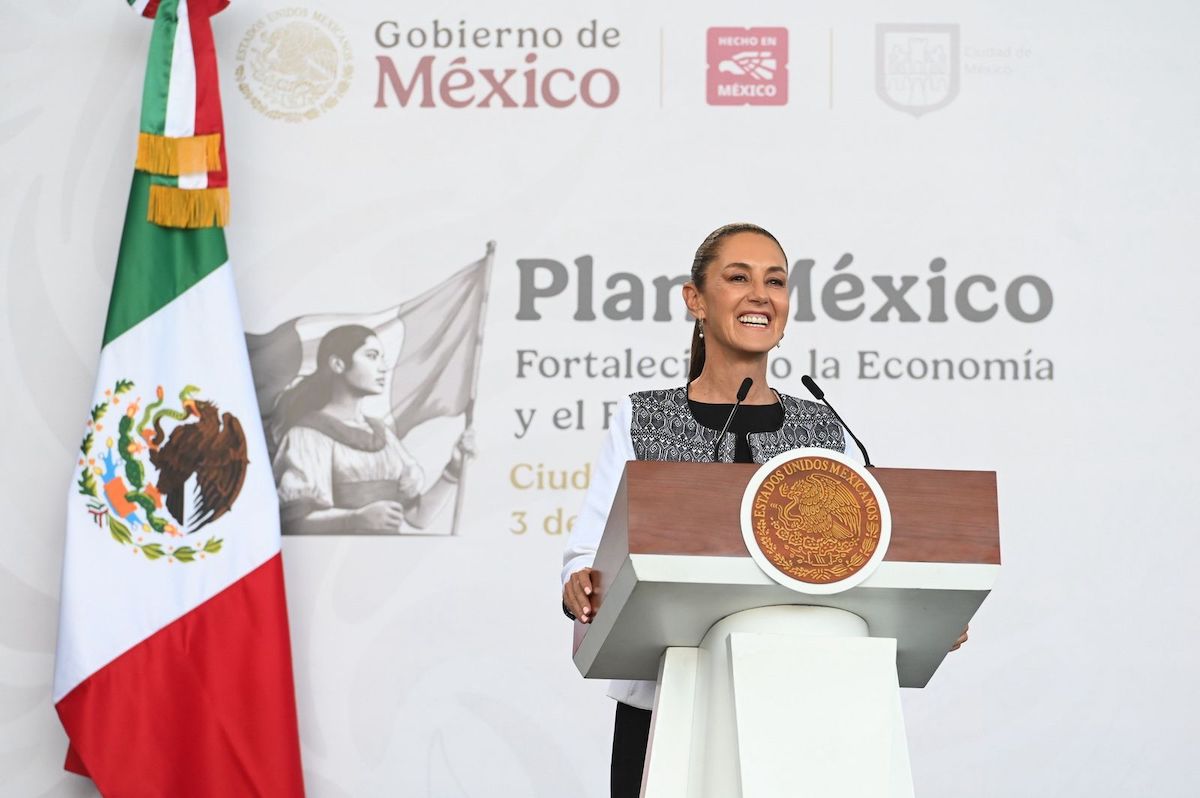
For decades, Mexican leaders have avoided the pursuit of a state-led industrial policy, opting to remain confident that open markets and trade liberalization would drive development. As a result, the Mexican economy remains in a difficult position, beleaguered by slow growth and low innovation. But a new path is on the horizon: the launch of President Claudia Sheinbaum’s Plan Mexico promises to align productivity, sustainability, and social justice. This turn towards state intervention has the potential to lay the foundation for a long-term, green industrial policy, with aspirations to be a regional and even global model.
Sheinbaum first presented Plan Mexico in January 2025, which aims to mobilize a portfolio of $277 billion in national and foreign investments toward a national developmental program. The plan, targeting thirteen goals, seeks to reduce poverty and inequality, generate employment, and grow Mexico’s economy, all while boosting national production in strategic sectors, promoting the adoption of value-added activities, and pursuing a green agenda. With the imposition of US tariffs demonstrating the need for greater economic resilience, Sheinbaum recently announced the acceleration of proposed policies meant to strengthen the domestic market. Entailing a significantly expanded role for the state in the national economy, Plan Mexico presents a radical departure from the economic policies that have governed Mexico for the past four decades.
Mexico’s earlier shift toward a neoliberal reform agenda was sparked by the 1982 debt crisis. The state’s response included trade liberalization, increased foreign investment, privatization, and fiscal discipline. Inspiration was drawn from the logic of the Washington Consensus, which frowned upon industrial policies, arguing that they generated market distortions. According to this view, the state ought to refrain from promoting strategic sectors, the best industrial policy being no industrial policy at all. Prior to this shift, from 1940 to 1970, Mexico had implemented strategic policies under an import substitution model that promoted industrialization through tariff protection, development banking, and state-owned enterprises. These decades represented Mexico’s golden age, during which the nation achieved an average real growth of 6 percent per year.1Banco de México, Historical GDP Growth in Mexico (1901-2020) https://www.banxico.org.mx/TablasWeb/informes-trimestrales/octubre-diciembre-2020/99B59D58-4537-4A19-A036-81D90F013EF1.html
The North American Free Trade Agreement (NAFTA), signed in 1994, consolidated the approach set out by the Washington Consensus, prioritizing free trade and export-oriented growth. This strategy used low wages to secure a competitive advantage and lacked coordinated policies to generate greater value-added activities, support local production chains, promote technological adoption, or strengthen national capacities. NAFTA was key in integrating Mexico with the US economy, deepening the country’s structural dependence on its northern neighbor.
The agreement hastened a transition from traditional sectors such as textiles, footwear, furniture and small-scale agriculture toward automotives, aerospace, electronics, and agricultural exports. A dual economic structure developed as a result of this shift. One the hand, exports integrated into global value chains utilized assembly processes with low national engineering and design content. On the other hand, a broad fabric of small firms remained trapped with limited access to financing, technology, and qualified human capital. The absence of active policies to support local suppliers, foster innovation, and scale up export sophistication prevented the gains of “new” sectors from spreading to the rest of the economy. As a result, total factor productivity stagnated, and Mexico recorded GDP growth rates of less than 2 percent per year between 1990 and 2014.2Claudia Schatan, Productive transformation, jobs and challenges for human capital formation in Mexico, Friedrich Ebert Stiftung Foundation, Mexico, December 2018, available at: https://library.fes.de/pdf-files/bueros/mexiko/15311.pdf This level was far below what was needed to reduce poverty, close wage gaps, or reach economic convergence with advanced economies.
Plan Mexico thus presents a rare window of opportunity to reverse these trends, seeking to reinvigorate national production through strategic industrial policies, directed toward generating employment, reducing poverty, and improving social conditions. But Sheinbaum’s vision for a coordinated industrial policy must overcome the challenges of a turbulent geopolitical environment, weak fiscal capacities, and longstanding political constraints on the Mexican state apparatus.
Consequences of the Mexican model
In the absence of a coherent federal strategy, several states in Mexico—among them Querétaro, Nuevo León, Guanajuato, Jalisco, and Aguascalientes—developed their own initiatives for promoting industrial clusters. These clusters attracted foreign investment and enabled labor specialization. As well documented, Nuevo León and Querétaro became two outstanding laboratories of industrial policy in the country. Nuevo León promoted a network of industrial clusters and now accounts for almost a tenth of Mexican manufacturing exports. Querétaro benefitted from eighteen years of institutional continuity in its Secretariat of Sustainable Development, which allowed it to grow from the automotive sector and become a national leader in aeronautics. The lessons are clear: state and municipal governments, closer to companies, universities, and workers, play a crucial role in shaping suppliers, fostering innovation, and increasing the national content of exports. This experience suggests that a green industrial policy for Mexico should be designed with a subnational perspective, strengthening the technical and financial capacities of local governments and coordinating policies and incentives around a long-term national vision.
Alongside broader national shifts towards neoliberal models in Latin American countries, other nations, including South Korea, Vietnam, and China, implemented well-coordinated industrial policies that allowed them to develop successful, globally competitive national companies and generate their own technological capabilities. Between 1980 and 2020, China recorded an average real annual growth of 9.2 percent, Vietnam 6.6 percent, and South Korea 5.5 percent, while Mexico barely reached growth of 2.2 percent. Today, faced with a new wave of green reindustrialization, the European Union, the United States, and Brazil have begun to mobilize hundreds of billions of dollars for public investment, favorable regulatory frameworks, and technological innovation directed toward the green transition.
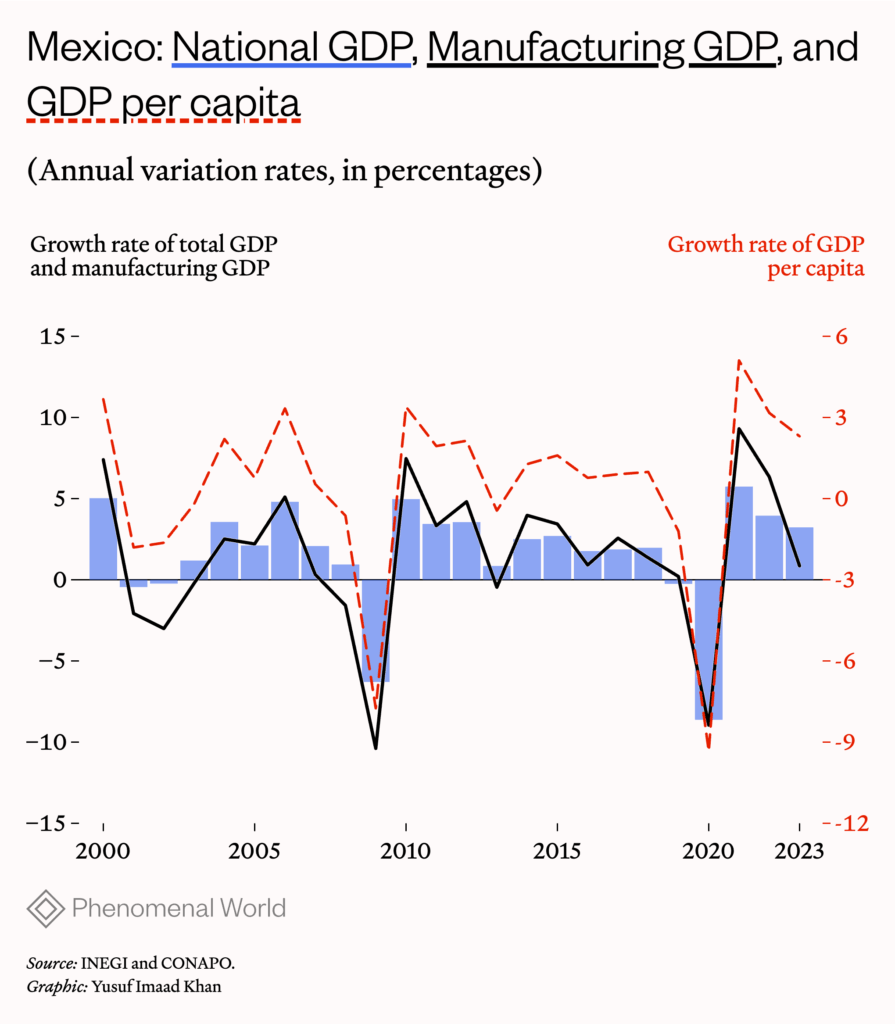
Since 2000, Mexico’s GDP has grown on average just 1.7 percent annually, while manufacturing—historically considered the engine of expansion—grew at an even slower rate of 1.5 percent. As a result, GDP per capita remained virtually stagnant, with an average variation of only 0.5 percent per year.
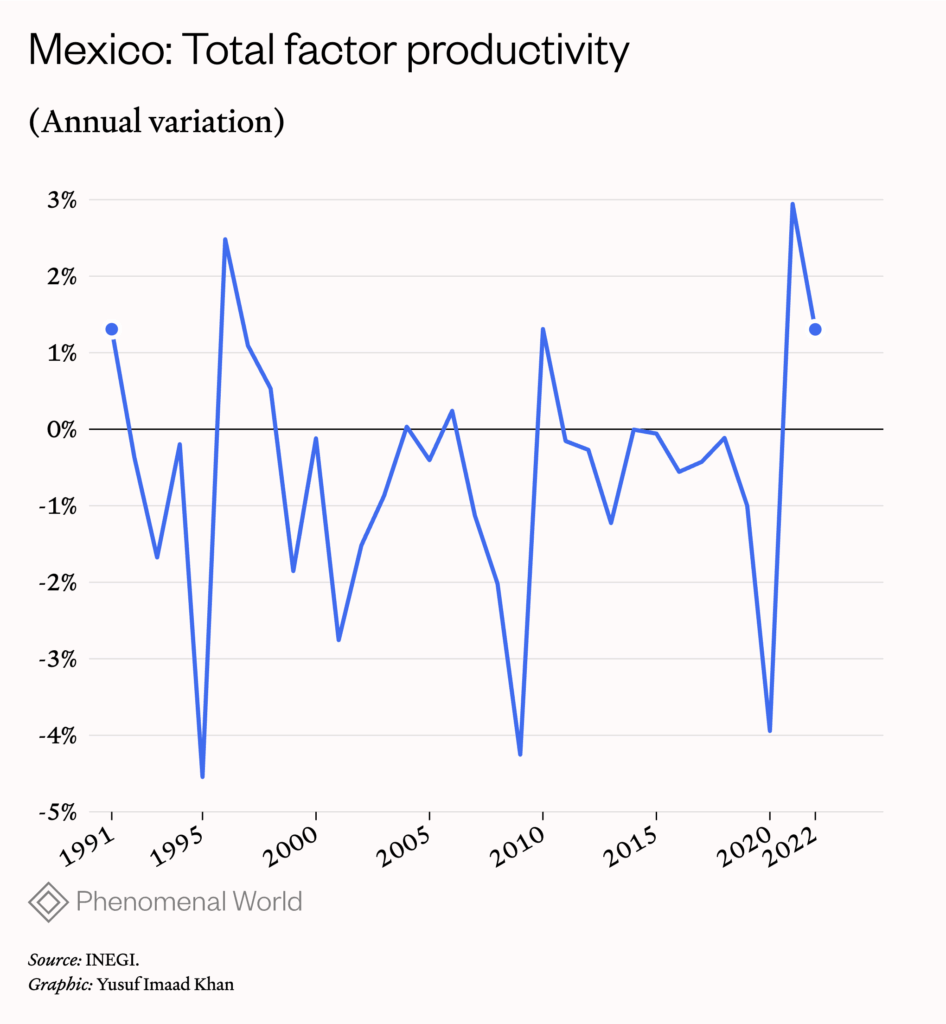
Between 1990 and 2022, the total factor productivity (TFP) of the Mexican economy decreased on average by 0.57 percent per year. This is largely explained by the prevalence of labor informality. In 2021, 55.8 percent of the employed population worked informally and generated just 23 percent of GDP, while the remaining 44.2 percent, formally employed, contributed 76.3 percent of GDP.
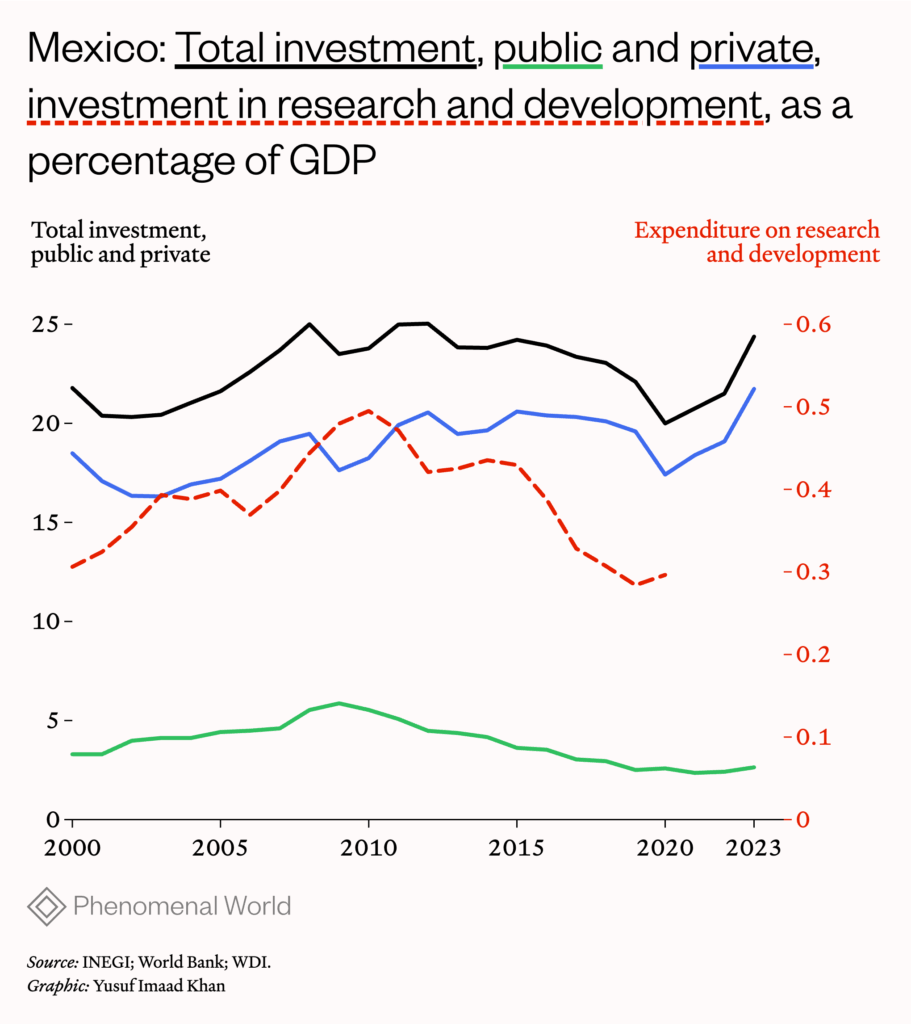
Low productivity limits quality employment, perpetuates poverty, and widens wage gaps. In 2022, 36.3 percent of the population (46.8 million people) was in multidimensional poverty, 7.1 percent (9.1 million people) in extreme poverty, and 43.5 percent failed to reach the minimum income necessary to afford a basic consumption basket. With such weak growth, Mexico has neither the tax base nor the necessary investment momentum to move toward a more sophisticated and sustainable economy. With revenue equivalent to 17.3 percent of GDP in 2022, the lowest in the OECD, the state lacks the capacity to finance social programs and strategic investments. Public investment in science, technology and innovation (STI) has particularly suffered, reaching just 0.27 percent of GDP in 2022, compared to an OECD average of 2.73 percent. Mexico stands far below economies in South Korea (5.21 percent), Germany (3.13 percent), or Brazil (1.15 percent in 2020).
Times are changing
With the arrival of Andrés Manuel López Obrador (AMLO), the government’s rhetoric shifted away from neoliberalism and sought to recognize the role of the state in the economy. In AMLO’s six-year tenure, all three economic ministers presented an industrial policy proposal. At the same time, the government promoted infrastructural projects and strengthened the role of state-owned companies such as the national petroleum company, PEMEX, and the Federal Electricity Commission (Comisión Federal de Electricidad, CFE). These initiatives, however, lacked a comprehensive framework that would link them to the promotion of strategic sectors, technological clusters, and innovation incentives that could generate spillover effects on the rest of the economy. Stronger public enterprises saw mixed results, as they lacked a clear strategy to move toward sectors with greater added value and sustainability.
Alongside these nascent industrial policies, AMLO’s government prioritized a social and labor agenda that heralded major achievements. A sustained increase in the minimum wage and greater regulation of subcontracting managed to reduce poverty (from 41.9 percent in 2018 to 36.3 percent in 2022) and increase formal employment. But social policies—prioritized by many progressive Latin American governments in recent decades—have their limits. In the case of Mexico, these achievements were unable to reverse low productivity and high informality, and they could not substantially expand the tax base. Fiscal and institutional capacities remain limited, and a full economic transformation has yet to take shape.
While the government rhetorically eschewed neoliberalism, it did not strengthen the state’s economic apparatus. The Ministry of Economy is particularly illustrative: its operational and technical capacities have been significantly eroded in recent years. Its budget represented 0.2 percent of federal spending in 2019, down from 0.5 percent of federal spending in 2013. Important units in regulation, export promotion, attracting foreign investment, and supporting entrepreneurship were eliminated without resources or alternative structures to replace them. As a result, the Secretariat was limited in its ability to implement a robust, long-term industrial policy.
The environmental agenda also lagged during this administration. The actual budget of the Secretariat of the Environment fell from around 82 billion pesos in 2017 to 39 billion pesos in 2019. At the same time, trusts were eliminated, suspending stable sources of funding for mitigation and adaptation. Emblematic projects (Tren Maya and the Olmeca Refinery) moved forward with express impact assessments and questionable social consultations, while in the electricity sector, the cancellation of renewable auctions and the reform to the Electricity Industry Law, which prioritizes the CFE’s fossil fuel dispatch, halted new solar and wind investments. This combination of cutbacks, prioritized fossil projects, and regulatory loopholes has undermined the state’s ability to meet its climate goals and lay the groundwork for a sustainable transition. Taken together, these decisions demonstrate the absence of a comprehensive approach that considers energy, economy, labor, and environment in a green, high value-added industrial policy.
The beginning of a green industrial policy?
Claudia Sheinbaum’s presidency has renewed aspirations for a broader economic transformation. Her administration explicitly recognizes the need to advance economic growth, environmental sustainability, and social justice through a long-term productive development strategy aimed at shared prosperity. Plan Mexico, conceived as the framework policy to advance in this direction, is emerging as the articulating force of this vision. Plan Mexico seeks to boost industrialization, strengthen national content in value chains, and reorient the economic model toward higher value-added sectors.
Sheinbaum, a scientist by training and a former member of the Intergovernmental Panel on Climate Change (IPCC), has placed renewed emphasis on the environmental agenda. During her tenure as Mexico City’s Chief of Government, she supported the Ciudad Solar project, the construction of two modern recycling plants, and a sustainable mobility model moving toward electric transportation and cycling infrastructure. Sheinbaum has elevated the environmental agenda to a national strategic priority. Her government has expanded electric trains, approved secondary legal reforms to accelerate the energy transition, promoted the first Mexican electric bus, and supported a circular economy pilot program in Tula, Hidalgo. Further major initiatives include the construction of the first national electric vehicle assembly plant —part of the Olinia project—and the launch of the Sol del Norte program in Mexicali, which will invest 200 million pesos to install 5,500 in residences. The state is once again positioning itself as a strategic actor in development, using public companies, particularly CFE and LitioMX, not only as operators, but also as key planning and investment instruments in the energy and productive transition.
Under Sheinbaum, those with solid international experience and technical backgrounds have been appointed to key cabinet positions: Alicia Bárcenaormer, former Executive Secretary of ECLAC, as the Secretary of the Environment; Marcelo Ebrard as the Secretary of the Economy; Luz Elena González as Energy Minister; Rosaura Ruíz as the Minister of Science and Technology; Julio Berdegué as the Minister of Agriculture; and Vidal Llerenas as the Undersecretary of Industry and Trade are all examples. The government has created a new business council, coordinated by Altagracia Gómez, to align the private sector with a new development model. The first months of Sheinbaum’s administration have already shown signs of better coordination between agencies compared to AMLO’s six-year term.
Unlike other countries in the region, Mexico has a relatively sophisticated productive capacity, which provides it with a realistic and ambitious platform to promote a green transformation. It has abundant renewable resources, strategic proximity to the United States, and a consolidated manufacturing base. The automotive and aerospace sectors, in addition to an emerging digital ecosystem and key segments of the semiconductor chain, can sustain economic complexity. Building on this foundation, the country has the opportunity to design new green industrial policies that simultaneously respond to contemporary geopolitical and climate challenges while meeting the urgent need for a more resilient development model.
A green industrial policy should not consider climate action and sustainability as restrictive conditions, but rather strategic levers to trigger investment, innovation, job creation, and competitiveness. The accelerated move in international markets toward green standards, clean technologies, and low-carbon value chains can turn sustainability into a competitive advantage. Delaying this transition would not only entail ecological and social risks, but also economic risks, as it would threaten access to strategic markets and expose the country to technological lag in carbon-intensive sectors with low-value-added activities.
Mexico has windows of opportunity in emerging industries, so its strategy must be anchored in principles of ecological viability. The country should prioritize clean energy-based sectors, promote environmental upgrading schemes, and consolidate the circular economy. This transformation, however, requires more than resources. It demands solid political coalitions, mission-driven roadmaps, and institutional structures capable of continuous learning. In this framework, the state must go beyond regulation and act as an investor in the first instance, technologically guiding productive trajectories and designing policies with a criteria of geographical equity, social inclusion, and environmental justice. Only with such attention will green industrial policy be able to reconfigure, rather than reproduce, the current structures of power and inequality.
Plan Mexico
Plan Mexico offers a compelling path toward a robust and sustainable industrial policy. Technically sound and well structured, the Plan has become a reference for key policies aimed at pursuing development and responding to the US tariff threat. Plan Mexico hinges on the active participation of the state, and broadens proposals introduced in previous years by including energy, infrastructure, communications, education, and innovation. Plan Mexico also pursues a broader geographical approach to recognize and address regional disparities.
Plan Mexico’s central objectives are to create quality employment, strengthen the domestic market, and promote national content and import substitution. The plan also establishes targets for training 150,000 more technicians and creating 1.5 million jobs in strategic sectors. In terms of public investment, the plan will support 145 CFE energy projects, create a fund to finance small and medium-sized enterprises, and develop passenger trains, highways, airports, and 100 industrial parks. The Minister of Economy Marcelo Ebrard stated in a recent article: “The priority is to focus on the productive transformation of the country. This implies designing and implementing an industrial policy that strengthens the national content of exports, reduces dependence on imports from outside the region, and develops more advanced productive capacities.”
To boost strategic sectors, the plan utilizes public procurement, tax incentives, digitized procedures, and financing via development banking, all while promoting an energy policy consistent with the green transition. The plan prioritizes the automotive and electromobility industries, semiconductors, pharmaceuticals and biotechnology, sustainable agribusiness, chemicals and petrochemicals, textiles and footwear, aerospace, digital technologies and water management. Despite the favorable political moment and the plan’s ambitious design, structural obstacles could still compromise the plan’s viability over time.
First, Mexico faces strong fiscal pressure, which has increased in recent years. At the end of 2024, the fiscal deficit reached a level of 5.7 percent of GDP, a level not seen in many years, which forced spending cuts in place of a comprehensive fiscal reform. This fiscal weakness severely limits the state’s ability to boost public investment. Between 2000 and 2023, gross fixed capital formation in Mexico averaged just 22.7 percent of GDP, compared to 39.1 percent observed in East Asia over the same period.
The design and implementation of a green industrial policy also requires complex and specialized state capacities, but the current institutional structure is weak. The Ministry of Economy and the Ministry of Environment and Natural Resources (SEMARNAT) have both suffered significant staff and budget cuts in recent years. There is also a paucity of experts available to train specialized teams to implement modern industrial policies.
Institutional weaknesses are not only technical, but also political. Mexico faces a political economy marked by elite coalitions that have historically operated under schemes of state capture, fiscal privileges, customized public contracts, and low competition. The ineffectiveness of industrial policy in Latin America is commonly blamed on these elite coalitions, and it’s important that Plan Mexico not be misused for extracting rents for economic groups close to political power.
Plan Mexico also confronts a new US protectionist policy led by the Trump administration, which has weakened Mexico’s economic integration with the US. New tariffs on steel, autos and electronics, as well as pressure to relocate supply chains, has shed light on Mexico’s key vulnerabilities—the country relies on a single market that purchases more than 80 percent of Mexican exports. The upcoming renegotiation of the USMCA will be key in defining Mexico’s strategic position in the continent. The automotive sector is a main issue of concern. Auto production is central to the national economy, but the sector faces high tariffs, which have added to the pressures of ongoing electrification and automation trends.
There are also legal uncertainties concerning Mexico’s political and economic apparatuses, and private sector actors have expressed concern about weakened institutional counterweights and regulatory ambiguities. The recently approved judiciary reform—which is poised to replace the country’s established judiciary with newly elected officials—has intensified concerns about respect for the rule of law, judicial autonomy, and regulatory predictability. The cancellation of renewable projects, retroactive changes in public contracts, and uncertainties in the electricity sectors have contributed to the deterioration of the business environment. These ongoing concerns may slow long-term investments, especially in capital- and technology-intensive sectors. Rebuilding confidence will require a long-term permanent strategy and commitments to strengthen the rule of law and guarantee the autonomy of regulators.
From ambition to foundation
Mexico today faces a decisive turning point. Not only did President Claudia Sheinbaum come to power with resounding support—61 percent of the vote—but she has maintained historic levels of citizen approval and holds sufficient legislative backing to advance structural reforms. The combination of political legitimacy, institutional alignment, and productive assets means that Mexico now has an opportunity to pursue a long-term development policy, one which has been absent for more than four decades.
This transformative agenda will require three key components: a strategic and participatory governance architecture, a solid and progressive financial system that guarantees sustained investment, and a state with the technical and institutional capabilities to lead complex processes. With this in place, the Mexican government will be able to coordinate with subnational governments, select sectors having structural impact criteria, and channel foreign investment toward national objectives.
The success of Mexico’s green industrial policy will not depend solely on presidential impulse or the volume of available resources, but on the state’s capacity to design, coordinate, and execute complex strategies consistently in a changing environment. Mexico’s history is replete with cases of well-intentioned plans failing due to a lack of operational capacity. To avoid this fate, governance must combine central leadership at the highest level, interministerial coordination, and regional reach. Industrial policy must also be to survive in the long term, persisting beyond political cycles, avoiding captures, and responding to the technical and political challenges of the productive transformation process.
Governing this agenda requires overcoming three historical obstacles: institutional fragmentation, fiscal weakness, and the disconnect between public policies and regional capacities. We must not only design new institutions, but also strengthen existing ones, provide them with qualified personnel, budgetary stability, and technical capacity. In Mexico, the federal executive branch must coordinate with the private sector, state governments, universities, and the general public. Along these lines, we should support initiatives that promote dialogue on sustainable industrial policies, such as the Oxford-Mexico Industrial Policy Co-Lab, a platform that supports collaboration between researchers, the state, and the private sector.
Also at stake is the state’s fiscal muscle. With a revenue collection of only 17 percent of GDP—the lowest in the OECD—Mexico lacks the resources necessary to sustain a productive transformation. How can an industrialization strategy then be aligned with a new progressive fiscal pact, one that allows the financing of strategic public goods? Efforts to strengthen development banking, mobilize green funds, and design new financing instruments will not be sufficient without a fiscal horizon that ensures stable, predictable, and strategically allocated resources.
Green industrial policy cannot be implemented with weakened institutional structures and limited technical teams. Reversing the process of institutional erosion in key areas such as economics, science, energy, and environment is as urgent as it is complex. It involves rebuilding technical capacities, reactivating interinstitutional cooperation, and connecting knowledge systems with productive development priorities. Without this foundation, policies could become fragmented, inconsistent, and short-term.
A central challenge is building an industrial policy that recognizes and strengthens the productive capacities and vocations of Mexico’s diverse regions. Plan Mexico attempts to do this, but its success will depend on state and municipal capacities. Replicating, adapting, and scaling up these experiences could foster a decentralized productive transformation, one which prioritizes local design and considers local linkages, technological capabilities, formal employment generation, environmental impacts, geopolitics, and social welfare.
Finally, the role of foreign direct investment, historically treated as an end in itself, should be reevaluated. Attracting capital is necessary, but not sufficient. Investment must be channeled toward clear goals, such as supplier development, technology transfer, talent training, and environmental sustainability. To achieve this, it is essential to build a new institutional framework that replaces the passive logic of the past with an active strategy that articulates a sectoral focus. International experience shows that this can be achieved when the state is clear about the type of investment it is seeking, the conditions under which investment is accepted, and the quid pro quos investment requires. Still, policy capture by special interests, bureaucratic fragmentation, and political reversals remain looming threats. External shocks—most notably changes in US trade policy and energy crises—demand institutional resilience. Mexico thus needs stronger mechanisms for accountability, citizen participation, and constant evaluation.
A new industrial policy brings forward the possibility of building a new productive contract, one based on its own capabilities, social inclusion, and sustainability. This economic transformation cannot rest exclusively on technical design or the typical political calculus. Rather, it requires strategic leadership, strong institutions, and popular support. If Mexico succeeds in building this foundation, it could advance a fairer and more resilient development model, one which attests to how a middle-income country can reindustrialize without repeating the mistakes of the past.
Further Reading

The Fourth Transformation
The political economy of Claudia Sheinbaum’s popularity
As anti-incumbent sentiment toppled governments around the world in 2024, Mexico’s Morena won in a landslide, and the presidency was passed from Andrés Manuel López...
How Mexico Doubled the Minimum Wage
Monopsony, corporate power, and the labor market
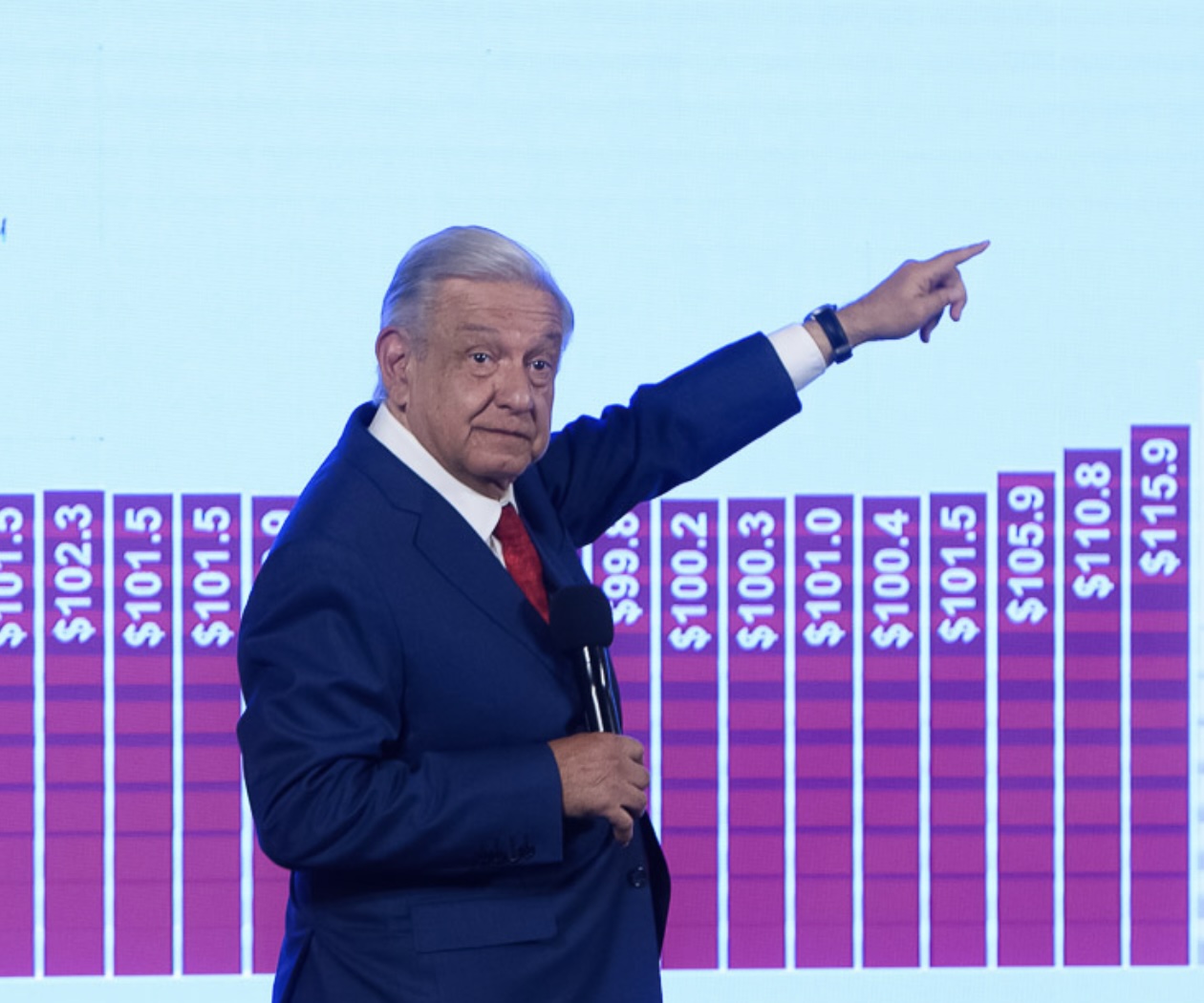
The minimum wage in Mexico has more than doubled in real terms over the last six years. This is no small feat, especially if we...

Capturing Production
The USMCA and the automotive industry in North America
The implementation of the USMCA in July 2020 heralded major changes for the North American automotive industry, with increased regional content and fundamental labor rights...