August 27, 2025
Analysis
Growing Pains
Spain’s search for a new growth model
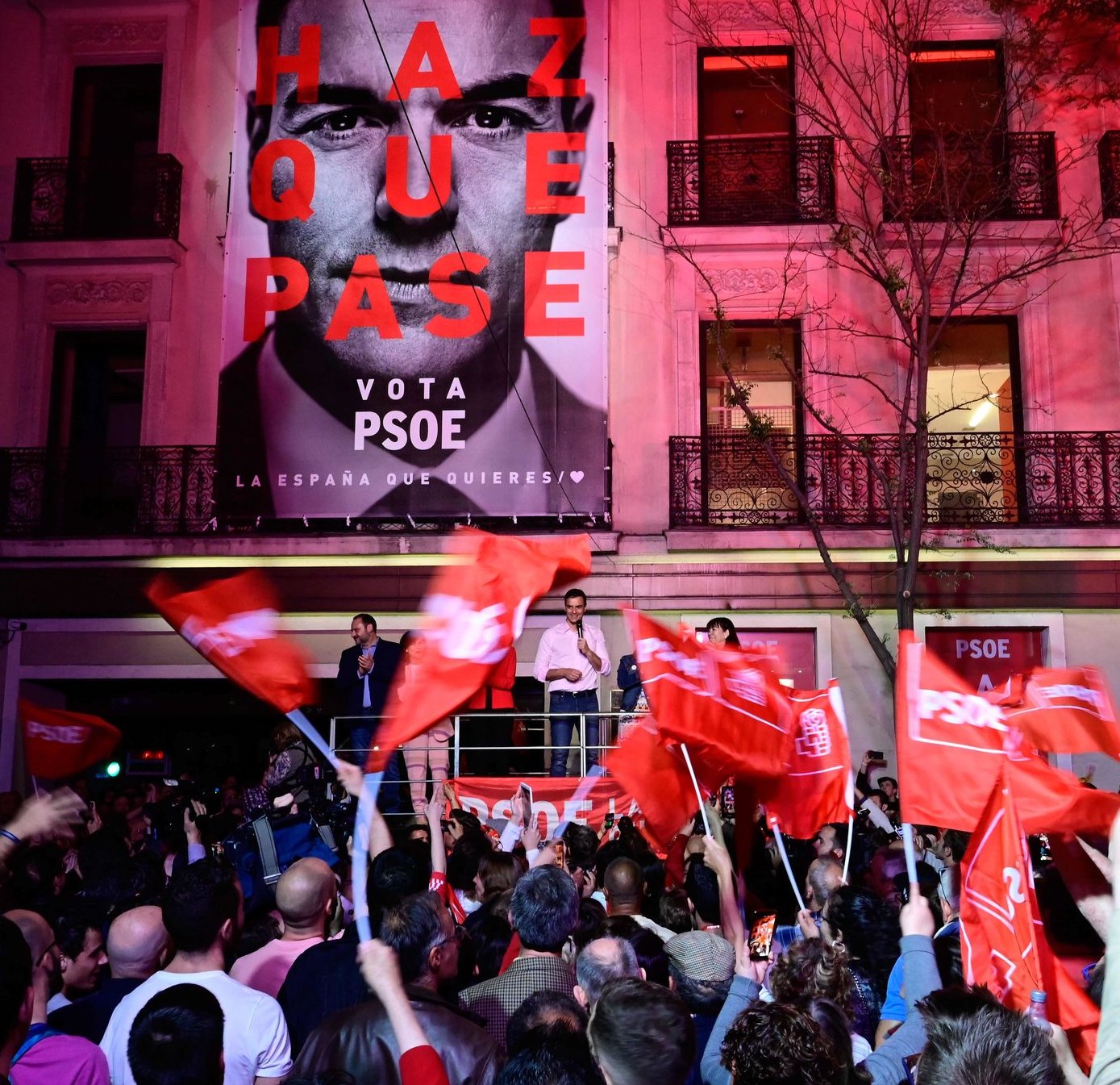
Figueruelas, a small village near Zaragoza, is about to triple its population size. Throughout 2026, 2,200 Chinese workers will arrive to build the European Union’s largest lithium-iron phosphate battery factory. Backed by a €4.1 billion investment from a CATL-Stellantis partnership, as well as funding from Spain’s Next Generation EU strategic investment program (PERTE), the project is set to create 3,000 jobs from 2027 onwards. In a geopolitical irony, it was General Motors who first set up shop in Figueruelas, opening an Opel assembly plant forty years ago.
The CATL-Stellantis project exemplifies Spain’s ongoing developmental ambitions. In power since 2018, center-left Prime Minister Pedro Sánchez has overseen a striking takeoff of wind and solar power across the country. Renewables generated close to 150 GWh in 2024, up 10 percent from previous years and representing 57 percent of the country’s energy mix. Cheap energy is key to drawing foreign investment, which in turn reorients Spain’s economy toward value-added sectors—electric batteries and vehicles, semiconductors, data centers, perhaps green hydrogen. Eventually, this process may serve to replace or at least balance the country’s historic growth model, which is overreliant on tourism, real estate, and low-paid, seasonal employment in low-productivity SMEs.
This developmental pathway comes with international and domestic implications. “Liberation Day” caught Sánchez meeting Xi Jinping during his third visit to China in the space of three years. He has so far avoided the subservient relationship that other European leaders have developed with Donald Trump, and demands the EU reconsider its tariffs on Chinese EVs. The Spanish government has also recognized Palestinian statehood, supports efforts by the International Court of Justice and the International Criminal Court to prosecute Israeli war crimes, and keeps pressing for a EU-wide weapons embargo. It has challenged NATO’s push to increase military spending to 5 percent of GDP, provoking an angry backlash from Trump during the Alliance’s recent summit in The Hague. The government’s international priorities lie elsewhere: in a recent United Nations summit hosted in Seville, Sánchez pledged to reach the 0.7 percent of GDP threshold for development aid by 2030.
Domestically, the government also swims against the tide of global reaction. Migration is a case in point. Spain has received almost 1.5 million migrants—mostly from Latin America and Morocco—in the last three years. These new arrivals, once integrated into the labor market, drive close to four-fifths of economic growth. A legislative initiative to grant regularization and an eventual pathway to Spanish citizenship for almost half a million undocumented migrants is underway. Its track record on civil rights is also impressive, featuring laws that expand trans rights and regulate euthanasia.
A simultaneous drive to broaden and deepen social rights across the country has witnessed the minimum wage rise by 61 percent in six years (to slightly above €16,500/year), as well as the implementation of a minimum income scheme in 2020. Energy price caps, approved at the European level, have played a critical role reducing inflation from 2022 onwards. Paternity leave has been expanded to nineteen weeks for each parent, up from five in 2018. The Labor ministry’s key proposal in this legislature involves reducing the workweek to 37.5 hours.
Taken together, these policies reflect a decision to not face an era of intensifying crises with further austerity, which has, since the 2008 financial crash, led to stagnant growth, ballooning unemployment, and social unrest. They also signal that Spain, led by the Spanish Socialist Workers’ Party (PSOE), is positioned as Europe’s last progressive government, notwithstanding those of smaller countries (Malta, Iceland) or those actively courting right-wing voters (Slovakia, Denmark, the United Kingdom). Importantly, to shore up constituents, the PSOE has relied on making alliances with several smaller parties and the radical left. Currently, the PSOE is part of a government coalition with Sumar, an alliance of small parties stitched together in an unstable arrangement, led by Labor Minister and deputy Prime Minister Yolanda Díaz, who is the architect of a labor reform law that has successfully reduced temporary unemployment. The junior coalition partner plays a minor but critical role steering the executive to take bolder positions, both domestically and overseas.
This heterodox governing arrangement has proved successful even by orthodox metrics. While the impact of Covid-19 was dramatic in an economy with a large services sector and a preponderance of small firms, Spanish growth has since rebounded: above 6 percent of GDP in 2021 and 2022, and between 2.5 and 3 percent in 2023–2025, far ahead of most other European economies. In December, The Economist upheld Spain as an example for the EU and placed it at the head of its OECD performance ranking. The Wall Street Journal, Financial Times, Goldman Sachs, and Bloomberg have delivered similar accolades.
On paper, the model seems a left-wing counter to both Trumpism and European austerity. Sánchez’s achievements stand out further when compared to the disappointing track record of contemporary center-left leaders, such as François Hollande, Olaf Scholz, or Keir Starmer. In practice, however, the Spanish government faces a fraught juncture both at home and abroad. Polls regularly give the conservative People’s Party (PP) and far-right Vox coalition an absolute parliamentary majority. It remains unclear whether the current government will be able to survive through the present legislature, which should last until mid-2027.
How can an administration that enacts a successful progressive agenda—and a party that retains and even increases its share of voters while handling a succession of unprecedented crises—become so fragile electorally? To grasp the extent of this vulnerability, it is necessary to understand the coalition’s trajectory and governing dilemmas, the limits of Spain’s new and old growth models, and the EU’s shifting security and macroeconomic priorities.
Between redistribution and decentralization
The government’s present ordeals are intertwined with those of its leading party. It is worth noting that Spain’s socialists, unlike other center-left European forces, have remained electorally competitive both quantitatively (in power for twenty-eight out of the forty-seven years since the restoration of democracy) and qualitatively, as they still command critical support from low-income voters. Their key to electoral primacy lies in electoral and governing strategies that cement continuity in the party’s style while granting it flexibility during critical junctures.
A central element in these strategies is the PSOE’s relationship with other parties of the left, which at times have challenged its hegemony. As the left-right divide remains profoundly salient in Spain, and is historically correlated with income levels, leading a progressive bloc is key to establish a dominant position within the Spanish party system. This can be achieved by coopting left rivals rhetorically and tactically, opposing them, or developing a combination of cooperative and adversarial tactics.
The PSOE’s strategy during the Felipe González years (1982–1996) relied on displacing forces to its left and aligning Spanish society with a broad modernization project. EU accession in 1986, as well as the 1992 Barcelona Olympics and Seville Universal Expo, were showcased as prime examples of what it meant to become an open society and transcend the dictatorship’s backward isolation. This somewhat apolitical drive toward social progress came hand in hand with economic liberalization, pitting the socialists against the broader left, including their own union arm, which broke with the party during the 1988 general strike.
Prime Minister José Luis Rodríguez Zapatero, in power between 2004 and 2011, sought to recalibrate this model with an inclusive civil rights agenda (featuring an impressive advancement of LGBTQ+ rights) as well as a more cooperative relationship with forces to the party’s left and regionalist Basque and Catalan parties. But this experiment was cut short by the 2008 financial meltdown and the successive adoption of austerity policies, which Zapatero undertook out of a commitment to the European integration process.
During his first stint (2014–2016) at the helm of the PSOE, Sánchez, with the PP in power, followed an orthodox script. He attempted to sideline the left populist upstart Podemos, which threatened to become Spain’s leading progressive party, and then tried—and failed—to govern with a centrist, now-defunct party. Once Sánchez refused to abstain and allow the PP’s Mariano Rajoy to continue governing, however, he was ejected from the party leadership by the socialist old guard that had placed him there to begin with.
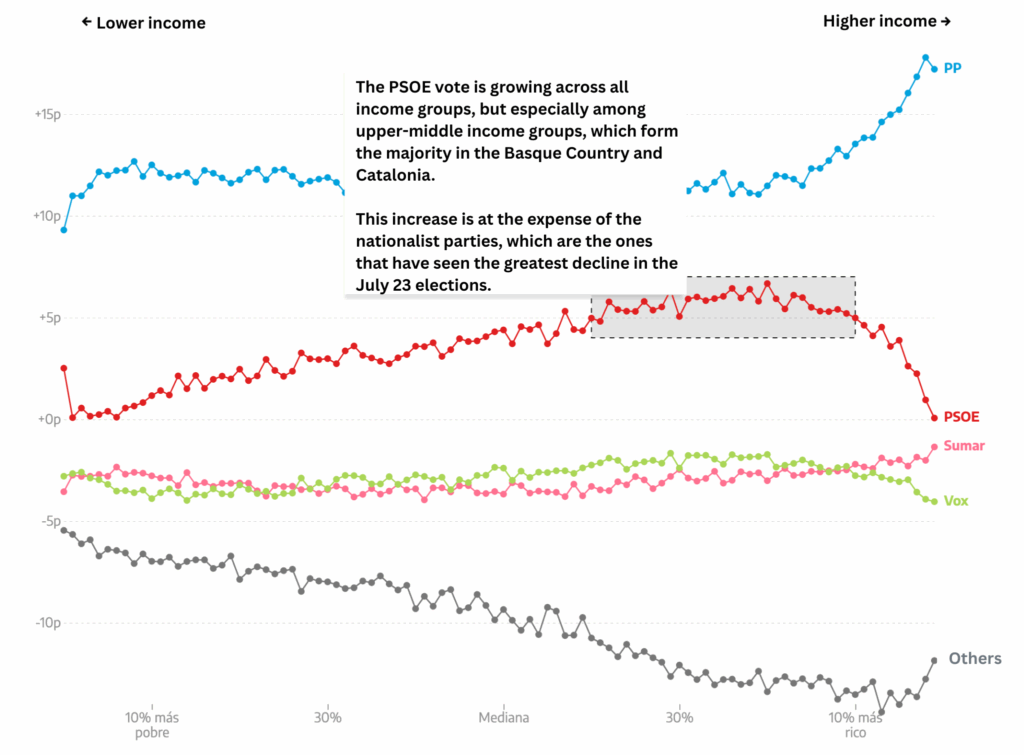
Reinventing himself as a firebrand, Sánchez won the 2017 primaries against the entire party establishment. One year later he won a no-confidence vote, following a judicial ruling on a decades-long corruption scandal that involved a sizeable part of the PP’s leadership, including Rajoy. Since then, he has governed not just with support from the broader left, but also from regional pro-independence parties. In addition to a left-leaning economic agenda, Sánchez has pursued progressive social policies and furthered the devolution of powers, especially in Catalonia and the Basque Country. This combination of redistribution and decentralization allowed the government to weather the July 2023 elections—where polls almost invariably gave the right bloc a majority—welding the center-left’s traditional low-income base with wealthier voters in Catalonia and the Basque Country, among whom the PSOE made significant gains.
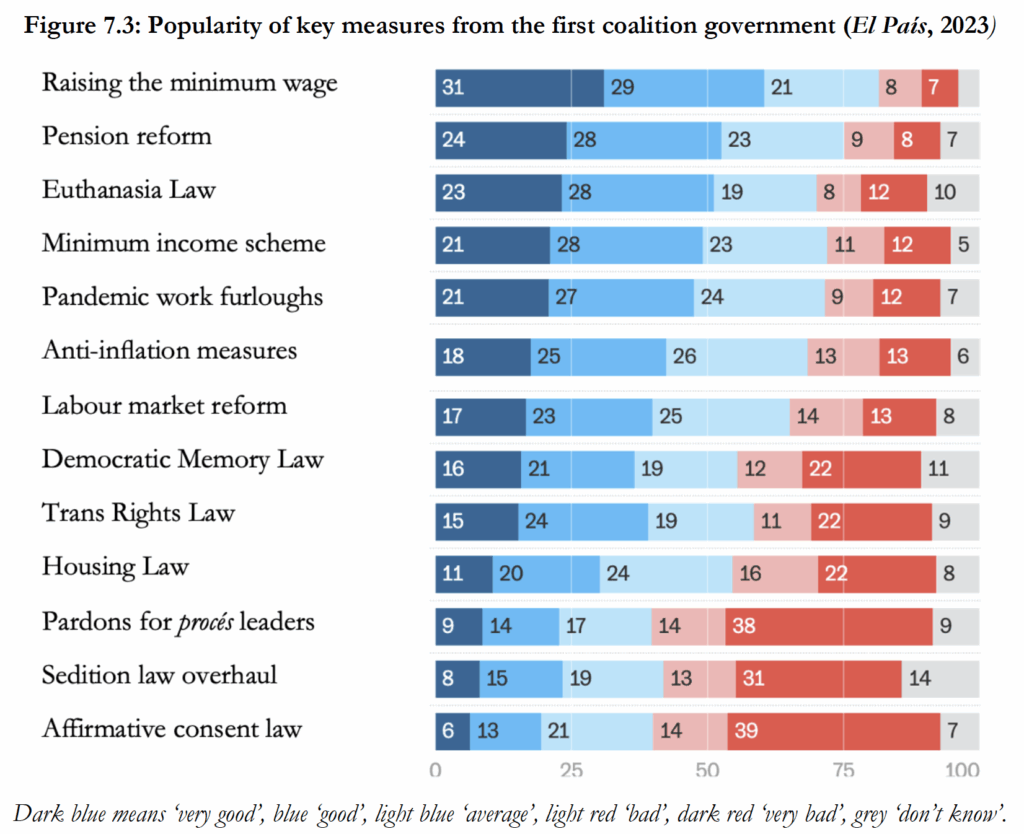
Since then, however, securing parliamentary support has become a vexing affair. The reason for this is that while the government scraped by on an unexpected victory, it now depends on support from center-right Basque and Catalan parties. These tolerate the executive because they fear a re-centralizing drive from the PP and especially Vox, but—unlike their left-wing regional rivals—will not approve progressive economic legislation. It is worth noting that, while decentralization is critical to maintain the support of regional parties, the government’s redistributive policies garner far broader public support and allow it to shore up most of its voting base.
Source: Cadena SER
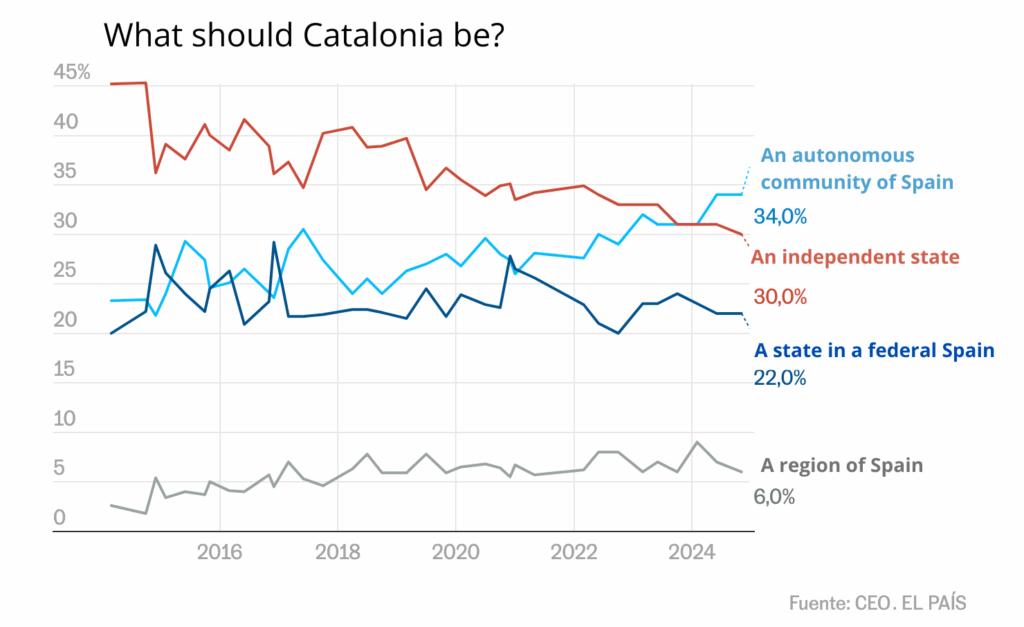
Sánchez’s accommodative stance vis-à-vis Catalan nationalists has, somewhat paradoxically, reduced pro-independence feelings from their mid-2010s high. The cooperation of the PSOE toward devolution is in sharp contrast to the Rajoy government’s half-dismissive, half-confrontational approach, which led to clashes between riot police and peaceful protesters, a strengthening of the pro-independence bloc, and an unilateral secession attempt in late 2017, followed by a brief suspension of Catalan self-government. But reconciling redistribution and decentralization has become increasingly fraught. In exchange for their present support, pro-independence leaders have received an amnesty for their involvement in the 2017 events—a demand that Sánchez had previously refused to consider, which galvanizes the Spanish right while splintering the socialist electorate. A fiscal deal between the Spanish and Catalan government, which would enhance the latter’s capacity to collect taxes while reducing its contribution to the former, cements the impression that Sánchez now pursues decentralization at the expense of redistribution and is hostage to the demands of pro-independence leaders. The fact that Catalonia and the Basque Country rank among Spain’s richest regions facilitates the right’s embrace of this discourse, even if it is largely uninterested in redistribution.
Source: El Diario
At the same time, Podemos has broken ranks with Sumar, growing loudly critical of the government. The party has even joined the PP and Vox in a number parliamentary votes to weaken the executive. The main effect of these attacks has been to make both Podemos and Sumar crater in polls, and to entrench parliamentary stasis. The government has not been able to approve a new budget since 2023, and its legislative agenda is largely on hold.
This vicious cycle is aggravated by constant clashes with Spain’s judiciary. While a number of right wing judges have sought to pressure the government on spurious claims, other revelations have highlighted massive liabilities within Sánchez’s close circle. Key here is a wide-ranging corruption scheme involving kickbacks from infrastructure giant Acciona to two former socialist organization secretaries (the party’s second-ranking position), one of them Transport Minister in 2018–2021 and the other held in pre-trial custody. The sordidness of the affair—which involves leaked audios where they debate their preferred escorts—and the fact that Sánchez’s rise to power came hand-in-hand with a commitment to eradicate the type of party corruption that had brought down Rajoy, have placed the Prime Minister in a vulnerable position. Displaced party rivals are now taking their opportunity to strike back and demand early elections.
This vulnerability is compounded by the spread of misinformation on social networks. Vox spends every summer fanning the flames of xenophobia in an attempt to cause riots. Recent emergencies (a flood in Valencia, dramatically mismanaged by regional authorities and leaving 228 dead; an electricity blackout that affected the entire country for a whole day; and a catastrophic succession of wildfires in northwestern Spain) were invariably seized upon by extreme right agitators to criticize the government. In both cases, the executive’s sluggish communicational response opened an avenue for further radicalization. The PP’s decision to follow Vox down the path of polarization, recurrently depicting the Prime Minister as an “autocrat,” adds fuel to the fire.
As things stand, the economy remains Sánchez’s saving grace. But even here the government faces significant headwinds and tradeoffs.
The limits of Spain’s growth models
Spain’s relatively strong economic performance in recent years no longer buoys the government’s electoral base. The reason for this has to do with the fact that Spain—similarly to the United States—seems caught between its new and old growth models. If the present trajectory of more affordable solar power and sustained foreign investment in value-added sectors holds, Spain can become a critical energy exporter within the EU while developing a more dynamic and diverse workforce. But this transformation is still in its budding stages. In the meantime, the Spanish economy has not shaken off the dysfunctionalities of its traditional growth model, which is overly dependent on tourism and real estate.
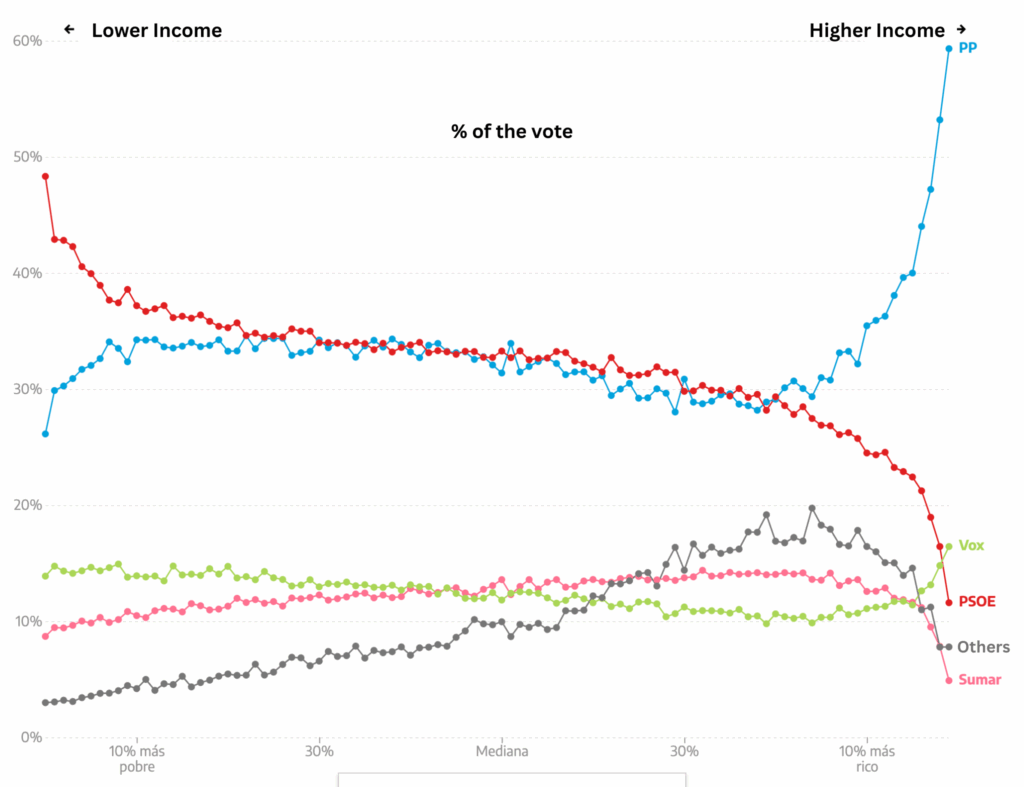
Source: El Diario
The first of these dysfunctionalities is unemployment. While the jobs market is now tighter than at any point after the 2008 crash, Spain continues to lead the EU in youth unemployment, which is half of what it was at the height of the Eurozone crisis but still a massive 25 percent for ages 16–24. Structural unemployment holds above 10 percent of the workforce, as does the proportion of working poor.
This situation is aggravated by an overheated housing market. The combination of increased demand, coupled with insufficient supply—from the private but more pointedly the public sector, which in recent decades has abrogated its role as a provider of social housing—and speculative practices from both homestaying apps, local landlords, and transnational hedge funds has led to ballooning rent prices: almost 80 percent percent in a decade, and above 100 percent in large cities like Madrid and Barcelona.
This juncture presents critical tradeoffs for the government. Close to three quarters of Spaniards are homeowners, and partially benefit from soaring real estate prices. But this dynamic makes it impossible for younger Spaniards to access a mortgage, the traditional avenue to achieve middle-class status. It also places extraordinary pressure on tenants, who are increasingly organized and combative.
The Socialist Party draws votes from all these cohorts, and therefore faces the electoral dilemmas generated by an asset economy. The Housing Ministry equivocates between cracking down on speculation and adopting rentier-friendly policies without fully satisfying the demands of either tenants or landlords. Furthermore, housing policy is largely a prerogative of regional governments, the majority of which are in the hands of PP/Vox alliances and therefore hardly interested in regulating the sector. The government is thus blamed for a problem it has both limited capacity and willingness to solve.
Together with real estate, tourism is the mainstay of present economic growth. It represents 13 percent of GDP, with a staggering 100 million visitors expected to arrive in 2025: twice the number of both all tourists in 2000 and the entire Spanish population today. Besides being associated with rentier dynamics, low-productivity, and temporary jobs, it compounds the housing problem. Over 400,000 apartments and houses are presently geared towards tourists. Government-led attempts to regulate this sector meet both the hostility of homestaying platforms and feet-dragging from conservative municipal governments in key cities like Málaga and Madrid. In Barcelona, fines against AirBnB and attempts to control rental prices have succeeded at driving down standard rates, but have also led to a spike in seasonal rentals, which largely avoid existing regulations.
Finally, the limited distribution of economic growth dampens its electoral payoff. If during the Rajoy years growth was almost entirely captured by top income earners, presently it largely reflects the increase in the Spanish labor force through migration, which fills up to 90 percent of new jobs and drives 80 percent of economic growth. As political economist Margarita León points out, “we are growing because there’s more of us, not because we live or work better.” At the same time, the Spanish welfare state is not designed to provide inclusive and universal coverage, and reducing income inequality has owed more to successful labor policies than to a redesign of social protection. This progress could be reversed if the housing crisis remains unresolved and migrant workers are not incorporated into the welfare state.
The old growth model, in short, cannot accommodate an inclusive jobs market and a much-needed reduction in housing prices. It is also threatened by the climate emergencies that Spain already faces, starting with extreme heat throughout the main tourist season (June–September). But an alternative growth model has yet to develop to the point where it can stabilize the government’s electoral base. As Paolo Gerbaudo points out, the rate of Spain’s economic transformation “offers insights on the possibilities and limitations of a market-oriented productivist industrial policy focused on regulation and leveraging private investment.”
National growth models are unlikely to change in the absence of deep crises, external intervention, or both. In this regard, EU-level dynamics are critical. While European funds during the post-pandemic years steered the change toward the green growth model, the European Commission’s present turn towards rearmament and US subservience offers no comparable opportunities. On the contrary, it poses considerable threats to the government’s agenda.
From NGEU to rearmament
Until recently, the EU’s orientation enhanced the government’s progressive goals. The activist response to the Covid-19 pandemic, featuring coordinated investment in vaccines and ambitious recovery plans (Next Generation, SURE, and the European Central Bank’s pandemic emergency purchases program), as well as a four-year suspension of fiscal rules, secured a robust recovery across the EU, in stark contrast to the 2008 crisis.
This was not an exogenous windfall, but a reflection of the balance of power within EU member states. In the critical weeks that followed the Covid-19 outbreak, Southern European governments, supported by anti-austerity forces that had risen throughout the austerity years (Podemos, Italy’s Movimento 5 Stelle, Bloco de Esquerda in Portugal) managed to join forces with France and convince the German government to support a coordinated, mutualized response to the sanitary and economic crisis. Sánchez combined his credentials as a progressive leader with the orthodox bona fides of his Economy minister Nadia Calviño (2019–-2023) to secure a generous NGEU package, featuring close to €80 billion in non-repayable grants.
At home, the recovery program stabilized the left and center-left alliance. Abroad, it allowed Sánchez to develop a strong relationship with Commission President Ursula von der Leyen. In 2024 he secured a powerful vice-presidency for former deputy Prime Minister Teresa Ribera, presently in charge of both EU climate and competition policies.
Last year’s European Parliament elections, as well as the subsequent reactionary shift across several member states, have nevertheless solidified a rightward drift across the Union. The ongoing rearmament drive, reflected in both the EU preparedness plan and the recent NATO summit, compound this problem. For the first time in his tenure, Sánchez finds himself out of step with the EU mainstream’s priorities. For the left, opposing further increases in defense spending—which is set to reach 2.1 percent of GDP—is a matter of principle. In the words of Sumar’s Pablo Bustinduy, minister of Social Rights, Consumer Affairs, and 2030 Agenda, “the battle within the coalition hinges on driving forward the government’s redistributive agenda, and refusing to reorient our growth model toward the European orthodoxy of competitiveness and militarism, with built-in austerity.”
Opposing NATO demands is thus essential for Sánchez to safeguard his alliance with the left. It has a strong base of popular support, as Spanish public opinion is largely anti-MAGA. Clashing with the EU is an entirely different matter, however. Spanish society remains pro-European, and is unlikely to rally behind a hypothetical spat with the Council, Commission, or Franco-German axis.
Spain’s present travails can therefore also be understood as a case study of the extent to which the EU’s rearmament plan—in contrast to the pandemic recovery agenda, or the 2010 austerity regime—shapes the options available to progressive European governments. While a broad conception of security, encompassing military, but also social, climate, and economic goals, could easily garner support from the Spanish government, the present decision to increase military spending along Trump’s guidelines while sacrificing welfare is hardly reconcilable with a left agenda.
A government at a crossroads
Resistir es vencer. An adage dating back to the Civil War states that resistance brings victory. It remains to be seen whether Sánchez—who in 2019 published an aptly-titled Manual de resistencia—can continue to embody this axiom. A formidable array of forces, both in Spain and overseas, is presently aligned against the EU’s last progressive government.
Sánchez holds one last arrow in his quiver. Throughout his career he has recurrently been bailed out by the ineptitude of his right-wing opponents, who adopt such an overwrought tone that they end up provoking a backlash. This is what happened during the June NATO summit. In the aftermath of new corruption allegations within his former inner circle, “Sánchez was against the ropes,” points out Ángel de la Cruz, a left-wing political strategist, “but Trump, [Mark] Rutte, the PP and Vox, with Podemos’ assistance, assembled once more to rescue him.”
The Prime Minister also makes his own luck. Under extreme pressure, his instinct typically leads him to take considerable risks—often, as during the NATO summit, by embracing much bolder positions than the more conservative voices in his party and the executive. Sánchez’s ongoing attempt to jumpstart the redistributive agenda follows this pattern.
Staking out a transformative agenda, instead of simply expressing frustration in the face of right-wing opposition, is the best course of action the government can presently take. It is also the only viable one. If it fails to garner legislative support, it will at least serve to express the coalition’s commitment to deepen economic redistribution, as well as the parties and forces that oppose this agenda.
Further Reading
Transitions
Four voices on Spain's transition from the Franco dictatorship to parliamentary monarchy — and what didn't change.
New System, New Society
An interview with former Prime Minister of Spain Felipe González.
Revolution, Reform, and Resignation
In the 1980s, the left abandoned its language of transformation. Can it be regained?
Further Reading

Transitions
Four voices on Spain's transition from the Franco dictatorship to parliamentary monarchy — and what didn't change.
It’s been some time since the term “transition” was fully incorporated into day-to-day usage in contemporary Spanish. It refers to the process of political change...

New System, New Society
An interview with former Prime Minister of Spain Felipe González.
Felipe González was Prime Minister of Spain from 1982-1996.

Revolution, Reform, and Resignation
In the 1980s, the left abandoned its language of transformation. Can it be regained?
Some time in 1991 I was invited to give a talk to the Andalusian Confederation of the Spanish Socialist Worker’s Party (PSOE). Afterwards, the secretary...