August 5, 2025
Analysis
How Mexico Doubled the Minimum Wage
Monopsony, corporate power, and the labor market
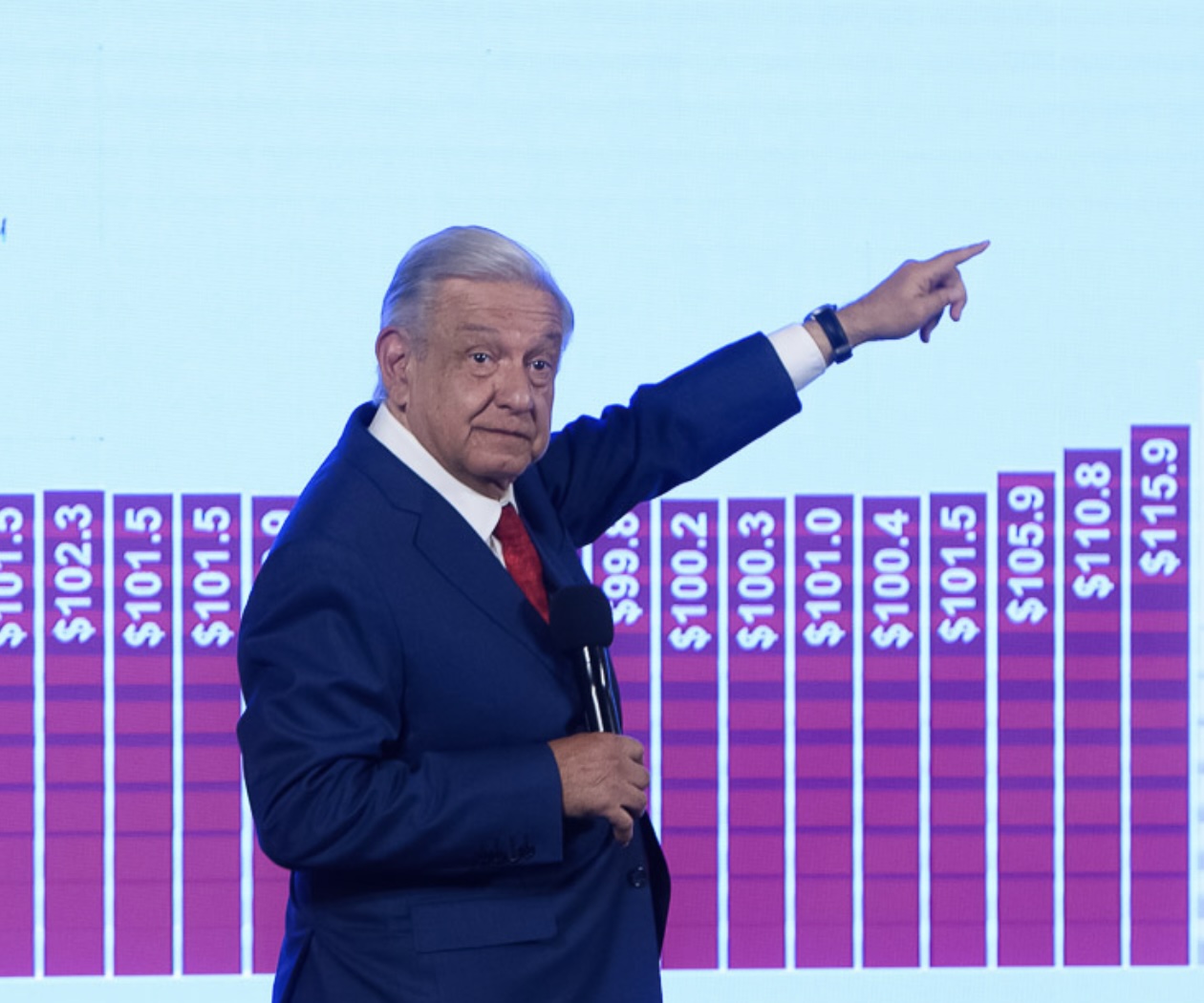
The minimum wage in Mexico has more than doubled in real terms over the last six years. This is no small feat, especially if we take into account that the policy neither led to feared job losses nor price increases. This was partly because the Mexican minimum wage was well below those of other Latin American countries. With the latest increase, however, Mexico’s minimum wage is now greater than those in half of the region. Each successive increase has helped more people—in the first year, the increase benefited 13.3 percent of the formal labor force and by 2025 it benefited 37.4 percent, representing around 8.4 million workers.1Marco Antonio Gomez Lovera, Luis Felipe Mungía, Karla Neri Hernández, “Effects of the Minimum Wage Increase in the Northern Border Free Zone,” (<)em(>)Conasami(<)/em(>) (2019). (<)a href='https://www.gob.mx/cms/uploads/attachment/file/494772/Efectos_del_salario_m_nimo_en_la_Zona_Libre_de_la_Frontera_-_Direcci_n_T_cnica_Conasami.pdf'(>)https://www.gob.mx/cms/uploads/attachment/file/494772/Efectos_del_salario_m_nimo_en_la_Zona_Libre_de_la_Frontera_-_Direcci_n_T_cnica_Conasami.pdf(<)/a(>)
With the radical shift in Mexico’s wage policy, these recent increases in the minimum wage—while translating into an average income growth of 25 percent in real terms and a significant decrease in poverty and inequality—have only begun to chip away at corporate power. The share of wages has only grown slightly, and the negligible increase in unemployment and inflation underscores drastic asymmetries in the relationship between employers and workers. The Mexican labor market is extremely monopsonistic,2 In the labor market, a monopsony occurs when there is a single (or very few) employer that concentrates the demand for labor in a region or sector, allowing it to set wages below the competitive level, as workers have few or no viable employment alternatives. This monopsonistic power can occur in contexts such as a mining company in an isolated community, where it is the only specialized employer; in public health systems such as the NHS in the United Kingdom, which hires the majority of doctors and nurses; or in maquiladora plants that dominate employment in certain border areas. In all these cases, the lack of competition among employers weakens the bargaining position of workers and can result in lower wages, reduced labor mobility, and poorer working conditions. in part because there are relatively few large companies, but also due to poor labor law enforcement and weak unions. Common labor practices in Mexico allow firms to exercise more power to determine wages well below what they would be in a perfectly competitive market, which has led to the prevalence of high profits at the expense of working conditions.
The history of the minimum wage in Mexico
Analyzing the historical evolution of the minimum wage in Mexico is fundamental to understanding how the Mexican wage policy has become a successful and innovative model. Its implementation has reduced poverty for millions of people and generated unprecedented growth in family income, defying traditional forecasts that linked minimum wage increases with uncontrolled inflation and unemployment.
In 1976, after nearly three decades of gradual growth, the minimum wage reached an all-time high of $20.76 per day (in 2025 equivalent terms).3 All references to the exchange rate were consulted on June 10, 2025. The following year, however, the country faced an economic crisis marked by hyperinflation and massive unemployment. The authorities responded by freezing wage adjustments below the inflationary pace, which, together with the indexation of other wages to the minimum, led to a 75 percent loss of purchasing power in the following decades.
After the crisis and into the 1990s, Mexico adopted an economic model based on neoliberal policies centered on trade liberalization, global integration, and building deeper ties within North America. To compete internationally, the government opted to keep wages artificially low, freezing the daily minimum wage at around $5.25 (adjusted to current prices) between 1990 and 2017. This stagnation was only broken with a meager 4 percent real increase toward the end of the period, mainly a result of accumulated social pressures that led the minimum wage to be decoupled from various legal provisions.
The turning point came in 2018, during the government of Andrés Manuel López Obrador. Faced with growing citizen demand for wage improvements, a team of economists from the progressive-oriented Colegio de México evaluated the feasibility of increasing the minimum wage without destabilizing the economy. Aiming to reconcile social justice with macroeconomic stability, a gradual and technically sustainable recovery strategy was implemented that restored the lost purchasing power within seven years.
There is also the misconception that the increase in the minimum wage was a consequence of the United States-Mexico-Canada Agreement (USMCA). Rather, the minimum wage policy was designed completely independently of the USMCA, in the absence of any pressure from the United States. The USMCA does not impose a specific increase in the minimum wage; all it establishes, in its Chapter 23 (Labor) and Annex 23-A, is that each party must “adopt and maintain laws and regulations governing acceptable conditions of work with respect to minimum wages,” including that such wages be enforced under domestic law.
The new minimum wage policy
Mexico’s new minimum wage policy was implemented in December 2018, marking the first minimum wage increase in double digits. The minimum wage increased by 16.2 percent for the entire country except for the northern border. This region is what the National Commission of Minimum Wages (La Comisión Nacional de Salarios Mínimos, Conasami) calls the General Minimum Wage Zone (Zona del Salario Mínimo General, ZSMG). However, in the Northern Border Free Zone (Zona Libre de la Frontera Norte, ZLFN)—which comprises the forty-three municipalities that border the United States and all municipalities in the state of Baja California—the minimum wage doubled (increased by 100 percent) starting January 1, 2019.
Salary increases were implemented in two phases. The first stage began in 2016, during the government of Enrique Peña Nieto, when constitutional reforms for the “de-indexation of the minimum wage” were approved. This step was taken in consideration of warnings from the business sector and some voices from the labor sphere, who both argued that increasing the minimum wage was unfeasible due to the risk of triggering an inflationary spiral. This claim had some truth to it, since in Mexico many essential components of the economy were linked to the minimum wage. Fines in most cities were expressed in terms of minimum wages; certain private loans and those corresponding to the Instituto del Fondo Nacional de la Vivienda para los Trabajadores (Infonavit) were similarly indexed to the minimum wage. Many collective bargaining agreements provided for wage increases and benefits calculated in terms of the minimum wage.
Consequently, it was essential to decouple these standards. In 2014, after facing immense public pressure, the government of Mexico City presented the first document which highlighted the need to both increase and de-index the minimum wage. A year later, various leftist legislators, led by the Party of the Democratic Revolution (PRD), formally proposed the de-indexation, with representatives of the labor sector of Conasami supporting the initiative. Finally, in 2016, the minimum wage was separated from these indexes, paving the way for subsequent increases. However, in 2017, despite the announcement of a “historic” increase, the minimum wage barely registered increases of 3.2 percent and 4.7 percent in real terms.
The second phase would prove more complex, as it involved bringing economic theory, years of advocacy, and popular struggles together to form a successful wage policy. The economic literature had shown that increasing the minimum wage in isolation could harm employment, as was the case of Colombia, where the increase had a dramatic effect on other wages.4 Carlos Arango and Angelica Pachón, “The Minimum Wage in Colombia: Holding the Middle with a Bite on the Poor,” (<)em(>)Banco de la República Borradores de Economía Working Paper(<)/em(>) (<)em(>)No. 280(<)/em(>) (2004); William Maloney and Jairo Nuñez Mendez, “Measuring the Impact of Minimum Wages: Evidence from Latin America,” In (<)em(>)Law and Employment: Lessons from Latin American and the Caribbean(<)/em(>), J. J. Heckman and C. Pagés (eds.), (Chicago: University of Chicago Press, 2004): 109–30. On the other hand, a case such as Brazil showed that the minimum wage had no impact on employment.5 Sara Lemos, “Political Variables as Instruments for the Minimum Wage,” (<)em(>)Contributions to Economic Analysis & Policy 4(<)/em(>), 1 (2005). The Mexican government carried out a series of studies to anticipate all possible scenarios. It was agreed that for the first year of the wage increase, the minimum wage would double in the newly established ZLFN in the north of the country, while it would increase by 16.2 percent in the rest of the country.
The business sector immediately opposed the doubling of the minimum wage in the north, arguing that it could generate inflationary pressure, though the sector was also likely hoping to protect its capital gains. The Ministry of Finance and Public Credit (SHCP) and the Presidency decided to create the ZLFN together with a package of tax incentives, including reductions in Income Tax (ISR) and Value Added Tax (VAT). The doubling of the minimum wage would ensure that the tax incentives would translate into direct benefits for workers. The ZLFN would ultimately serve as a control to evaluate the effects of the new minimum wage for the country.
Following the first year, the government proposed increasing the minimum wage in the ZLFN slightly above the inflation rate to compensate for the wage compression implied by doubling the minimum wage in one year.6Wage compression is a phenomenon that usually occurs when the minimum wage is increased. It consists of all wages “bunching” very close to the minimum wage, since companies are only obliged to increase up to the minimum wage, while, to compensate for costs, they keep other wages the same. Wage compression disappears after a year or two, depending on the country. In the rest of the country, the 16.2 percent increase in the minimum wage raised it, for the first time in history, above the poverty line. The goal was to subsequently increase the minimum wage nationally by 20 percent (with a margin of error) and exceed a 100 percent increase by the end of the six-year term.
The plan proved to be successful and the model estimates were accurate. Despite strong concerns from the business sector, the increases were approved in the first year and, to the surprise of many, the initial inflation data obtained in the north showed lower prices. Inflation continued to be substantially lower that year in the north than in the rest of the country. This finding definitively dispelled the myth that increasing the minimum wage always leads to inflation.
Capital, labor, and government: the negotiations
The balance of power between the government and the factors of production has shifted for a variety of reasons. First, the technical rigor of the new Conasami7The Conasami Council is made up of representatives and alternates from twelve economic sectors, including business and labor, totaling twenty-four votes, in addition to the vote of the Conasami president, who represents the government. has helped to discard unevidenced arguments and scare tactics of the business sector aimed at maintaining the minimum wage. Conasami has transformed in recent years from a quiet agency to the public institution issuing the largest number of publications and studies on behalf of the Mexican government each year.8 Conasami studies are available at https://www.gob.mx/conasami. Second, the working class and unions have gained significant momentum, with the labor agenda advancing by leaps and bounds. Third, the political will and gains in confidence of a left-wing movement in government have stifled producer interests.
The Conasami Council’s reports have filled a gap in informed debate that had hampered progress on reform with both unions and the business sector. In the first years of the minimum wage policy, the business sector only repeated the argument that increasing minimum wage would cause inflation. But as data continued to show low inflation, or even lower inflation, in areas with higher minimum wages, their argument lost credibility. Similarly, evidence showing that the Mexican labor market is monopsonistic and that the minimum wage has zero effect on employment disproved the sector’s argument around decreased employment. With each hike in the wage, the business sector resisted, as higher wages came at the consequence of higher labor costs (although business indirectly benefited from increased consumption). But thanks to a plethora of research, the business sector has been convinced on numerous occasions of the advantages of strengthening the domestic market through higher income for workers. Unions, in turn, were “timid and cautious” at the beginning of the wage increases, relaying concerns similar to those of the business sector. Somewhat ironically, unions expressed greater fears than the companies themselves, despite international cases demonstrating positive effects for workers. Over time, however, unions became more “combative,” even presenting proposals from various unions requesting increases above the established estimates.
The labor market of 2025 is a very different one from that of 2018. Labor unionism is undergoing a revival. After reaching a minimum unionization rate of 12 percent of formal employees in 2018, the figure has jumped to 12.8 percent in 2024, implying an increase of almost one million unionized people.9National Occupation and Employment Survey (ENOE) of the National Institute of Statistics and Geography (INEGI). In addition, all union movements, including those that had normally been associated with business power and the corporate power of the state, are in favor of increasing the minimum wage, despite opposing it for years.10Sindicalismo blanco, in Mexico, known as sindicalismo charro. Unions are now in favor of increasing vacation days, improving social security, and reducing the hours in a legal work day.
Finally, the victory of President Andrés Manuel López Obrador in 2018 represented a tide shift. López Obrador was convinced that radical changes were needed in labor and employment. He appointed public servants who, in addition to being very capable, came from the working class. During negotiations with the business sector and the unions, the president, along with Conasami and the Ministry of Labor, intervened on multiple occasions to move the balance in favor of a higher wage increase.
High concentration in the labor market
Globally, the minimum wage is a controversial public policy issue that has generated much debate in economics. Since the publication of Card and Krueger (1994), the empirical evidence has been divided in determining the employment effects of raising the minimum wage. There are studies showing negative effects, positive effects, and no effect. While there is a consensus that a higher minimum wage has a positive impact on the income of those it reaches, the question of adverse employment effects remains relevant.
A number of economists have put forth several hypotheses attempting to understand inconsistencies in the empirical evidence. Approaches toward this end can be generally divided into an econometric method, which assesses the impact and relevance of the minimum wage; a legal method, which examines the application of the law; and a method that focuses on the effects on formal or informal sector employment. Recent work also explores the possibility of monopsonistic labor markets.11Some examples are Allegretto, Dube and Reich (2011), Alegretto et al. (2013), Azar et al. (2019), Munguía and Neumark (2020), Munguía (2020).
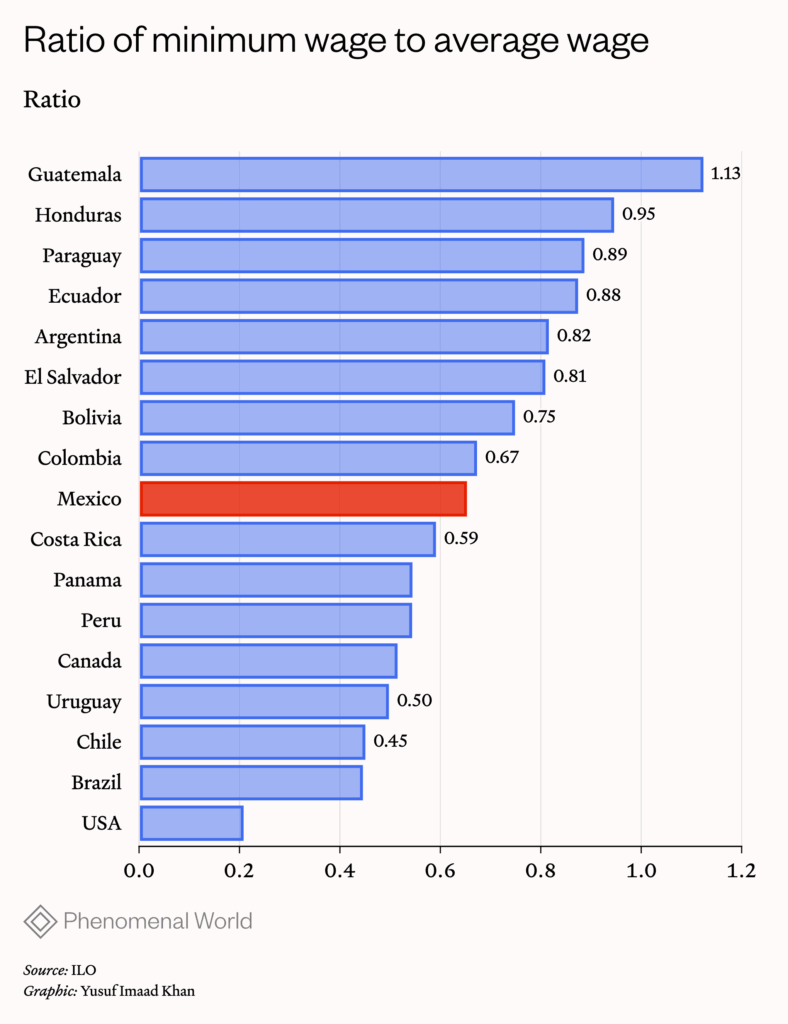
In the case of Mexico, there have been several studies on the impact of the minimum wage, especially linked to the new minimum wage policy.12 Conasami (2019), Campos-Vazquez and Esquivel (2021) and Gómez and Munguía (2023) What is most interesting about the Mexican case is that the minimum wage increasingly affects a larger proportion of the working population (13.3 percent in 2019, 24.3 percent in 2020, 27.8 percent in 2021, 29.4 percent in 2022, 28.8 percent in 2023, and 38.6 percent in 2024). This implies that the minimum wage is creeping closer and closer to the average wage. One way to measure the minimum wage is to use an index that results from dividing the average wage by the minimum wage (Kaitz Index). In the figure below, we can see the comparison for Latin American countries. Mexico is in the middle of the table, below Colombia, Bolivia, El Salvador, Argentina, Ecuador, Paraguay, Honduras, and Guatemala.
This ILO data includes the informal sector in all economies, and therefore the indicator is likely to be high (since the average wage is lower due to informality, but informal workers are not paid the minimum wage). This is why countries like Guatemala and Honduras have such high indicators—the minimum wage is high, but enforcement is weak, so many workers earn below the minimum wage.
Studies in Mexico tend to focus on the formal sector, where by law the minimum wage is almost always enforced—on average only 0.5 percent of the working population earns less than the minimum wage in the formal sector. Still, the most recent findings show that the minimum wage has had no impact on employment. I argue that Mexico’s ability to increase the minimum wage without negative employment effects is the result of high concentration in the labor market.
A recent study in progress, co-authored by Marco Antonio Gomez Lovera and me, analyzes the effects of labor market concentration on wages, employment, and the heterogeneous effect of the minimum wage depending on the level of monopsony. The study calculates the Herfindahl-Hirschman concentration index for employment, measuring the concentration of employment at the municipal level and by sector, ranging from 0, when there is perfect competition in the market, to 1, when there is a single firm that concentrates all employment in the market.
The calculation for Mexico shows a high degree of concentration in labor markets. In the figure below, the concentration is mapped for the whole country, where the redder the municipality, the more concentrated the market is. Green municipalities denote competitive markets.

Mexico’s average HHI is 0.81, indicating that in most of the country’s municipalities workers face few job offers. In contrast, the estimated average HHI for the United States is 0.58.13Luis Felipe Munguía Corella, “Monopsony Power and Minimum Wages, (<)em(>)IZA Journal of Labor Economics(<)/em(>) (2020).
The impact of monopsony on the labor market has been extensively studied from a theoretical point of view.14 Manning (2003) and, Card and Krueger (1995). Card and Krueger (1995) find that first, wages tend to be lower in monopsonistic markets, because firms have more bargaining power and optimize their costs away from the average wage. Second, employment in monopsonistic markets is also lower, since a lower wage in the market reduces the labor supply. Third, companies show extraordinary profits. And fourth, labor productivity moves away from the average wage, meaning that productivity increases without an increase in workers’ wages. The same theory argues that it is possible that increasing the minimum wage has a positive effect on employment, since companies attract more workers with higher wages and produce more.
The effect of the minimum wage in a monopsonistic country like Mexico is very different than in countries where there is greater competition. Still, each of the assumptions of the theoretical models can be debated in the case of Mexico. The first assumptions posit that employment and wages tend to be lower when there is higher concentration. The study cited above estimates the effect of HHI on employment and average wage for Mexico. If concentration increases 10 percent, total employment falls 4.75 percent, youth employment falls 5.54 percent, female employment falls 5.10 percent, and the average wage falls 0.51 percent. In regions with more competition, the HHI reaches 0.14, signifying that employer concentration increases by 5.78 times between areas with the lowest concentration and the national average. This implies that the monopsony effect between municipalities is enormous—the average area has 29.4 percent lower wages due to the monopsony effect.
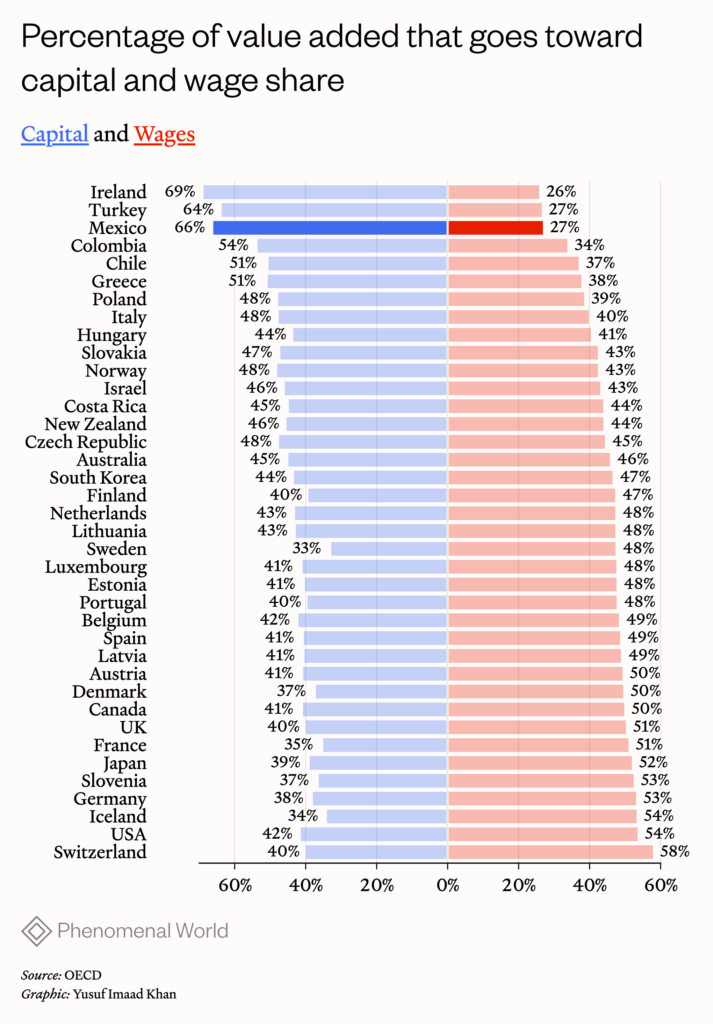
When it comes to the question of profits, in Mexico, payment to capital out of the total value added to the economy is completely inverted. In 2021 (latest available data for all countries), 66 percent of total value added was paid to capital, while labor only took 27 percent.15 The number does not add up to 100% because of taxes. In the US, payment to capital is 42 percent and payment to labor is 54 percent; in Chile, payment to labor is 37 percent, and in Colombia it is 34 percent. The Mexican case is unique.
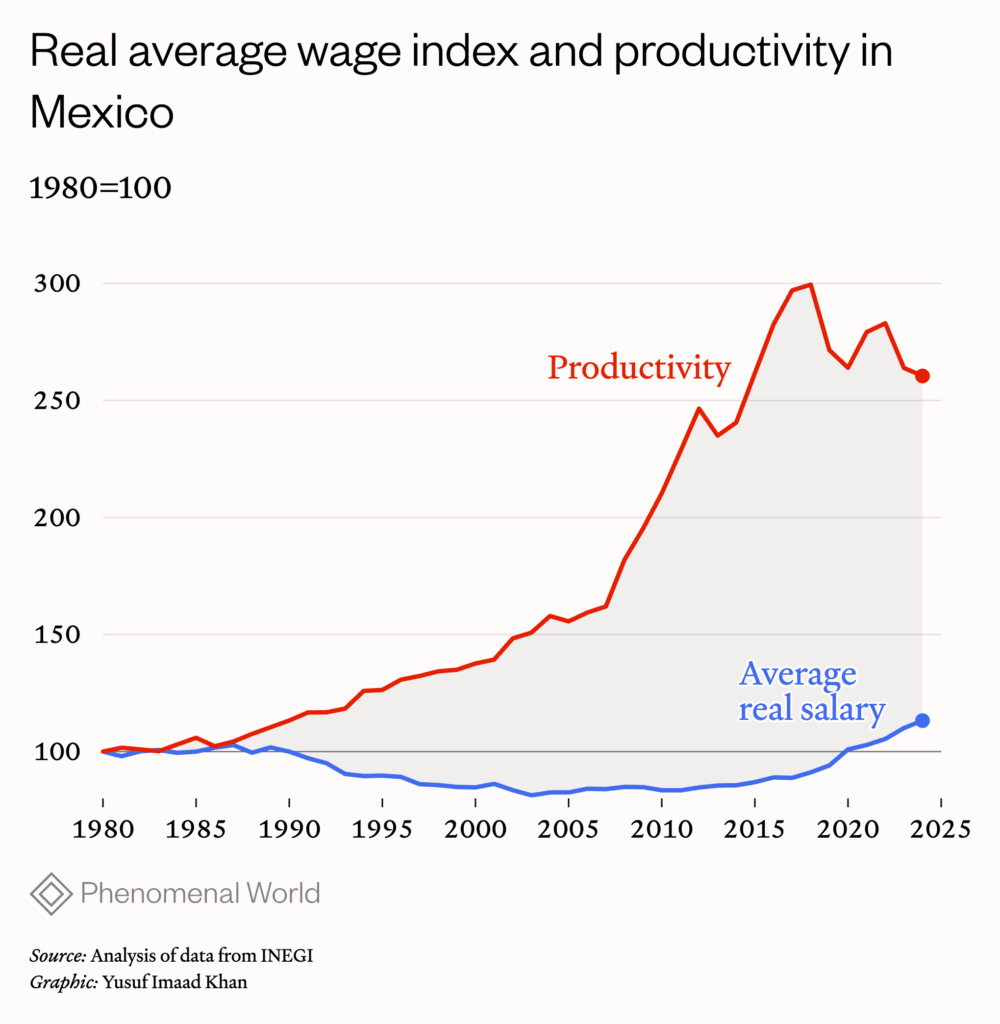
High corporate profits in Mexico can be attributed to the difference between productivity and wages. In a perfectly competitive market, labor productivity should move alongside the average wage, but if the degree of monopsony is high, the gap between the variables grows. The figure above shows that, in the case of Mexico, productivity in the industrial sector has increased by more than 160 percent, while wages have only risen 13.2 percent—mainly a result of the minimum wage hikes of the last six years.
Our study also determines that the minimum wage has no effect on employment in competitive markets, but it has a positive and very large effect in monopsonistic markets. If the minimum wage increases 100 percent, employment increases 69.7 percent more in monopsony markets than in competitive markets, where it only sees a tiny increase. A 100 percent increase in the minimum wage translates into a 44 percent increase in the average wage in a competitive market and a 54 percent increase in the average wage in a monopsony market—an additional ten points.
Labor markets in Mexico are highly concentrated, which gives companies asymmetric power to determine wage levels. The degree of concentration is so extreme that profits for companies in Mexico are extraordinarily high compared to the rest of the world. Labor policies that increase the minimum wage, strengthen union democracy, and eliminate subcontracting could help balance the power between capital and labor, though the path ahead remains difficult.
Minimum wages, inequality, and corporate power
The increase in the minimum wage has generated important socioeconomic benefits, especially for the most vulnerable sectors, without triggering inflationary pressures or affecting employment. There has been a persistent myth that few were actually earning the minimum wage, a claim itself contradicted by the argument that an increase in the minimum wage would lead to inflation. The most recent increase in the minimum wage benefited 8.4 million working people affiliated with the IMSS, making it clear that the policy has a significant scope.16 Conasami, “Propuesta de fijación del Salario Mínimo 2025.” (2024). Available at: https://www.gob.mx/cms/uploads/attachment/file/960834/Propuesta_de_fijaci_n_2025.pdf.
The real average salary of those affiliated with the IMSS has grown by 25.6 percent above inflation since 2018. This dynamism has boosted domestic consumption: studies indicate that consumption power increased an additional 3.6 percent thanks to these wage improvements. This effect is even more pronounced in regions such as the ZLFN, where consumption is 10.5 percent higher than in the ZSMG, reflecting the direct relationship between wages and spending power.17Ibid.
Changes to the minimum wage have also reduced poverty: of the 5.1 million people who moved out of poverty between 2018 and 2022, 4.1 million changed their condition exclusively as a result of wage improvements. With most Mexican households depending on formal or informal labor income, the minimum wage can be an effective redistribution mechanism. This rise in wages has not only mitigated food shortages, but it has also facilitated access to basic services such as health and education.18Luis Felipe Munguia Corella and Marco Antonio Gomez Lovera, “The Minimum Wage Impact on Poverty in Mexico.” (2023) Available at SSRN: https://ssrn.com/abstract=4626139 or http://dx.doi.org/10.2139/ssrn.4626139
The minimum wage has also contributed to closing historically significant gaps. Since the beginning of the wage recovery process, lower-income workers experienced increases of 204.6 percent in the ZLFN and 115.0 percent in the ZSMG, reducing wage inequality by 19.7 percent. In addition, between 2019 and 2024, the gender pay gap decreased by 29 percent, with more marked advances (66 percent) in municipalities with a high concentration of women in poverty.19 Conasami, 2024.
In the last seven years, increases in the minimum wage have allowed for a significant recovery of its purchasing power: 133.6 percent at the national level and 251.8 percent in the northern region of the country. Nevertheless, challenges persist. Wage policy and Conasami face at least three challenges. The first is to raise the minimum wage to a truly dignified level, which not only covers the basics, but also ensures an adequate standard of living for families, with the goal of reaching the equivalent of 2.5 basic consumption baskets. Conasami plans to achieve this by 2030, and this goal also covers dependents. In Mexico, a typical family has two working people and two economic dependents. The proposal suggests that a minimum wage not only cover two basic consumption baskets, but also include an additional 0.5 baskets, so households can hold savings, invest in education, and improve their well-being. This would require annual wage increases of 12.4 percent, assuming an average inflation rate of 3.5 percent in the coming years. With this trajectory, the national minimum wage would reach 500 pesos per day, equivalent to approximately 15,220 pesos per month.
The second challenge is updating professional minimum wages, with the aim of revaluing women’s work and reducing gender inequality. Currently, Conasami has a list of sixty-one professional minimum wages intended to guarantee a base income for those occupations that lack union representation or labor organization, as well as for jobs that face precarious conditions, such as the lack of formal contracts or low salaries. This situation disproportionately harms women, since their lower pay is often justified through labor flexibility. Conasami must work with labor and business representatives to agree to renew and adapt this list to the current market realities—taking into account the percentage of women in each profession in order to revalue them through higher minimum wages.
The third challenge is transforming Conasami into an institution with a broader role in combating monopsony. In addition to setting the minimum wage, Conasami would also be in charge of analyzing the labor market and eradicating practices such as wage abuse or contracts that restrict competition. This would help rectify the balance of power between capital and labor. The current proposal to transform Conasami into a National Institute of Living Wages is one response to the high concentration in Mexico’s labor market. The main function of the new institute would be to identify monopsony practices at the municipal and industrial level. The institute would have the authority to inspect companies, enforce labor standards, and impose sanctions on the companies with abusive labor policies.
Further Reading
The Runaway Shop
An interview with Jeffrey Hermanson on labor unionism and manufacturing under NAFTA and USMCA
In the early years of NAFTA, the maquiladora system undermined national manufacturing and unions in Mexico across industrial sectors, drawing workers around the country into...

The Fourth Transformation
The political economy of Claudia Sheinbaum’s popularity
As anti-incumbent sentiment toppled governments around the world in 2024, Mexico’s Morena won in a landslide, and the presidency was passed from Andrés Manuel López...

Capturing Production
The USMCA and the automotive industry in North America
The implementation of the USMCA in July 2020 heralded major changes for the North American automotive industry, with increased regional content and fundamental labor rights...