October 30, 2025
Analysis
Stabilization and Speculation
Struggles over New York City’s housing policy
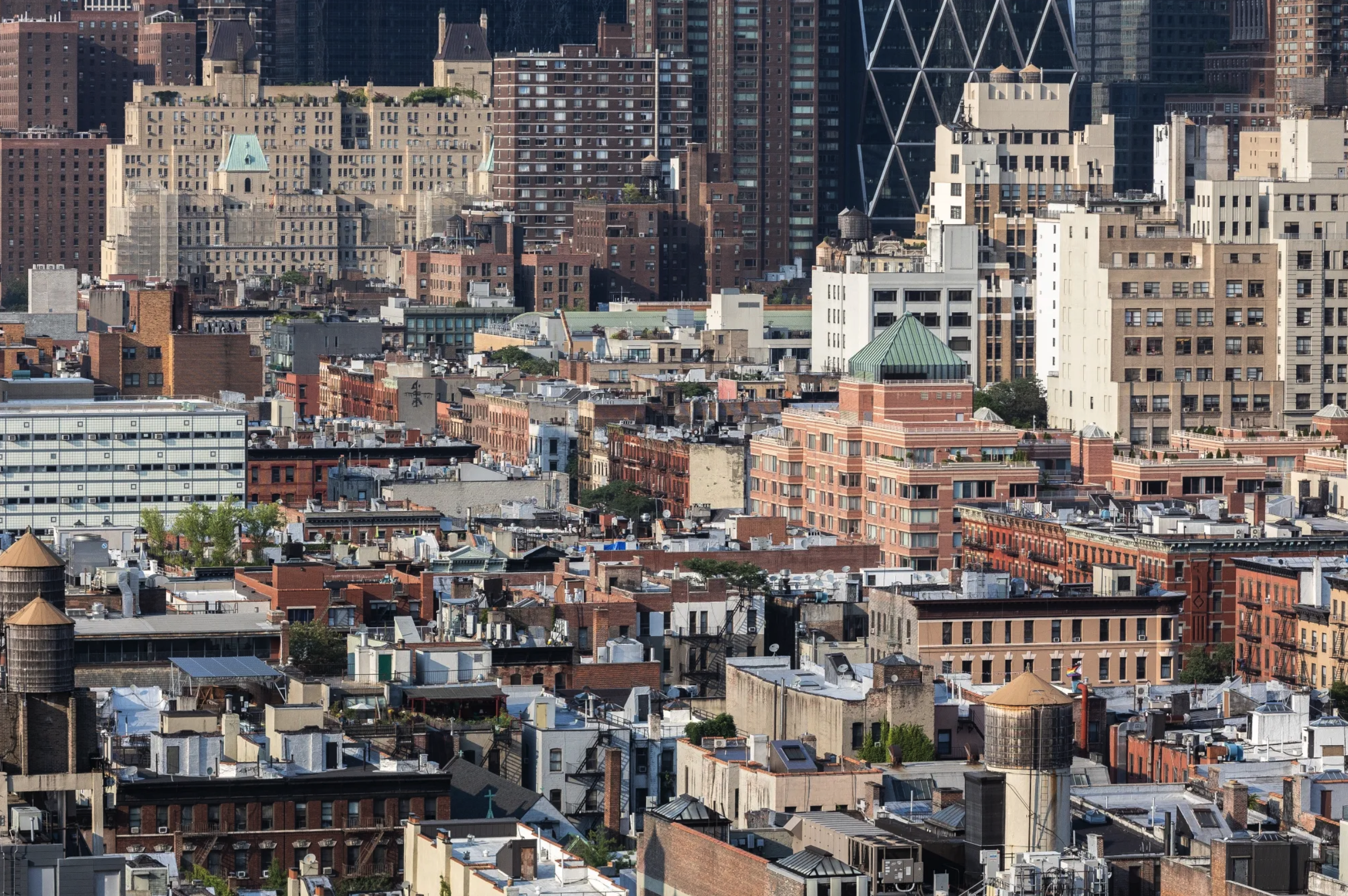
New York’s housing crisis—characterized by sky-high rents, extraordinary waitlists for affordable housing, and low-quality housing stock—is undeniable, and solving it calls for new policy interventions. Tenant organizations generally argue that the solution is stronger rent regulations, increased enforcement of housing maintenance codes, the right to organize, and, increasingly, public-sector ownership. Real-estate associations, on the other hand, assert that such laws are in fact the very cause of the crisis, and that the remedy is deregulation to allow for higher profit margins, which will in turn incentivize the building of more housing. The more we unleash the private market, they claim, the more rents will eventually come down.
This entrenched conflict reflects a broader national trend. For at least the last fifty years, private real-estate speculation has driven urban politics in the United States.1Mayors confronting federal austerity amid the inflationary business cycles of the 1970s signaled this shift. Recognition among social scientists can be dated to Harvey Molotch, “The City as a Growth Machine: Toward a Political Economy of Place,” (<)em(>)The American Journal of Sociology(<)/em(>), September 1976, though, as William Domhoff and others have argued, the presence of real-estate developers in many Democratic Party growth machines dates at least to the New Deal, when the political coalition included a much more powerful labor movement. For a study of the growth coalition in Atlanta, see Clarence Stone, (<)em(>)Regime Politics: Governing Atlanta, 1946-1988 (<)/em(>)(University of Kansas: 1989). For a history of New York City arguing for a regime change during the 1970s, see Kim Phillips-Fein, (<)em(>)Fear City: New York’s Fiscal Crisis and the Rise of Austerity Politics(<)/em(>) (Metropolitan: 2017). In countless American statehouses and local governments, the notion that our cities will thrive when property values are on the rise is rarely challenged. Rising land value (and therefore, rising rents) is the overriding goal, and the broader question of providing housing that people can afford is, by and large, secondary. In New York City, as elsewhere, lawmakers struggling to solve the housing problem will fail to do so if they are unable to face the underlying problem of speculation at its root.
New York City’s housing politics are defined by acute competition between these organized forces: a robust tenant movement that has secured the strongest rent stabilization laws and public-housing tools in the United States, as well as the country’s most powerful real estate lobby, accustomed to shaping our city in its image. It’s no surprise that the New York City mayoral race has brought this antagonism to the fore. Apartment owners and real-estate developers are the largest group of donors to mayoral candidate Andrew Cuomo’s largest super PACs—Fix the City, Inc. ($32.6 million), Put NYC First, Inc. ($3 million), and Housing for ALL ($2.5 million)—while tenants propelled Zohran Mamdani to victory in the Democratic primary. The election has revealed both the enduring influence of the idea that public policy must prioritize ever-rising property values for private owners—and the outlines of a path beyond it.
Regulation and deregulation in New York City
Rent regulation is best understood not as an affordable housing program but as consumer protection. In tight real-estate markets where a housing shortage produces rapidly rising rents, it is in the public interest to regulate them. New York City has regulated rents in one form or another since 1920, when soldiers returning from World War I flooded the market and demand for housing spiked. Moves to regulate the cost of rental housing have often come in response to rapidly rising rents, during periods in which working-class incomes and prices were generally on the up. When workers have more to spend, landlords can charge more.
New York’s current form of rent stabilization has its origins in the early 1970s, when inflation forced the cost of living to the top of the political agenda. During the 1969 mayoral election, incumbent John Lindsay responded to organized tenant pressure by passing the Rent Stabilization Law, bringing 400,000 housing units under “stabilization”—annual rent increases permitted within limits set by a Rent Guidelines Board. Enforcing these limits fell to a private, but licensed, Rent Stabilization Association (RSA), with powers delegated by the Board which monitored this “self-regulation.”
Yet self-regulation of rents by apartment owners quickly became problematic, particularly after 1971, when organized apartment owners successfully lobbied Albany to enact “vacancy decontrol”—meaning that upon vacancy, a landlord could raise the rent on units to the going market rate. In a context of rising vacancies, the opportunity to raise rents on empty apartments introduced an incentive to create more empty apartments, displacing families in pursuit of higher monthly profits. The ensuing evictions, rent increases, and landlord-tenant conflicts compelled the state legislature to seek new solutions. The resulting Emergency Tenant Protection Act (EPTA) of 1974 created the system we know today.
Each year, landlords and tenants come together to duke it out before a locally-appointed Rent Guidelines Board. The Boards then adjust the maximum permitted rent increases for regulated apartments, with state lawmakers in Albany deciding which properties are subject to regulation. In a temporary commission convened by Governor Nelson Rockefeller to draft the EPTA, policy makers took aim at vacancy control and profit-motivated real-estate speculation, noting its incompatibility with high-quality housing. “In New York City,” they wrote, the excess rent for above-stabilization rent increases under vacancy decontrol “was not reinvested in capital improvements, but in fact resulted in an actual decrease of 30 percent in renovations.” Landlords were not reinvesting; they were pocketing the extra money.
By 1982, the State of New York had fully ended self-regulation of rent stabilization. The Rent Stabilization Association reinvented itself as an advocacy organization to represent the industry, and was joined by another such lobby group: the Community Housing Improvement Program (CHIP).
An interest group and business model
The next twist in the story came in 1994, when the RSA began to push through reforms that gave rise to a new business model for the rent stabilized market, which would endure for more than two decades. The group won new amendments to the city’s rent stabilization system that gradually caused it to disappear through attrition: once a unit costing $2,000 a month or more was vacant, it would now be released from stabilization altogether.2 To accomplish this, the RSA hired the chief of staff to City Council Speaker Peter Vallone. These laws also provided landlords with an instrument to raise rents between vacancies: individual apartment improvements (IAIs), submitted by the landlord but without meaningful oversight of the claimed costs of the investments. Three years later, Albany took the further step of awarding 20 percent “rent bonuses” to landlords whenever a stabilized unit fell vacant, regardless of improvements. As a result, between 1994 and 2019, NYC lost nearly 250,000 rent stabilized apartments—about a quarter of the stock.
While rent stabilization cut into real-estate profits by limiting the amount of income owners could get from tenants, decontrol created an entirely new business model. Whereas a traditional response to rent regulation was for landlords to “milk” buildings, maximizing owner income by cutting costs rather than raising rents, under the new decontrol laws owners sought to use capital improvements, individual rehab submissions, and vacancy bonuses to raise stabilized rents above the decontrol threshold—and into the higher margins of market rents. Much like in the early 1970s, this model relied on eviction, displacement, and harassment. Faced with laws intended to protect working New Yorkers from the rising cost of living, landlords of regulated units mobilized to replace existing tenants with richer ones.
Multi-family real-estate financing adapted to this market. Increasingly, banks financed multi-family housing acquisition based on the assumption that rent-stabilized units could be converted into market-rate ones. From 2008 to 2016, for example, a group of twenty-nine New York City landlords engaged two property management companies, Newcastle and Highcastle, to submit individual-apartment-improvement rent-increases where labor costs always exactly met the threshold required to bring the units out of stabilization. Meanwhile, Signature Bank issued many loans during the 2010s on terms that assumed people buying apartment buildings would raise rents far beyond stabilization ceilings. Banks that specialized in lending against multifamily properties, such as New York Community Bancorp (the second largest multifamily lender in the country), extended credit liberally on this basis, as did larger ones such as Bank of America, Wells Fargo, and JP Morgan Chase.
Consider the case of Emerald Equities, a corporate apartment landlord in New York. In 2016, the company purchased eleven rent-stabilized apartment buildings in East Harlem for $357 million, using funds raised from private lender LoneCore Capital. Over the next year, it successfully converted 251 of the total 1,181 units to market rate by allegedly harassing tenants into moving out. Brookhill Properties, which in 2015 had purchased sixteen apartment buildings in the East Village, likewise undertook what the State Attorney General described as “illegal and fraudulent acts to harass tenants and vacate units as quickly as possible”—including falsely informing tenants that their units had been removed from rent stabilization and carrying out “unsafe construction…intended to drive away the remaining rent-regulated tenants.” In 2016, two Brooklyn landlords were convicted of hiring “vandals” to intimidate tenants with sledgehammers, bats, and pitbulls at five of their Bushwick apartment buildings.
Such activities elicited organized opposition. Tenant groups fought to close the many loopholes that had been created over the last twenty-five years. This period of sustained pressure on lawmakers resulted in the Housing Stability and Tenant Protection Act (HSTPA), which passed in 2019, rendering unlawful many planned rent increases by landlords such as Emerald, Brookhill, and others. Emerald company pushed ahead with the increases regardless and was later criminally charged by the state Attorney General. Unable to make good on its debts, it declared bankruptcy in 2024.
Blood from a stone
The HSTPA reforms, along with the pandemic-induced slow-down in working-class incomes, the Federal Reserve’s high interest rates, rapidly rising costs of real estate insurance, and general volatility in the real-estate market caused by Trump, have since interrupted this speculative business model—spurring a series of foreclosures and bankruptcies. The crux of the problem, however, is the fever-dream of real estate speculation that fueled the rent-stabilized market from 1994 to 2019. As one New York landlord and financial consultant told Bloomberg last year, “Everyone in this world of rent stabilized buildings is sort of engaged in this collective delusion. They’re waiting for the Supreme Court to overturn rent control. They’re waiting for the legislature to weaken the HSTPA.” But the financial gamble on deregulation is also running into a simple market reality: people who live and work in New York City can only pay so much more in rent. “Even if the laws did allow for higher rent increases than they do now,” the landlord continued, “at some point you can’t pull blood from a stone.”
Recently the bad bets have started to come due. Signature Bank declared bankruptcy in 2024. The government superintended a merger with New York Community Bancorp, which itself declared bankruptcy a few months later—ultimately rebranding the reorganized entity as Flagstar Bank. If industry’s business model had depended on bringing units out from stabilization into the high-income, market-rate market, stronger rent-control laws have now made this impossible.
Rent stabilization covers nearly half of the apartments in New York City, and the industry claims that HSTPA has made it financially infeasible to maintain these buildings. They argue that without deregulation, the City of New York will fall back into what they describe as the disinvested hellscape of the 1980s. It is true that there is a small but acute crisis within the rent-stabilized housing stock: 2–3 percent, or about twenty to thirty thousand rent-stabilized units, meet the statutory definition of physical distress. The buildings are hundreds of years old, and in certain cases the rental income cannot cover operating and maintenance costs. But the history of decontrol shows that allowing landlords to raise rents in New York has rarely improved conditions at the bottom of the market. “IAIs are not being used to encourage basic investment and maintenance,” concludes a joint study by Association for Neighborhood & Housing Development and the Housing Rights Initiative, “but to enact extreme rent increases between tenancies.”In other words, New York City’s housing market remains unaffordable for renters, and the cost of building and maintaining housing is higher than ever before for owners—but the financial struggles of the former are fundamentally different to those of the latter, and most proposed solutions to the second problem tend to intensify the first.
Beyond the impasse
In the June Democratic mayoral primary, hundreds of thousands of tenants who cannot afford their monthly housing costs voted for Zohran Mamdani, whose flagship policy was to freeze rents on all stabilized housing. Now, with Mamdani on the cusp of winning the mayoralty, the details of his plan are coming under intense scrutiny, with the landlord lobby arguing that it will exacerbate the poor condition of the housing stock.
It is true that a rent freeze, without additional intervention, risks deepening the crises within the market. Owners of rent-stabilized buildings may choose not to invest in their properties. If conflict between the city and the large real estate firms intensifies, and building conditions continue to deteriorate, the question of new construction could be politically pinned on the rent freeze. What would effectively be a capital strike could then be construed as the effect of this progressive housing reform.
What impact will the rent freeze have, then, on the current impasse? Already, the centrality of the demand to city politics has opened up a new chapter in the struggle for a sane housing policy. A long-due conversation about housing conditions can make possible new housing politics—if paired with an effective code enforcement program and public investment in housing affordability, the proposed freeze will place the Mayor’s office squarely on the side of habitability, in defense of the quality of life for hundreds of thousands of New Yorkers.
But investment in enforcement is not in itself enough. With its multi-billion-dollar capital budget, the City has the capacity to act as a non-speculative market actor: purchasing buildings where the landlord is no longer interested in ownership. Thanks to its scale, its lack of a profit motive, and its taxing power, the City can intervene to stabilize volatile markets and act as a counter-cyclical force that puts housing quality first and property values second. It can use this power—to acquire rent stabilized housing as a market actor—to drive down costs for operators and improve housing quality across New York.
As a long-term owner, meanwhile, the City can act as something like a quasi-community land trust: holding land in a city-wide portfolio and leasing out the right to collect rents, while using its position as landowner to pursue asset management at scale. As its portfolio grows, it could use rents from higher-income buildings to fund operations and lower-income buildings in other parts of New York. This type of portfolio-wide asset-management approach would help New York avoid some of the challenges of private-sector-led affordable housing deals of the past, where individual operators sought building-by-building deals with the City and many projects ended up facing cash-flow issues.
To ensure quality housing for renters in a market where the tools of real estate speculation are suppressed, we need to combine the power to enforce housing standards and the power to finance and acquire rental housing—two capacities the City already has.
Tenants in the growth machine
The example of the Mamdani campaign—in which tenants’ demands can carry a mayoralty—is rare in American cities. An entire academic literature has sprung up to examine the “local growth machines” that determine urban politics in favor of elites, particularly those who can claim rents on real estate.3This financial power has long been on display in America’s largest cities, whether in the National Association of Realtors’ campaign to defeat Chicago mayor Brandon Johnson’s “mansion tax,” the California Business Roundtable’s attempts to repeal local tax initiatives to fund affordable housing, or Andrew Cuomo’s speech to the Real Estate Board of New York during the New York Democratic Primary. It is reflected in the rhetoric that predominates in local news and politics: the corollary to the “job-creator” epithet is the “housing provider”—the landowner who has made an (<)em(>)investment (<)/em(>)in the neighborhood, and whose business renting homes to residents makes them valuable to the political representative. Tenants—comparatively more transient, owning no property—must then have less of a “stake” in their communities and neighborhoods. Tenants make up the majority of the population in every major city in the US but tend to vote at lower rates than homeowners. They also tend to be less organized, less rich, and therefore less politically connected than real-estate developers. In this sense, the Mamdani victory in June represents a genuine disruption, whose ultimate implications are yet to be seen.
This is the backdrop to Cuomo’s flagging campaign. Before incumbent Mayor Eric Adams had dropped out of the race, Jeff and Lisa Blau—the developers of Manhattan’s twenty-eight-acre, six-building Hudson Yards skyscraper complex—along with Aby Rosen of RFR Holding and Laurie Tisch—billionaire aunt of NYPD commissioner Jessica Tisch—organized an emergency meeting of real estate moguls, who came together to devise a strategy “to ensure that the next mayor of New York is Andrew Cuomo.” The Fix the City super PAC—which as of late October had spent $17.5 million supporting Cuomo and another $8.8 million opposing Zohran Mamdani—now has a diversified war chest with money from Michael Bloomberg, DoorDash, and hedge funds, yet it began as a project of those whose solvency depends on paying back debt issued to them on the assumption of ever escalating rents. These are the executives of such corporate landlords as A&E Real Estate Management (one New York City’s worst landlords), RXR Realty (investor in the JFK airport redevelopment), RFR Holding (owner of the Times Square Paramount Hotel and the Seagram Building), and Two Trees Management Co., whose CEO Jed Walentas also chairs the Real Estate Board of New York. The other major super PAC backing Cuomo, Housing for All, is funded entirely by $2.5 million from the New York Apartment Association—the super lobby formed by the merger in 2024 of CHIP and RSA to move the city’s Rent Guidelines Board every year for higher rents on city’s rent-stabilized apartments.
And yet, despite this astonishing level of landlord organization, Mamdani is nonetheless poised to win on November 4. Whether he will be able to break the cycle of stabilization, disinvestment, and speculation depends on what happens next. If a new era of housing policy is to begin in New York City, the next Mayoral administration must seize the moment to reset a broken market—not just freezing the rent, but making active policy interventions across the sector—and tenants must organize to defend such an ambitious program against the power bloc that would inevitably seek to thwart it.
Further Reading
Land Value Politics
An interview with Daniel Wortel-London
The rise to power of a new urban progressive politics has been a hallmark of the Trump era. From the City Council of Los Angeles...

Loosening the Markets
Los Angeles housing in the age of incentive-driven development
Rather than new housing driving down market rents, development in the “affordable housing” market replaces below-market units with market-rate rentals. With market rents unchanged, “filtering”...
Adding Value
The Federal Housing Administration and the costs of incentive-driven development
Mortgage insurance has traditionally been the method the federal government has used to induce investment in owner-occupied housing. But for multifamily rentals, the history of...