October 17, 2025
Analysis
State of Emergency
The consolidation of an oligarchic-neoliberal model in Ecuador
Ecuador’s May elections were a testament to the country’s extreme polarization. Incumbent Daniel Noboa, representing the right-wing Acción Democrática Nacional (National Democratic Action) party and supported by big business, won 55.6 percent of the votes in the second round. On the left, Luisa Gonzales won 44.3 percent of the vote, representing the Revolución Ciudadana (Citizen’s Revolution) movement, a product of the progressive party structure that governed the country for over a decade. With voters concentrated across these two major parties, the Pachakutik party, linked to the indigenous movement, was the only third party to survive, gaining 5.2 percent of first round vote.1The Pachakutik party is the political arm of the Confederation of Indigenous Nationalities of Ecuador (CONAIE) presided by Leonidas Iza. In the second electoral round, it (<)a href='https://www.primicias.ec/elecciones/ecuador2025/presidenciales/pachakutik-acuerdo-revolucion-ciudadana-luisa-gonzalez-segunda-vuelta-electoral-92751/'(>)announced its support(<)/a(>) to the candidate of the Movimiento Revolución Ciudadana Luiza González.All other political parties received less than 1 percent of the vote share.
The election marks a crucial moment in Ecuadorian history, defined by the convergence of economic, political, energy, and security crises. But to understand the consolidation of right-wing power in the present, it is important to examine the two major political cycles that have characterized twenty-first century Ecuador. The Revolución Ciudadana movement, which held power from 2007 to 2017, promoted state intervention and redistributional policies.2Originally, the political project that brought Rafael Correa to power in 2006 was articulated under the name Alianza País. But in 2021, after the internal fracture during the government of Lenin Moreno, the Movimiento Revolución Ciudadana was founded, as an expression of the so-called Correismo.This decade-long rule was interrupted by the breakaway of Lenin Moreno from the movement in 2018, signaling the beginning of a reactionary turn.
The dominance of major business groups in the Ecuador’s national politics has formed what I refer to as an oligarchic-neoliberal model, characterized by extreme political polarization, weakened constitutional protections, and a return to indebtedness. The country’s recent dealings with the International Monetary Fund (IMF) and the World Bank should be viewed in the context of this political transformation. With a staff-level agreement reached with the IMF this October, Ecuador has entrenched its commitment to an austere economic program. This austerity accompanies Noboa’s harsh security agenda targeting an internal armed conflict, through which his government has instrumentalized emergency laws and used judicial proceedings against the opposition under the guise of a heightened security apparatus. Amid the parallel trajectories of economic liberalization and political repression, the oligarchic-neoliberal model has been fortified through tools of immobilization, neutralization, dissuasion, and political control. In just a few years, oligarchic rule has reversed the democratic and social gains won less than two decades prior.
Political cycles
Since the beginning of the Latin American debt crisis in 1982, Ecuador has experienced the severe consequences of the IMF’s structural adjustment programs. Consecutive Ecuadorian governments imposed austerity measures while dismantling the regulatory capacities of the state, culminating in the financial-monetary crisis of 1999, which prompted dollarization. In response to this crisis of neoliberalism, the Alianza País (Country Alliance), which would later become the Revolución Ciudadana, rose out of an alliance of several social and civic movements. Led by Rafael Correa, the movement sought a departure from the structural adjustment programs that had plagued the country, consolidating its gains in the constituent assembly of 2007–2008.
With the support of the Alianza País, Correa won successive presidential elections and used the 2008 constitution to bolster his authority. The movement began to fracture early on, however, as Correa expanded extractivism and mining, leading to conflict with Ecuador’s indigenous organizations defending their territories. Correa’s efforts to increase state control also led to confrontations with civil society organizations, which accused him of authoritarianism. Still, from 2007–2017, the movement was able to preserve and maintain power through public investment, social spending in health and education, and the political instruments of a hyper-presidential constitution.3When the 2008 Constitution was approved, the Revolución Ciudadana, which at that time was called Alianza País, was at the beginning of the political cycle in which it would be hegemonic. To consolidate this hegemony it needed to control, directly, the key levers of power and these levers were the ability to control from hegemonic positions the control authorities, the State budget, the veto power of the President and his ability to legislate, the monopoly over public policies and the discretionary power over the public budget. It was because of this need for hegemony that Alianza País designed an executive power with hyper-presidential capacities. The government also coopted the Transparency and Social Control function of the new constitution, which served to guarantee citizen participation, accountability, and access to public information.4The other four functions established in the 2008 Constitution are the Executive, Legislative, Judicial and Electoral.
In 2017, however, the election of Lenin Moreno under the banner of Alianza País and his subsequent political turn to the right divided the movement, representing a rupture within Correismo. Lenin Moreno rejected the social distribution model of the left and supported IMF-backed structural reforms which would eliminate fuel subsidies, promote labor flexibilization, reduce public spending, and encourage foreign investment. The 2017 election thus election commenced a struggle over the control of the state, with the right striving to dismantle state capacity and rebuild political domination, an effort with overlapped with the agendas of the IMF and the World Bank. Right-wing state capture would enable the implementation of an oligarchic-neoliberal model expressed not only in the reestablishment of the market and a reduction of regulatory functions, but also a corporate concentration of economic, political, and symbolic power. Democratic transformation was no longer a radical possibility.
In a two-party political dispute around government control, the central economic issues concerning the population and criticism of the IMF’s program were often overlooked in mainstream discourse. Political polarization was the main topic of most debate, and the population was divided into two camps. With the exception of the indigenous movement, polarization prevented the emergence of alternative paths.
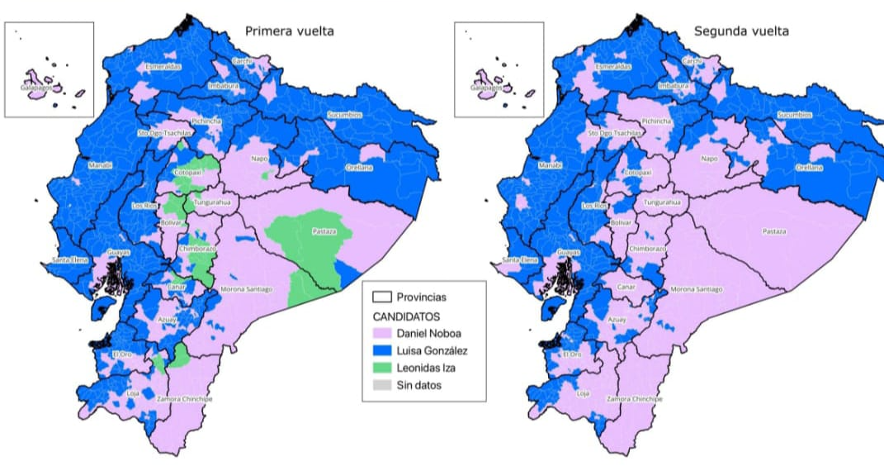
The following map testifies to the extent of polarization, showing the geographic concentration of the 2025 vote. Although Noboa surpassed Gonzalez with only 16,746 votes in the first round, he extended his advantage to more than 1.18 million votes in the second round. He won nineteen provinces—including Guayas, El Oro, Imbabura and Orellana, previously strongholds of Correism and the Revolución Ciudadana—while Gonzalez only held only five provinces. Even so, his party only obtained sixty-six seats in the National Assembly, compared to the sixty-seven obtained by the Revolución Ciudadana. Both blocs failed to reach the seventy-seven seats required for an absolute majority.
2025 Electoral map of Ecuador, first round and second round
A return to indebtedness
In 2019, Lenin Moreno signed a deal with the IMF, marking significant departure from the political and economic program of the Revolución Ciudadana. After more than a decade, Ecuador had returned to the IMF, and the credit and economic cooperation between the IMF and Ecuador increased drastically from 2020 onwards.
Prior to the 2019 agreement, the IMF had not had a significant presence in Ecuador since 2003. The Revolución Ciudadana had no relationship to the IMF and the World Bank. But the agreement under Lenin Moreno, ratified in 2024, imposed a harsh fiscal adjustment and consolidation program, reducing public investment, government spending on social programs, allocations to universities, research for development, funding for public enterprises, and more.
We can compare Ecuador’s fiscal adjustment to those of Argentina and Honduras. In the Extended Fund Facility Arrangement (EFF) with Argentina, signed in 2022, the IMF projected a fiscal consolidation of 2.2 percent of country’s GDP from 2022–2024.5The IMF uses the EFF as an instrument to “assist” nations facing medium-term balance of payments problems, derived from structural deficiencies that require a considerable period of time to rectify. This entails the installation of conditions such as cuts in public spending, fiscal reforms, privatizations or market liberalization, which in some cases have led to an increase in social inequality. In the agreement signed with Honduras in 2023, the fiscal consolidation program was set at 1 percent of GDP. In the case of Ecuador, the IMF proposed an adjustment program that, on average, amounted to 5 percent of GDP and in aggregate terms represented 10 percent. Ecuador thus faces a much harsher structural adjustment than other countries in the region, and the consolidation targets as a proportion of GDP have increased over the last five years.
IMF fiscal consolidation targets for Ecuador as a percentage of GDP
| Measures and policies as % of GDP | SAF-2019-21 | SAF-2019-21 | SAF-2019-21 |
|---|---|---|---|
| New revenue measures | 0.7 | 2.6 | 3.7 |
| Tax Reform | 1.8 | 3.0 | 1.9 |
| Previously adopted tax changes | -1.0 | 0 | 0 |
| Elimination of ISD | -0.2 | 0 | 0 |
| Monetization of assets (privatizations) | 0 | 0 | 0 |
| Other income | 0.2 | 0 | 1.7 |
| Expenditure measures | 4.3 | 2.9 | 1.8 |
| Wages and salaries | 1.0 | 0.6 | 1.2 |
| Goods and services | 0.8 | 0.7 | 0.8 |
| Other expenditures | -0.1 | 0 | 0.2 |
| Capital expenditure (public investment) | 0.9 | 2.1 | 0 |
| Elimination of fuel subsidy | 2.1 | 1.1 | 0 |
| Social spending | -0.4 | -0.9 | -0.4 |
| Total fiscal consolidation | 5.0 | 5.5 | 5.5 |
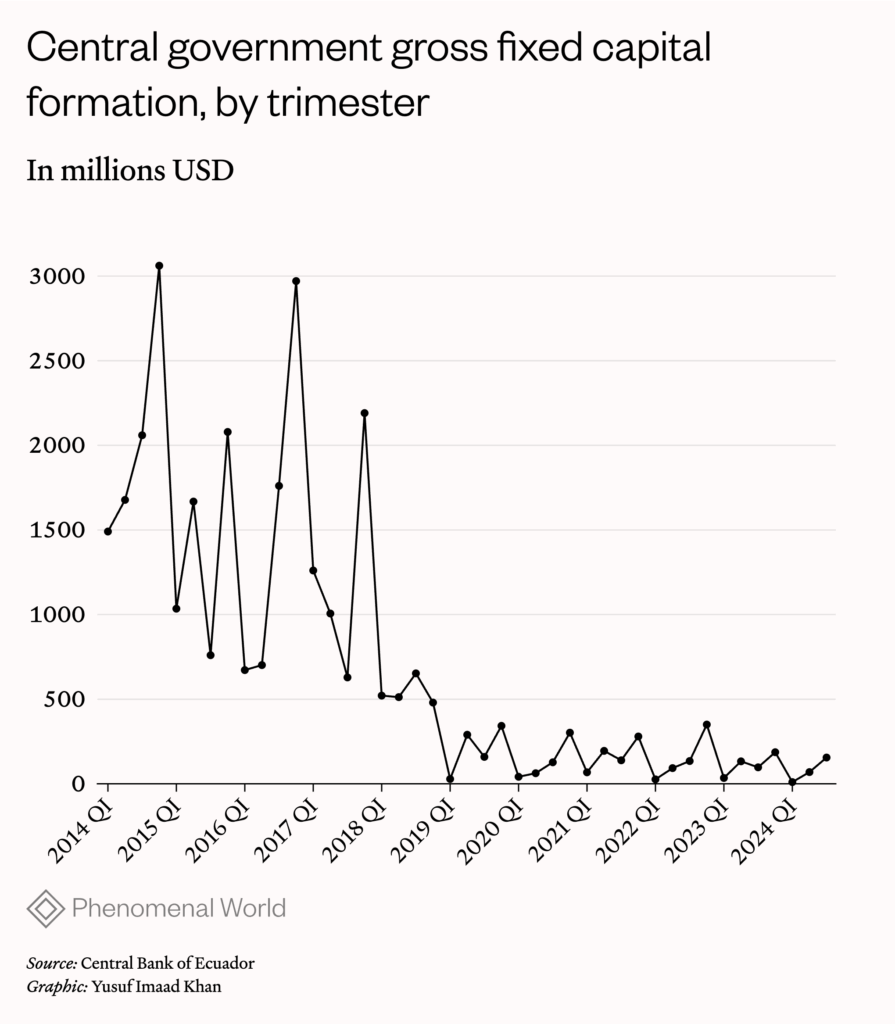
The following graph shows how public investment rapidly decreased as a result of the economic adjustment.
The IMF adjustment program led to employment stagnation and reduced formal employment. In response to the poor labor market, the right advocated for weakening labor legislation and increasing labor flexibilization to boost employment levels.
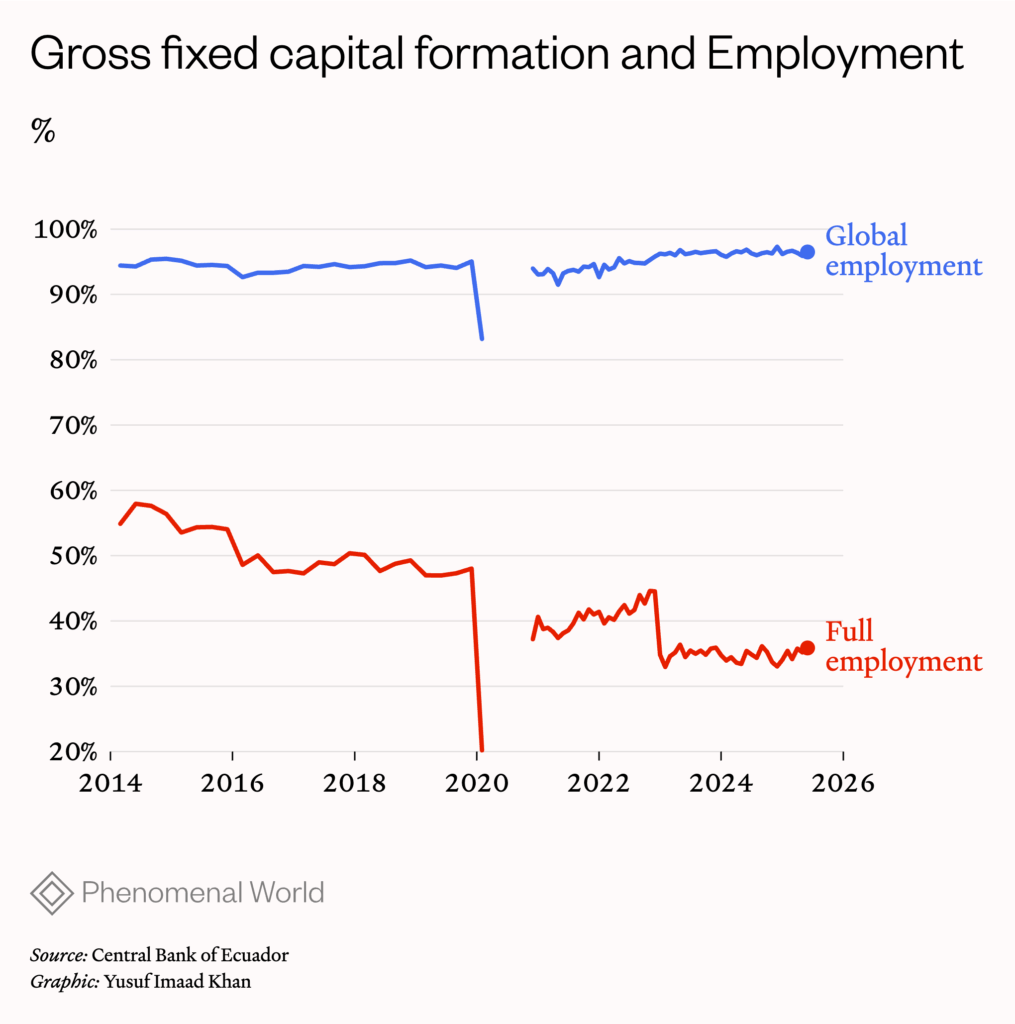
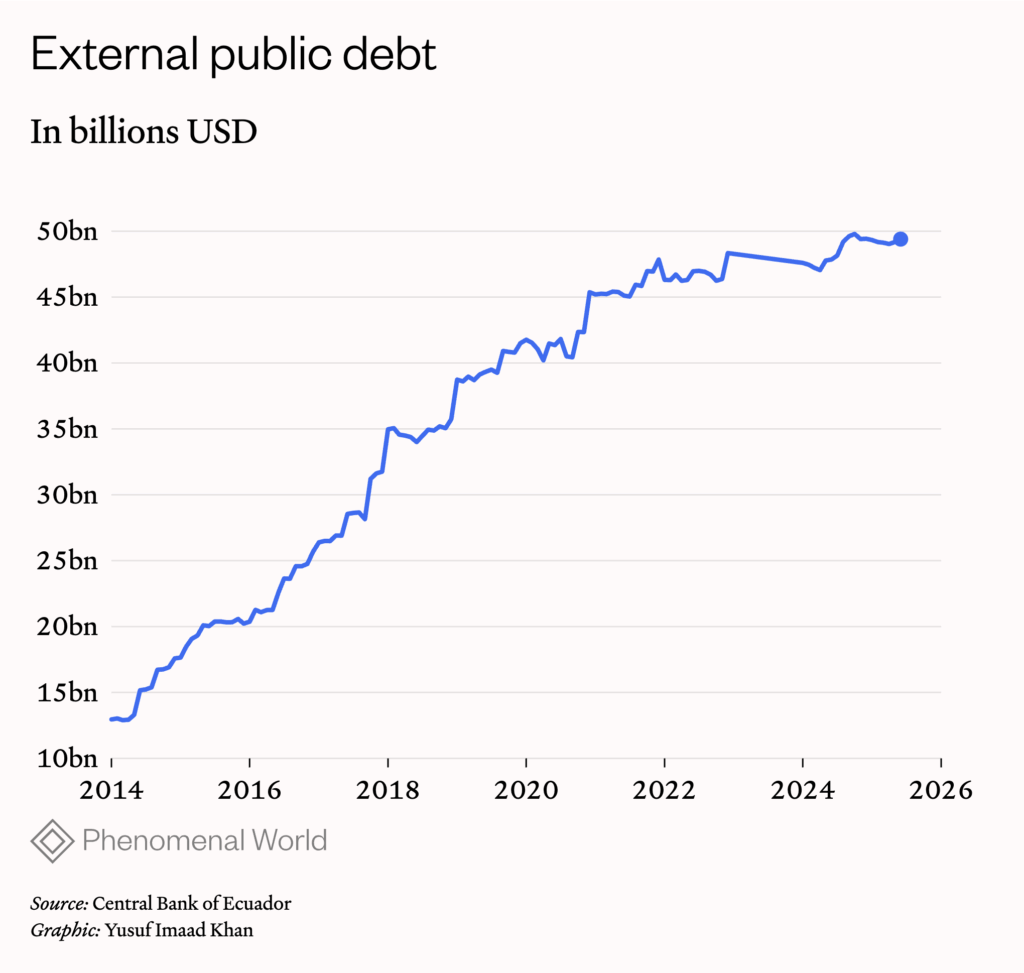
Ecuadorians paid for the austerity policies through unemployment and informality. The above graph indicates that full employment was close to 60 percent of the economically active population before the adjustment, and it dropped to around 30 percent afterwards. The IMF program also created an excessive amount of public debt, which rose from $17.6 billion in 2014 to more than $47 billion in 2024. At the same time, the program delinked public debt and development financing.
These effects spurred an economic crisis. If spending and investment policies of the Revolución Ciudadana had continued, so too would have economic growth— the projected GDP for 2027 would have been close to $160 billion. The current projection in the IMF’s own forecasts (2024) points to a GDP of slightly less than $130 billion by 2027. The difference of $30 billion is the cost of the fiscal consolidation program.
The structural adjustment also led to a reversal of the social protections in place since 2008. These protections were based on the guarantee of rights, in accordance with the new constitution. The sudden cutbacks to these programs sparked a series of social mobilizations against the agreement in October 2019 and June 2022, which were met with violent state repression. The government conducted mass arrests, with human rights organizations warning that 76 percent of detentions were arbitrary or illegal.
In response to the protests, the government agreed to suspend a reform to fuel subsidies which would have increased fuel prices according to an automatic fuel pricing formula. The IMF wrote on the unrest:
The (IMF staff) report should have recognized the fierce opposition to the reduction of fuel subsidies among influential groups in the population…. Ecuador faced weeks of destabilizing social unrest when fuel prices were revised. There were also violent social protests that nearly toppled the government when the administration attempted to cut fuel subsidies in October 2019, highlighting how politically sensitive the issue had already been prior to the program’s approval (Emphasis added).
The economic recession sparked by the adjustment hurt both the poorest sectors and the middle classes. With the suspension of social programs and decreased spending on health and education, the absence of the state led to a power vacuum in many regions of the country. This was immediately exploited by sectors of organized crime and drug trafficking, leading to a serious internal security crisis. Organized criminal groups began to dispute urban and peripheral territories and state institutions, especially with the onset of the Covid-19 pandemic. Violence spilled across towns, and the state was accused of abandoning the population. Despite an exponential increase in violence, Ecuador did not update its Comprehensive Security Plan 2019–2030 until 2024.6The National Comprehensive Security Plan (PNSI) 2019-2030 was approved in its first year, but was not fully updated or implemented for several years, as a result of institutional instability, political crises, and lack of coordination among the bodies in charge of internal security. The intersection of the political, economic, social and security crises thus formed the basis of the 2025 election, in which Ecuador again saw the triumph of the right amid a hegemonic dispute.
The oligarchic-neoliberal model
There was no need for big economic groups and right-wing political parties to negotiate over power—right-wing political leaders came directly from the country’s oligarchic class. In Ecuador, as in most liberal countries, large business groups dominate the economy. As a result, markets are monopolistic or oligopolistic. The following chart displays the economic power of these groups:
| Sector | Economic group |
|---|---|
| Finance | Pichincha; MultiBG-Banco Guayaquil |
| Commercial distribution and imports | La Favorita; Mi Comisariato; Almacenes Juan Eljuri; Comandato; Tomebamba. |
| Multinational | Schlumberger; OCP; Claro; Movistar; General Motors; Halliburton; Nestlé. |
| Agroexports and Agribusiness | Noboa; NOBIS; Santa Priscila; Reybanpac; Ubesa. |
| Industry | Andec; Arca; Dinadec; KFC; Alex; La Fabril; Adelca; Holcim. |
| Health and Health Insurance | Difare; Future; Conclinica; Farmaenlace; Fybeca |
The income of these groups represents about 75 percent of domestic GDP. The heads of these groups participate directly in elections and ad hoc political parties on the right. Daniel Noboa, for example, is the heir to the Noboa Corporation and the NOBIS group. Guillermo Lasso Mendoza, who served as President from 2021 to 2023, served as the CEO of Banco Guayaquil. Otto Sonnenholzner, Vice President from 2018 to 2020, was linked to the Santa Pricsila Group. The oligarchic-neoliberal model is not just of influence, but of governance.
The consolidation of the oligarchic-neoliberal model has transformed Ecuador’s political system. Since 2017, the right has sought to undermine the 2008 constitution. The government declared independence and autonomy of the Central Bank, alongside the Law for the Defense of Dollarization of 2021, and imposed fiscal ceilings on decentralized autonomous governments. These new policies have generated a contradictory and redundant legal regime, which has since been used to justify privatization, deregulation, and the imposition of the IMF economic program.
The oligarchic-neoliberal model has sought state capture and intensified corruption. Through hyper-presidentialism, emergency economic laws have legislated all aspects of the transition and ensured political domination. The Organic Law of Public Integrity of 2025, for example, was presented as an urgent economic law, but it changed nineteen legal texts, many of which pertained to non-economic spheres.
The oligarchic-neoliberal model has also mobilized lawfare against the Revolución Ciudadana, instrumentalizing legal codes, and particularly criminal law, to persecute the political opposition.7(<)a id='_ftn1' href='#_ftnref1'(>)[1](<)/a(>) Virgilio Hernández, Silvina Romano and Marcelo Maisonnave, coords., (<)em(>)Lawfare en Ecuador: Guerra contra la democracia y el derecho (<)/em(>)(Quito: Ruta Crítica, 2024). The State Attorney General’s Office has gone after political opponents, incapacitating the Revolución Ciudadana and preventing full electoral participation.
Under Daniel Noboa, Ecuador’s state of emergency has been made permanent. Organized crime is now a “beligerant non-state actor,” and the internal conflict is the focus of state policy. To this end, Noboa issued more than eleven Decrees of State of Exception and Internal Armed Conflict, consolidating this permanent state of exception through both legal and electoral reforms. The vast majority of Noboa’s term has taken place under this state of exception, and extraordinary “iron fist” measures have become normalized. These harsh strategies have failed to reduce violence and received criticism from human rights organizations.
Although oligarchic-neoliberal model seems incapable of resolving the security crisis, it does have a strategy to retain power. On one hand, business elites have dismantled existing state institutions to serve the interests of business elites and impose a model of indebtedness, dependent on IMF support. On the other hand, elites have used the armed conflict to gain political support, using a permanent state of exception to pacify the Revolución Ciudadana and prevent the opposition from recovering power.
The only social sector that has escaped total political polarization is the indigenous movement, which captured 5 percent of the national vote. But Noboa’s government still managed to sway the majority of its representatives to the right. This cooptation was itself enabled by state repression—Noboa responded to social unrest with violence, criminalization, and persecution. While this move speaks to the growing power of the oligarchic-neoliberal model, it is important to recall that civic organizations and social movements have historically proved resilient in Ecuador. The current juncture marks just one conflictive episode in a history of political disputes, and an alternative path still remains a possibility.
Further Reading

Border Traffic
Ecuador in the global drug trafficking chain
The rise of Ecuador in the transnational network of organized crime is a relatively recent phenomenon. Although the country has supplied chemical inputs for cocaine...
Argentina’s Debt Trap
Milei’s return to the IMF
After publicly endorsing Javier Milei’s economic achievements since coming to power in December 2023, the IMF has approved a new Argentine bailout package of $20...

Concentration Spiral
The growing power of Colombia’s banks
In Colombia, economic and political power is concentrated in the hands of a few major economic players. From 2000 to 2022, thirteen conglomerates have risen to...