October 24, 2025
Analysis
Syrian Continuity
The emerging picture of Syria’s political economy
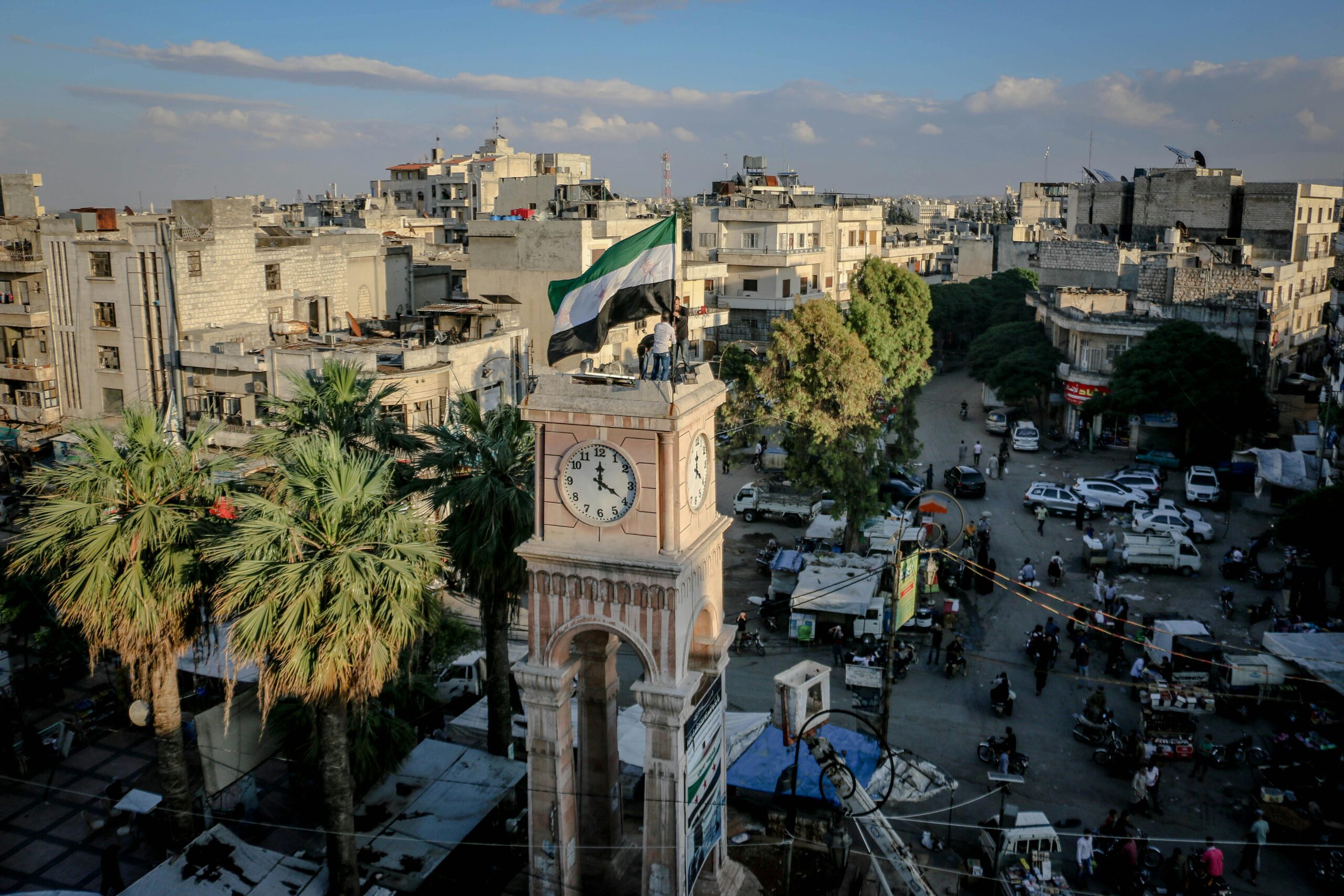
Abu Muhammad al-Jolani, founder and commander of the Nusra Front, reached the outskirts of Damascus on December 8 last year, after a stunning rout of provincial capitals. Emerging from their stronghold in Idlib, the northeastern Syrian city near the Turkish border, Jolani’s rebel coalition—Hay’at Tahrir al-Sham (HTS)—took Aleppo, Hama, Deir ez Zor, and Homs, with the support of the Turkish-backed Syrian National Army (SNA). For the past decade, with the aid of Russian air cover and Hezbollah’s fighters, the Syrian National Forces had slowly expanded their territorial control in Syria’s civil war. In two weeks, Jolani’s opposition reversed these gains and ended fifty-four years of Assad dynasty rule.
The project of reconstruction the rebels inherit will be one of one of the region’s largest since the Arab Spring began in 2011. Of the civil wars in Syria, Yemen, and Libya set off by those uprisings, Syria’s has been the bloodiest. According to the Syrian Observatory of Human Rights, 656,000 people (more than 200,000 civilians) died violent deaths in Syria from the start of the revolution in 2011 to March 2025. About 12 million remain displaced. The physical infrastructure of transportation, health, and education is devastated. Syria faces severe drought and multiple, ongoing foreign occupations. But for Jolani’s cautious supporters, the possibility, however small, of a break with the Assad regime cannot be overlooked. What are the potentialities for change under the new Syrian government?
Since taking the helm, Jolani—nom de guerre for Ahmad al-Sharaa1A popular assumption about his (<)em(>)nom de guerre(<)/em(>) Jolani is that it refers to the Syrian Golan region where his family was displaced by Israel. A competing theory is that it refers to the Jolan neighborhood in the Iraqi city of Fallujah, where as a jihadist soldier in Al-Qaeda in Iraq, he may have served during the Anbar insurgency.—has pursued a program of sanctions relief and geopolitical realignment with Europe, the United States, and Gulf states. Syria has adopted a new flag, parliament, and constitution. But despite Sharaa’s attempts to distance the new regime from the symbols and alliances of its predecessor, the rebels’ first year in power has presented an image of economic statecraft that is more continuity than rupture with the political economy of the Assadist ancien regime. Key policies have included reducing subsidies and public services, privatizing state-owned firms, cutting taxes on the wealthy and corporations, liberalizing trade, and chasing Gulf investment. In the words of Minister of Economy Bassel Abdul Hanan, the new Syria will be a “free-market economy respecting Islamic laws” where private property is “sacred.” Foreign Minister Asaad al-Shibani emphasized this theme at the Davos conference in Switzerland, where he spoke in January 2025. For the people of Syria, how different will this be to Assad’s Syria?
An Assadist Inheritance
Bashar al-Assad accelerated a reform process started by his father, Hafez, who rose to Syria’s presidency through a series of coups d’etat in 1966 and 1970 as the head of the Syrian branch of the Ba’ath Party. The first reforms were gestures toward liberalism. “Elected” in June 2000, Bashar released hundreds of prisoners, closed the notorious Mezzeh prison in Damascus, and authorized newspapers like al-Dommari, banned for four decades, to resume publishing. They were also politically centralizing: the once mighty Ba’ath Party was hollowed out: within two years, sixty top political and military officeholders, nearly all provincial governors, and all Ba’ath party provincial heads, were dismissed. In the 2003 parliament, 178 of the 250 deputies were newcomers, and the 2005 party congress ousted vice president Abdel Halim Khaddam—last of the Ba’ath old guard. Others, like the former interior minister Ghazi Kana’an, were found dead in their home. In their place, Assad recruited a crop of liberal technocrats with Western graduate degrees.
It was Bashar al-Assad, not Sharaa, who first enlisted Syria into obligations to western finance. Despite claiming the mantle of Arab socialism, a myth which persisted among elements of the American and European left, the Assad regime by the mid 2000s was privatizing most significant economic sectors.2Daher, Joseph. 2020. (<)em(>)Syria After the Uprisings: The Political Economy of State Resilience(<)/em(>). Haymarket Books: esp. chapter 1. Max Ajl, Bassam Haddad, and Zeinab Abul-Magd. 2021. “State, Market, and Class: Egypt, Syria, and Tunisia.” (<)em(>)A Critical Political Economy of the Middle East and North Africa(<)/em(>): 46–67. In 2001, after four decades of state control, private banks were allowed to operate again. Between 2003 and 2005, taxes on private sector profits were reduced from 63 percent to a range of 15–27 percent—easily evaded given lax or incapacitated enforcers. In its 2005 conference, the Ba’ath Party declared a “social market economy” as a new guiding star for policy. In 2007, a new Syrian Investment Agency was established. The next year, foreign ownership was legalized by decree. Foreign direct investment climbed geometrically, from $120 million in 2002 to $3.5 billion in 2010.
Departing from his father, Bashar gave ears to the International Monetary Fund and World Bank. Foreign exchange bureaus were liberalized, and a Damascus stock exchange opened in 2009. Bilateral trade agreements were signed with Turkey in 2004, Iran in 2006, and Arab League states in 2005, eliminating customs duties and simplifying cross-border trade. This contributed to a surge of imports, which grew at a faster rate than exports, deindustrializing the country as import-competing manufacturers shut down. The geography of factory closures shaped the country’s politics, concentrated in the Sunni-dominated suburban rings of cities where rural-to-urban migration was most intense—and where the first protests in 2011 began.3Matar, Linda. 2016. (<)em(>)The Political Economy of Investment in Syria(<)/em(>). Springer (page 115).
The gains of this new capitalist largesse largely benefited the upper class, especially a narrow group of oligarchs who exploited the new loosening of capital controls to transfer profits abroad. Chief among them was Assad’s cousin Rami Makhlouf, who became the wealthiest man in Syria after winning generous state contracts for his Syriatel telecom company in the early and mid 2000s and reinvesting his earnings into real estate. Others received exclusive licenses to import luxury vehicles or buy large farms previously owned by the government.4These include Nader Qalai’s dealerships, Issam Anbouba’s agro-businesses and Samir Hasan’s Syria-Russia Business Council. The coercive apparatus also saw a change of guard: Bashar’s brother Maher became the de facto commander of the army’s special fourth Armored Division. Key government positions—head of the defense ministry, family security detail, major branches of the General Security Directorate and military police—were staffed by a narrow network of Bashar’s family and close associates.5See Donati, Caroline. 2013. “The Economics of Authoritarian Upgrading in Syria.” (<)em(>)Middle East authoritarianisms: Governance, contestation, and regime resilience in Syria and Iran(<)/em(>): 35–60. Hinnebusch, Raymond. 2012. “Syria: From ‘Authoritarian Upgrading’ to Revolution?” (<)em(>)International Affairs(<)/em(>) 88(1): 95–113. And Hinnebusch, Raymond, and Tina Zintl. 2015. (<)em(>)Syria from Reform to Revolt: Volume 1: Political Economy and International Relations(<)/em(>). Syracuse University Press (pages 29–38).
On the lower end of the income distribution, the share of wages in national income slipped, and the share employed in services rose. As part of the de-Ba’ath-ification program, public sector workers over the age of sixty were retired, opening space for new cohorts, while state pensions were scaled back. The cost of living was allowed to rise, as rent controls were lifted and subsidies on food, gas, and other consumables reduced. New private schools were approved, and the health system was gradually privatized.6Al-Abdulla, Orwa, Maher Alaref, Agneta Kallström, and Jussi Kauhanen. 2025. “The Health System in Syria (2000–2024): Assembling the Pieces of a Fragmented System—A Scoping Review.” (<)em(>)Health Research Policy and Systems(<)/em(>) 23(1).(<)br(>) But as the public share of spending in education and healthcare dwindled, social inequities became more apparent. Real-estate speculation inflated housing costs for renters, and the housing construction sector found it unprofitable to build for the poor.7Ahmad, Balsam, and Yannick Sudermann. 2011. “Syria’s Contrasting Neighbourhoods: Gentrification and Informal Settlements Juxtaposed.” (<)em(>)Syria Studies(<)/em(>) 3(2): 1–63. Privatization of land, previously owned by the state but tended by the rural poor, was particularly brutal. Drought and cuts to fuel subsidies wiped out smaller farmers, forcing them to sell.
Provinces of Syria that produced the lion’s share of grain and hydrocarbons, like majority-Kurdish Jazirah in the northeast, were already among the poorest and least developed of Syria. In 2004, the government began allowing landlords to evict tenants who had worked the land for generations, replacing them with temporary workers. Syria’s agricultural labor force contracted by about 44 percent between 2002 and 2008, magnified by a two-year drought in 2007–08. With no corresponding growth in industrial sectors to absorb the surplus, the population in the outskirts of cities like Aleppo, Damascus, and Dara’a had grown by 300,000 families by November 2009.8Aita, Samir. 2010. “Is There an Agricultural Problem in Syria?” (Arabic) (<)em(>)Ar-ra’e. (<)/em(>)See also Ababsa, Myriam. (2015). “The End of a World: Drought and Agrarian Transformation in Northeast Syria (2007–2010)”. In R. Hinnebusch & T. Zintl (Eds.), (<)em(>)Syria from Reform to Revolt: Volume 1: Political Economy and International Relations(<)/em(>) (pp. 199–222). Syracuse University Press. For 300,000 families, see Mohamad Alloush, director of the environment department at the State Planning Commission (SPC) cited in IRIN, “Syria Drought Pushing Millions into Poverty,” 24 November 2009. On the eve of the revolution, an estimated 30 to 40 percent of Syria’s population lived in informal dwellings.
The political economy of civil war
As the social fabric strained, Bashar leaned on oligarchs like Rami Makhlouf to mobilize electoral support when needed. Religious foundations—newly licensed by the Assad regime and funded by Gulf capital, like the Jama’at Zayd—filled the vacuum left by the shrinking welfare state. In place of the old Ba-ath party network, tribal networks became increasingly important: in Aleppo, the Berri and Shahada tribes gained a new prominence, while in Raqqa, loyal tribes took over state farms privatized by Assad. This kleptocratic governance model, committed to imposing austerity, shredded a social contract and laid the foundation for a revolutionary uprising in 2011.9For a good comparative review, see Anand Gopal. 2020. “The Arab Thermidor.” (<)em(>)Catalyst: A Journal of Theory & Strategy(<)/em(>) 4 (2).
The regime’s iron response to that uprising and the subsequent civil war, inflamed by a gridlock of foreign powers, claimed more than half a million lives and precipitated horrific crimes: sarin gas attacks in Ghouta, mass torture and executions in Sednaya, Yazidi genocide, US and Russian bombings that reduced Deir e Zor and Raqqa to rubble.
The rise of ISIS—the extension of Abu Bakr al Baghdadi’s caliphate in Iraq, which established its headquarters in Syria’s rebel-held town of Raqqa in 2014—marked this violence at its most extreme. Ahmad al-Sharaa had arrived in Syria three years earlier from Iraq, on al-Qaeda’s orders to raise an army. As ISIS followed the Euphrates upstream, occupying a string of cities in Syria, the US began arming a Kurdish-Arab militia calling itself the Syrian Democratic Forces (SDF). Turkey, in turn, began to arm a rival rebel group calling itself the Syrian National Army (SNA). In 2019, the Turkish military itself invaded northern Syria, displacing 310,000 Kurdish residents from the Afrin Canton, whose homes were seized and forcibly resettled with Arab transferees from eastern Ghouta.10Attempts to Arabize the Kurdish periphery had roots in the policies of the Ba’ath and Assad dynasty: in 1962, following a census, an estimated 120,000–150,000 Kurds were stripped of Syrian citizenship. The disincorporated Kurdish populace and the Kurdistan Workers Party’s (PKK) use of the Syrian cross-border safe haven made Syria a military target for Erdoğan, who was quick to claim credit for the new Islamist regime. See Tuğal, Cihan. “Erdoğan’s Syria?” New Left Review – Sidecar, 13 December 2024. Sharaa, for his part, had remained loyal to Al Qaeda in its split with Baghdadi. By 2017, he had dissolved Nusra and maneuvered its successors into an independent coalition: Hay’at Tahrir al-Sham (HTS) in the western city of Idlib. For Assad, war propelled him to centralize control over his kleptocrats. By 2020, the palace had established a conglomerate of more than 100 companies in strategic sectors such as telecoms, banking, real estate and energy. Dubbed “Al Ahed,” it may have held more than 30 percent of Syria’s economic output by 2024.11Reinoud Leenders, in Timour Azhari and Feras Dalatey, “Syria is secretly reshaping its economy. The president’s brother is in charge.,” (<)em(>)Reuters(<)/em(>), August 6, 2025, (<)a href='https://www.reuters.com/investigations/syria-is-secretly-reshaping-its-economy-presidents-brother-is-charge-2025-07-24/'(>)https://www.reuters.com/investigations/syria-is-secretly-reshaping-its-economy-presidents-brother-is-charge-2025-07-24/(<)/a(>).
This included the business empires of Samer Foz, Mohammed Hamsho, and the Qaterji brothers. Another consolidation scheme was the Syria Trust for Development, an NGO empire run by Asma al-Assad, wife of Bashar, who channeled development and humanitarian funds to regime-held areas, skimming off the cream for luxury consumption. After Bashar’s 2019 feud with his cousin Rami Makhlouf, she also seized control of his telecom company Syriatel in what she labelled an “anti-corruption campaign.”
For the vast majority, war meant immiseration. The share of Syrians living below the poverty line tripled, from 30 to 90 percent, over the course of the uprising and civil war. Farm production sank to a quarter of pre-conflict values. The war unleashed an era of looting and narco-trafficking, particularly the amphetamine-like drug Captagon. The health sector collapsed: by 2016, almost half of Syria’s 453 hospitals had been damaged (a third fully destroyed), and the number of persons to physician rose from 611 to 1,442. A third of Syria’s housing stock—1.3 million units—was destroyed or severely damaged, leaving much of Aleppo, Yarmouk, and Daraya to prefigure the haunting landscapes that would later characterize Gaza.
The war precipitated a period of commercial isolation. US, EU, and UK sanctions froze Syria off from the global economy. By 2022, Syria had become the third heaviest sanctioned country in the world. Iran and Russia extended the Assad regime credit and fuel lines, comprising the majority of the current government’s estimated $23 billion of sovereign debt. As external liabilities grew, annual export earnings shrank from $8.8 billion to roughly $1 billion between 2010 and 2024. Bank-held foreign exchange reserves plummeted from $18.5 billion to $200 million, a 99 percent drop. Beginning in 2019, to conserve hard currency reserves following a financial crisis in neighboring Lebanon, the Syrian central bank in Damascus introduced varied exchange rates for different economic sectors. By official exchange rates, the Syrian pound’s value against the dollar declined 300-fold—from 47:1 in March 2011 to over 11,000:1 in late 2024. At that time, Syria’s GDP still hovered at less than half of its 2010 value.
Balkanization and the Idlib system
The 2020 Idlib ceasefire did not lead to recovery. Impeded by scarce credit and Western sanctions, hydrocarbon production declined by 74 percent over the decade, particularly in the northeast of the country, under the Kurdish-led Democratic Autonomous Administration of North and East Syria (DAANES). After the US-backed SDF took control of the Rmeilan and Jabsah oilfields, these sites remained largely idle. In 2020, Turkey also began reducing the volume of Euphrates waters flowing into Syria, as part of Ankara’s planned construction of nineteen hydroelectric power plants and dams upstream—a regional development strategy that also deprives Kurdish-led Rojava of water.12As Bashar Youssef (<)a href='https://aljumhuriya.net/en/2025/07/11/thirst-and-geopolitics/'(>)argues (<)/a(>)in (<)em(>)Jumhuriya(<)/em(>).
The last holdout against Assad, the rebel stronghold of Idlib in the country’s west, benefited from its proximity to the Turkish border. In an effort to ensure that Syria’s civil war did not escalate hostilities between Turkey and Russia, the two foreign military powers established a demilitarized zone across northern Syria. It was there that Sharaa spent the war establishing economic monopolies for a circle of loyal elites.13As Mansour Hussein (<)a href='https://aljumhuriya.net/en/2024/05/24/from-freelance-jihad-to-crony-capitalism/'(>)recounts(<)/a(>) in (<)em(>)Jumhuriya(<)/em(>). Under Assad, a businessman could only pursue accumulation up to limits set by regime insiders. When a luxury car initiative encroached too far on Rami Makhlouf’s Mercedes Benz dealership, for example, the government suspended its import license.14When another magnate refused to sell majority shares of (<)em(>)Orient TV(<)/em(>) to Makhouf, his Damascus office was shut down and raided by security forces.In Idlib, HTS similarly cracked down on local rival profiteers, protecting a coterie of monopolists dominating key sectors of the rebel economy: oil imports, building construction, monetary exchange, and animal products. Restrictions on smuggling were tightened, channeling trade through HTS customs authority and subsidiaries.
The Salvation Government that emerged in Idlib intervened to prevent the formation of independent labor union federations. It appointed its own leadership to professional associations. Espousing a platform of “e-governance” and permit reform, the statelet’s prime minister reformed zoning, lowered real-estate fees, and simplified planning regulations. Glitzy new shopping malls appeared. Idlib state contracts were awarded to a close circle of cronies including Sharaa’s son-in-law Abu Hafs Binnish and former HTS commander Mustafa Qadid.
The rebels assumed power in a country under multiple foreign occupations. By mid 2024, there were 102 foreign military bases in Syria, not including the Israeli-occupied Golan Heights: fifty-two for Iran, twelve for Turkey, twenty-one for Russia, and seventeen among the United States and its Western allies.15This is according to the (<)em(>)Jusoor (<)/em(>)independent think-tank.This is not without its expected consequences. As the Assad regime fell in 2024, Turkish and Turkish-backed forces in the Syrian National Army launched new offensives against the US-backed Syrian Democratic Forces in areas such as Kobani, Manbij, and the Tishrin Dam. From November to May, about 800 people had been killed in Turkish bombing or clashes between the SNA and SDF.16“Operation Peace Spring”, as Ankara dubbed the latest iteration of Erdoğan’s power game, has involved drone strikes on Kobani’s only water station, as well as DAANES oil refineries. See Tol, Gönül. 2022. (<)em(>)Erdoğan’s War: A Strongman’s Struggle at Home and in Syria(<)/em(>). Oxford University Press. In December, Iranian assets were overtaken by HTS forces. But the US has, to date, preserved eight major military bases, and Russia hopes to keep two.
Israel represents perhaps the most direct foreign threat to the regime’s stability. Already deeply involved in a genocidal war in Gaza, Israel invaded Syria last December and undertook a massive bombing campaign that destroyed 85 percent of Syrian surface-to-air batteries, as well as airfields, munition warehouses, and weapon production sites from Latakia to Palmyra. Moving beyond the Golan Heights (annexed in 1981), Israel seized the Syrian side of Mount Hermon, several towns in the Quneitra and Daraa governorates, as well as dam reservoirs along the Yarmuk river, placing its forces sixteen miles from Damascus and in control of approximately 30 percent of Syria’s remaining fresh water supply. Further Israeli advances are ongoing.
At more than a thousand missile strikes and counting, the bombing has ensured any Syrian government is at the mercy of Israeli air power. Against US injunctions, the Damascus General Staff compound was hit in July, even as Israeli prime minister Netanyahu announced plans to double the number of Jewish settlers in the Golan and attempted to peel off Syria’s southern Druze leaders into an Israeli alliance. Israel has used the pretext of ongoing bloodshed in Syria’s southern province of Sweida between Druze, Bedouin, and HTS forces to occupy the south while demanding an entire swath of it be “demilitarized.” Others in the Israeli governing coalition, frustrated with what they take to be the inadequate pace of Damascus’ capitulations, such as National Security Minister Itamar Ben-Gvir and Finance Minister Bezalel Smotrich, have called for the new Syrian president to be “eliminated” and the HTS regime to be “dismantled.”
Economic alliances new and old
Against this backdrop of persistent military threats to HTS rule, Ahmad al-Sharaa has rapidly expanded the regime’s network of foreign backers. Immediately, he switched his combat fatigues for a Western tie—a rare choice for Islamist party leaders—and in December granted high-profile interviews to the BBC, France 24, and the Saudi Al-Arabiya, projecting the aura of a calm and responsible statesman eager to turn a new page. As the new foreign minister Asaad al-Shibani, who founded the Nusra Front with Sharaa, said, Syria “has not and will not pose a threat to any party in the region.”
US allies were responsive. In January, Sharaa met with German, French, and Italian foreign ministers. In February, many non-legislative EU, UK, and US sanctions on Syria were removed, while Sharaa’s high-profile handshakes with regional leaders—Mohammed bin Salman, Recep Erdoğan, King Abdullah, as well as Emmanuel Macron—signaled his permanence to domestic rivals and Washington. This process culminated in May with a visit with Donald Trump in Riyadh, followed by Sharaa’s address to the UN assembly in New York City in September and a Pentagon-proposed agreement on military bases.
Consequently, Syria’s economic isolation has begun to unwind. By May, Gulf monarchies Qatar and Saudi Arabia had paid off $15.5 million of Syria’s debts to the World Bank, allowing Damascus to apply for development assistance. The next month, the IMF sent a delegation to Syria, and the World Bank approved a $146 million grant to repair the country’s electricity sector.17This is the first grant to Syria since 2011. Qatar similarly pledged to double electricity supply, currently available in Syria for only two to three hours a day in most areas. Trump issued waivers for the 2019 Caesar Act, which sanctioned the Syrian government and its state-owned enterprises. In October, the US Senate voted to repeal it. Washington also lifted hundreds of Syrian names from its OFAC blacklist and removed most restrictions on US exports to Syria. European measures have unfrozen Syrian bank assets, removed export restrictions on oil, and unbanned national transport firms such as Syrian Arab Airlines. In June, Syria successfully carried out its first SWIFT bank transaction since 2011.
Trump’s move to dismantle financial sanctions on Syria has been momentous.18See Jihad Yazigi ‘US sanctions remain the biggest obstacle’. Interview with (<)em(>)IPS Journal(<)/em(>). April 15, 2025. About 80–90 percent of forex trades are conducted in dollars. Given the sheer global reach of US correspondent banks and the dominance of New York-based clearance facilities for foreign exchange markets, like those of CLS Bank, the Gulf monarchies were reluctant to risk secondary sanctions over Syria. The same applied to private investor heavyweights. Following Trump’s announcement in May, the Syrian pound rallied, rising 30 percent against the US dollar in one day, where it has since stabilized. The thaw will likely continue: after Syria successfully avoided being added to Trump’s travel ban in June, HTS had its US-designated status as a Foreign Terrorist Organization rescinded in July.
A raft of new investment deals has followed. In February and March, agreements with the Kurdish-led DAANES and the US-backed SDF restored production of Syria’s oil and natural gas. Ministry of Transport officials host ongoing meetings with the Islamic Development Bank and builders from Italy, Cyprus, France, and Turkey to rehabilitate railways degraded during the war.19Syria recently signed a memorandum of understanding with a French engineering company Matière to rebuild three dozen bridges across the country, while Turkey has (<)a href='https://www.csmonitor.com/World/Middle-East/2025/0606/syria-hejaz-ottoman-railway-revival'(>)made(<)/a(>) ambitious promises to resurrect the Ottoman-era Hejaz Railway. In August, Saudi Arabia announced $6.4 billion in deals for 47 new investment projects, including a cement plant, baby formula factory, and hotels. Damascus also welcomed an entourage of foreign companies that month: Samsung, Nokia, Thales Group. American hydrocarbon developers in the region now include oilfield services company Baker Hughes and the oil and gas production companies Hunt Oil and Argent LNG; in September, Swiss energy conglomerate Vitol Group processed Syria’s first crude oil shipment since the removal of sanctions. Despite his overtures to the US and Europe, al-Sharaa has also maintained cool, but cordial ties with old rivals. For instance, there is evidence that Russian oil and gas shipments to Syria have risen since December. Russia’s mint continues to honor its thirteen-year contract to print Syrian currency, and Russian oil companies have been invited to prospect and develop its northeast. The announcement by the Kurdistan Workers’ Party (PKK) in May to end its forty-year insurgency against Turkey—a “bitter pill” to swallow, according to Alp Kayserilioglu—could ease northeast incorporation, which Ankara and US envoy Tom Barrack have been pressuring Kurdish leaders and the SDF to accept.
For their part, Israeli policy shapers have envisioned a Syria balkanized into confessional micro-states—Alawite, Druze, Kurdish, and Sunni—dependent and easily dominated by foreign powers. Barrack recently clarified the motivation: “Strong nation-states are a threat, especially Arab states are viewed as a threat to Israel.” Syria’s geopolitical vulnerability, its proximity to Israel, its lack of military defenses, plus the contestable position of Sharaa within the rebel movement all create strong incentives for him to extend his network of foreign backers. A general finding in the study of rebel politics is that groups that come to power without a clear hegemonic position within the rebel movement are vulnerable to spoilers or coups d’etat that push the country back into civil war.20See Clarke, Killian, Anne Meng, and Jack Paine. 2025. “Violent Origins and Authoritarian Order: Divergent Trajectories after Successful Rebellions.” Working Paper. Also Krause, Peter. 2017. (<)em(>)Rebel Power: Why National Movements Compete, Fight, and Win. (<)/em(>)Cornell University Press. This is why Sharaa himself characterized the Idlib system of governance and reconstruction, favorable to foreign investment under tight centralized control, as a “successful model to be emulated.”
Nusra at Davos
The Idlib model is a striking expression of Syrian neoliberalism. In January, Damascus announced plans to lay off one-third of public-sector workers, some of whom the regime claims are “ghost employees,” but which critics see as a pretext for preferential hiring. Thousands of nurses and teachers have been fired. Tariffs on Turkish products were reduced, leading to a 31-percent increase in Turkish imports, while the land and ports authority has signed a new free-trade zone memorandum with a Chinese firm.
Syria’s foreign minister al-Shibani recently told the Financial Times that state-owned ports and factories, such as those in oil, furniture, and cotton processing will be privatized. The new income-tax law taking effect in 2026 will cut taxes on the wealthy in a bid to boost investment. In January, the electricity minister announced intentions to reduce electricity subsidies. The same month, the price for gas cylinders was raised six times over. The World Food Program, which has documented a 20-percent reduction in bread subsidies, estimates that HTS plans to eliminate this price support altogether would increase food insecurity by another 1.2 million people.
Damascus has also made attempts to incorporate sections of the Assad-era business elite. According to a Reuters investigation in July, a committee led by Sharaa’s brother Hazem, former PepsiCo manager in the Iraqi city of Erbil, has led far-reaching restructuring. Oligarchs like Foz and Hamsho both reportedly gave 80 percent of their assets to the new committee in exchange for immunity from prosecution. Sharaa also announced the formation of a sovereign wealth fund run by his brother and a development fund headed by his brother’s associate. Both schemes seem intended to develop stakes in major companies and NGOs. A presidential decree in October centralized all state-owned oil institutions and assets under the presidential palace. The conglomerate Al-Ahed created by the Assad family received a light rebranding, the Assad-era flag on its promotional materials simply swapped with the new one.21Issam Shammout, sanctioned head of Syria’s only private airline Cham Wings gave the committee a 45-percent stake. For other sanctioned oligarchs, the continued burden of US sanctions remains a powerful incentive to reach a deal: Anas Talas, Mazen Tarazi, and Wasim Kattan. Wael al-Alwani’s Syrian Observatory for Political and Economic Networks is especially useful in mapping these elites.
As HTS establishes its new government in Damascus, the country’s center of economic gravity has shifted toward the leaders of the Idlib system. Cabinet, army, security apparatus, religious councils, and provincial heads of the caretaker government have been dominated with HTS and SNA hires. The new president of the Federation of Syrian Chambers of Commerce, Alaa Al-Ali, comes from Idlib. Leadership in the Syrian bar association was replaced by members of the Free Bar Council from Idlib. Despite this consolidation of national power by Sharaa’s Idlib system, Syria’s business elite have responded favorably, and diaspora capital is trickling back in: according to the Minister of Economy Mohammad Nidal al-Shaar, Syria had by April returned some 160 factories from neighboring countries. By June, the new Directorate of Companies had reportedly registered 5,768 new Syrian companies, the large majority wholly owned by Syrians.22The Aleppo and Damascus chambers of commerce also (<)a href='https://syria-report.com/government-reshuffles-chambers-of-commerce/'(>)received(<)/a(>) a major, unelected reshuffle which limited the number of board positions and replaced the majority of members. There is also a (<)a href='https://syrianobserver.com/syrian-actors/syrias-economic-reboot-three-ministers-one-mission.html'(>)layer(<)/a(>) of diaspora technocrats for the ministers of economy, finance, and transport, while opposition-supporting business networks, such as the Ghreiwati or Ferzat families, have already moved back.
National purpose after Assad
Amid austerity and authoritarian consolidation, what sources of hope are there for a democratic, class-conscious project of national regeneration in Syria? In February, protests erupted among public-sector workers against the announced employment cuts. These wildcat strikes and protests by the civil service, disproportionately women and minorities, originated outside the parameters of the General Federation of Trade Unions, the only national affiliate of collective bargaining groups in Syria, which did nothing to mobilize its affiliate members in opposing the mass layoffs beyond issuing a few letters to the government. No significant opposition party supported the protests, either.23The revolutionary government initially dissolved existing unions in December 2024. In February 2024, however, the GFTU held elections in which many new officers won formal leadership and the public-sector unions entered into contracts with the government. For doctors, lawyers, engineers, and journalists, union leadership is directly appointed by the government. In fact, in Damascus the protests were at the GFTU headquarters, suggesting it is as much an object of contestation as the government. Only the professional associations for lawyers and journalists demanded a fair democratic process for elections and open bidding on state contracts.
This represents another point of continuity with the Assad era. After a brief period of labor militancy, independent unions were crushed or co-opted in the 1970s. But public-service bureaucracies in Syria remained largely intact throughout the war and often stretched across rebel and regime jurisdictions; the winter protests underscore the potential of an autonomous labor movement to emerge from the public sector, capable of threatening the regime with mass strikes to extract political concessions. This scenario is not entirely unrealistic. That independent labor unions, especially in the public sector, can form in autocratic corporatist settings and exert pressure is a well-documented phenomenon among Syria’s peers, such as Egypt, Jordan, and Tunisia.24Bishara, Dina. 2018. (<)em(>)Contesting Authoritarianism: Labor Challenges to the State in Egypt(<)/em(>). Cambridge University Press. Parker-Magyar, Biff. (<)em(>)Striking from the Schoolyard: Workplace Networks and Civil Society in the Contemporary Middle East (<)/em(>)(forthcoming). Beinin, Joel, 2020. (<)em(>)Workers and thieves: Labor movements and popular uprisings in Tunisia and Egypt(<)/em(>). Stanford University Press. In Syria, Sharaa’s government backed down from some of its planned reductions in public-sector employment. Instead, the government announced a raise for remaining workers, justified as a bid to prime consumer purchasing power.
A common explanation for the difficulty of such mass labor action is Syria’s sectarian cleavages, often overplayed in simplistic accounts of the war. Currents of anti-sectarian solidarity and cooperation between ordinary Syrians endure. The northeast DAANES has managed, despite Turkish invasion and mass poverty, to govern with relative peace a multi-ethnic population of 4.6 million Syrians in the area of northeast Syria reconquered from ISIS. The DAANES government’s co-chair system includes a prominent place for women, as well as the combination of a majority-Kurdish leadership and a majority-Arab army.25Debate continues about the degree to which Rojava’s social revolution is real or romanticized. See Sinan Hatahet’s (2019) working paper “The political economy of the autonomous administration of North and East Syria” and Schmidinger, Thomas. 2018. (<)em(>)Rojava: Revolution, War and the Future of Syria’s Kurds.(<)/em(>) Pluto Books.
During the March massacre of Alawites on the coast, some Sunnis adopted the role of “little Schindlers”—sheltering neighbors from HTS-aligned forces. Similarly, after the bombing of a Christian church in Damascus in June, Syrians of all confessions lined up to donate their blood. Such national, cross-confessional solidarity is a motif throughout Syria’s modern history.26As dramatized by Syrian shows like (<)em(>)Bab al-Hara, (<)/em(>)episodes of shared Muslim-Christian resistance against French colonialism were routine and celebrated: Al-Ghazzi, Omar. 2013. “Nation as Neighborhood: How (<)em(>)Bab al-Hara(<)/em(>) Dramatized Syrian Identity.” (<)em(>)Media, Culture & Society(<)/em(>) 35(5): 586–601. The old Ba’ath Party, for instance, was established in 1947 by two Sunnis, an Alawite, and a Christian. The popular base for the party’s socialist agenda was also a coalition of Sunni rural farmers and marginalized minorities (Druze, Alawites). This national coalition was a powerful redistributive force, adopting what many have referred to as the most radical planning measures of any country in the Arab world, significantly leveling inequality in the process.27Max Ajl, Bassam Haddad, and Zeinab Abul-Magd. 2021. “State, Market, and Class: Egypt, Syria, and Tunisia.” (<)em(>)A Critical Political Economy of the Middle East and North Africa(<)/em(>): 47. See also Hinnebusch, Raymond. 2004. (<)em(>)Syria: Revolution From Above.(<)/em(>) Routledge.
During the first years of the revolution, it was not unusual to hear expressions of solidarity that transcended sect. As Kurdish youth in Qamishli chanted, “No Kurd, no Arab, and Syrian people are one.” Or students in Damascus: “Not Sunni nor Alawi, we want freedom!” Or a banner in Zabadani: “Neither Salafi, nor Muslim Brotherhood … My sect is freedom.” That rejection of sectarianism is alive today: as could be read at a recent demonstration in the Mediterranean city of Latakia: “From Latakia to Sweida: one land, one blood, one fate.”
Further Reading
Three Frontiers of Global China
Prospects for South–South development without dependency
What defines Global China today? China’s global power extends beyond infrastructural investments in the global South to entail normative and epistemic shifts as well, with...
Superdependence
The Canadian auto industry's crises and organized labor
The Canadian auto industry is in a state of existential crisis, facing new US tariffs and pressures. What does this mean for organized labor?
Fiscal Democracy
Lula’s overhaul of the tax system represents a challenge to the Brazilian oligarchy which goes beyond the distributive policies of previous PT governments.