September 24, 2025
Analysis
The Anti-Climate Common Sense
How a new climate common sense was built and how Trump’s assault threatens its unraveling
Climate action in the US has lately suffered a series of disorientating reversals and is under vertiginous assault. Across the 2010s and into the 2020s, climate advocates successfully connected beliefs about the future with coalition building that made climate action an unavoidable priority for the US government. A new common sense had been built around a single premise: that the future is carbon constrained. This premise cohered a vast but fragile ecosystem of sometimes competing interests around the imperative of responding with economy-wide decarbonization.
But since 2023, skepticism has grown about the timeline on which carbon constraints will bind, and doubt has seeped in regarding the ability of climate action to deliver for its constituencies. In all its forms, the Trump assault on climate policy aims to convince Americans that climate action will make them worse off, and, in doing so, to blow up the painstakingly assembled coalitions that made US climate action possible. The undermining of both American confidence in climate action and its coalitional foundations risks locking in self-propelling negative feedback loops.
The following poses the challenges we face starkly, in the hope of sparking grounded debates about the path forward. Finding that path requires clear strategies, which in turn depend on an accurate analysis of the terrain on which advocates now have to fight.
Creating the new climate common sense
Since the 2015 Paris Agreement and the 2018 Intergovernmental Panel on Climate Change report that predicted disastrous consequences if global warming reached above 1.5 degrees Celcius, advocates of climate action shaped an understanding of the future that would rearrange the self-interest of actors in the present. Among the parameters of that imagined future: Global warming is real, and anthropogenic; as emissions accumulate and temperatures rise, ecological and economic systems will be destabilized, presaging a future that is considerably worse for human civilization; the prospect of that future, and the increasing signs of it in the present, will ultimately force governments to act to restrict carbon emissions, one way or another. In other words, the future is carbon constrained. We can call this the New Climate Common Sense (NCCS).
The strategy and solution that flows from the NCCS is rapid decarbonization. Transitioning to a low-carbon economy is in nearly everyone’s interest because the costs of mitigation and adaptation grow with delay, asset stranding threatens both public and private balance sheets, first-actors in a post-carbon system will have an advantage in a carbon constrained world, and the life prospects of ordinary people would be dramatically improved by a more stable climate system. Whereas prior consensus in the climate community understood the problem primarily as one of collective action, the new common sense advanced a theory of competition among policy makers, companies, and countries to be first to solve for the post-carbon future.
The establishment of this view in elite power centers spread rapidly in the middle of the last decade. At the highest levels of coordination—corporate boards, multilateral organizations, national and subnational governments—the new common sense turned into novel forms of commitment, and in some cases action. Net zero commitments proliferated in the corporate and financial sector, following the Nationally Determined Contributions under the Paris Agreement. Ideas for shifting financial power toward low-carbon activity emerged, like ESG and the Glasgow Financial Alliance for Net Zero. Governments undertook policies to propel the energy transition, including subsidies for renewables, carbon markets, and so on. These policies functioned as proof that the future was carbon constrained, as an accelerant on further corporate and government action, and as a wager that leadership would produce followers.
Translating NCCS into concrete climate action required prevailing in a political struggle with all of the interests opposed to decarbonization—whose nucleus is powerful business models organized around carbon intensive energy and production. A new flourishing of strategies emerged to chart a path forward, predicated on the goal of building a coalition powerful enough to overcome the political power of this carbon bloc. Among a range of actors, the emergent strategy was that of “co-benefits”—the production of alignment among many constituencies who could pursue multiple goals through decarbonization. Social movements, corporate leaders, and policy makers acting in the national interest could all find their alignment.
Youth social movements, most prominently Fridays For Future and the Sunrise Movement, garnered enormous media attention by focusing squarely on the question of their own futures. New formations like the BlueGreen Alliance (where I work) pursued policies and organizing that could win union members to the cause of climate change, by protecting workers affected by decarbonizing industry—the just transition—and to attach labor standards to public investment in the new green industries. Green New Deal activism oriented discursive and movement demands toward a vision of social renewal, in which the generational fights against income inequality and racial stratification could merge with the existential battle against climate collapse.
Corporate interest was forged by policy makers and corporate activism. Those with some carbon assets, which could plausibly become green, like electric utilities and the automakers, could be offered “decarbonization bargains” in the form of subsidies, guaranteed markets, and so on. Acting in line with the new common sense, which described an inevitable future of technological development, growing consumer demand, and government regulation, they could take the deal. And the multinational giants of the oil and gas industry began—however dubiously—placing bets on shifting off of fossil fuels and onto transition technologies like carbon capture, hydrogen, and so on. Meanwhile, the falling costs of renewables—the levelized cost of solar fell by half from 2010–2015, and again by half from 2015–2020—encouraged deployment and bolstered the common sense argument that the transition was less about trade-offs than who would reap the benefits of the inevitable era of abundant and affordable energy. Climate action was increasingly seen to mean an impending investment boom.
Meanwhile, Democratic Party foreign policy elites—absorbing the electoral rejection of the liberal establishment with Trump’s victory in 2016—increasingly alighted upon climate as a key part of a strategy of liberal renewal. The world’s technological leader, largest historical emitter, and most powerful country could spur other countries to action and supply the technology and financing needed to make the transition. Arriving at the view that climate change represented the world’s biggest challenge, but also an opportunity for the US to demonstrate constructive leadership on the global stage, and to position the US economy at the forefront of a coming technological revolution, members of this community increasingly linked public investment to fight climate action with an attack on domestic economic inequality designed to undo the economic and political damage of deindustrialization. Notably, in their February 2020 programmatic essay on this subject, Jake Sullivan and Jennifer Harris argued that a transformation in domestic economic policymaking was central to US foreign policy success—with climate action as a key factor linking the two.
The coalitional theory was one of positive feedback loops. By lowering the cost of transitioning from carbon to noncarbon business and economic models, by delivering social benefits that make climate action electorally popular, and by persuading actors that the future will in fact be carbon constrained, all would be further incentivized to get ahead of it. Each step taken in response solidified the belief that the future is low-carbon, and increased the perceived costs of inaction. This theory of change contributed to the unprecedented centrality of climate to the 2020 election. By the start of primary season in 2019, this common sense was hegemonic within the Democratic Party, such that one of the major factors the presidential candidates debated was just how aggressive they would be in combating climate change.
Common sense and consensus
The new common sense asserted the decarbonization imperative, and advanced a theory of transformation that involved co-benefits. But on a more fundamental level, the consent and action of power brokers was based on the recognition of three macro trends: the rise of China as an economic and technological power, the economic and political disturbances in advanced economies since the Great Financial Crisis, and the unavoidability of climate change itself. All of these developments—China, the crises of democratic capitalism, and climate—interacted with and shaped each other. For example, the “China shock” was blamed for deindustrialization and the rise of populism among blue collar workers. And climate action was framed either as a space in which the US and China could cooperate, or, increasingly, the need to compete with China became a reason to prioritize climate policy.
These trends had set the foundations for breaking policy orthodoxy among leading Democrats. The idea that fiscal rectitude had harmed their political prospects—in particular, that the limited fiscal response to 2008 had contributed to Trump’s election—was widespread. Helped along by (of all people) Larry Summers’s resurrection of the liberal Keynesian idea of “secular stagnation” in 2013, and the absence of any inflation in response to the loose fiscal policy of Trump’s first term, Democrats began to wonder if they had overlearned the lessons of the 1970s. The radicalization of the Republican Party—and the rise of Bernie Sanders and a “populist” wing among the Democrats—suggested that tepid bipartisanship and the median voter theorem were no longer politically winning. And China’s extraordinary economic development ignited a competitive panic, and an interest in industrial policy—which, in light of the earlier failure of cap-and-trade, came to be seen as a central vector for climate action.
The Covid-19 crisis generated a new sense of urgency and possibility. Supply chain snarls and the sudden visibility of global production networks affirmed arguments about industrial policy and domestic economic resilience. The reaction to the Covid-19 economic depression made calls for enormous fiscal stimulus commonplace—and enlivened the political possibility of public spending on all manner of social needs. Then, on January 6, 2021, the Capitol riot managed to temporarily convince national Democrats that they could and should act on a partisan basis to address the present crises—Covid, climate, inequality, and racial justice, per Biden’s inaugural.
By the beginning days of the Biden Administration, Democratic Party leaders were persuaded that something like “green industrial policy”—with pro-labor and environmental justice provisions, alongside a set of long-deferred welfare state expansions—would be the skeleton key to addressing a set of crises that went far beyond climate change. Reflecting the desires of the coalition’s constituent parts, it was thought that “big green fiscal” could reinvigorate the American economy, reduce inequality, advance racial equity, and buttress American democracy.
The trajectory from the American Jobs Plan to Build Back Better to the IRA is, by now, well-known. But it bears repeating that the sheer magnitude and number of crises that Democrats believed climate action could address—carried by the dramatic alignment around the new climate common sense—led them to prioritize climate over practically every other priority when their initial ambitions were curtailed by Manchin and Sinema in late 2021.
Governing with the common sense
The policy design of the IRA reflected the theory of the new climate common sense. Interventions were developed to align with Paris goals—most significantly the technology neutral clean electricity tax credits, which were set to last until emissions fell 75 percent from 2022 levels. The federal government was assigned a major role in guiding and financing investments in infrastructure and technologies—through uncapped investment and production tax credits, a wide assortment of grant programs, and the massive expansion of the loan authority given to the Department of Energy—with the aim of steering the transformation of the entire US energy system. Prevailing wage and apprenticeship bonuses were attached to IRA tax credits, for the first time embedding labor standards in the tax code and connecting them to low-carbon investment. Decarbonization bargains were offered to autos and the power sector, but also industry and agriculture—heading off some amount of opposition from those sectors. Domestic manufacturing was promoted, as was the notion of long-term business certainty provided by the assurance that long-term investments were being made to tackle the climate problem.
And these policies were aimed to lock in to a political economy hostile to climate action. The heartlands of the carbon coalition received the majority of new investment flows, on the conviction that future Republican congresses and administrations would be unlikely to reverse policies that were directly supporting investment and jobs in their districts. The initial impacts were considerable: capital did appear to be “crowding in” to clean energy sectors, and subsidy uptake exceeded Congressional Budget Office estimates, suggesting that, despite Manchin’s efforts, “big green fiscal” was indeed getting into gear. Together with state and federal regulatory actions that signalled a further push towards decarbonization on the heels of IRA subsidies, NCCS was being affirmed and strengthened, and positive feedback loops looked poised to kick in.
The Green New Scam
The political right and the hard-core of the carbon bloc took aim at the new common sense. Powerful and purely ideological campaigns proliferated. The push was especially strong in Republican-controlled states, which saw preemption of local climate laws and boycotts of private sector actors, representing the specter of “woke capital,” who they claimed were discriminating against their states, and grassroots misinformation campaigns to discredit the entire agenda. Finding their footing on culture war terrain, the right increasingly framed climate action as an exercise in coercive social engineering by “radical left lunatics” who hate America.
Among Democrats, developments beginning already in 2022 raised questions about whether decarbonization was quite the economic, political, and geopolitical slam dunk it appeared to be in 2021. Awkwardness first emerged in response to Russia’s invasion of Ukraine, when lowering energy prices became a domestic political imperative and US LNG looked to many like a source of both power and plenty on the world stage. Full employment, forty-year-high inflation, and the end of the Fed’s Zero Interest Rate Policy cut against some of the economic and political-economic justifications for big green fiscal, especially in the rank ordering of job creation vs. affordability among top concerns in the electorate, while also making the economics of many decarbonization investments more difficult. The eruption onto the scene of generative AI in late 2023 exploded everyone’s sense of what it would take to decarbonize the power grid. In conjunction with heightened anxieties about competition with China, AI increasingly presented a cause for “realism” with respect to the pace of decarbonization. BYD’s success underscored a growing gap with China in clean tech and raised fears of a “second China shock,” this time directly associated with decarbonization.
All the while, doubts grew as to whether the promised co-benefits of climate action were materializing. The administration consistently spoke of “good, union jobs,” but relatively few manufacturing jobs in particular were on course to be union. Commentators and advocates wondered whether procedural issues and efforts to tie direct local benefits to projects were slowing the pace of investment, and therefore slowing the timeline along which a broader set of people would experience the co-benefits (“everything bagel”) of climate action. Had Harris defeated Trump, these questions would have formed the terrain of climate politics during her administration. With Trump’s victory, they became the fissures that the new administration would exploit in its attempt to unravel what climate advocates, the Biden administration, and congressional Democrats had accomplished.
Trump’s 2024 presidential campaign made the “Green New Scam” a central theme. When Trump and the GOP won the White House and the Congress, it was clear there would be fights and reversals. But there were countervailing factors locked in by the IRA: hundreds of billions of dollars in investments and hundreds of thousands of jobs, overwhelmingly located in Republican districts and downstream of IRA tax credits. The AI boom was exploding electricity demand—cutting off clean energy tax credits would raise the price of energy precisely at the time when powerful firms and regular people wanted it abundant and cheap. And the bipartisan commitment to competition with China would demand government support of potential competitor firms in the US.
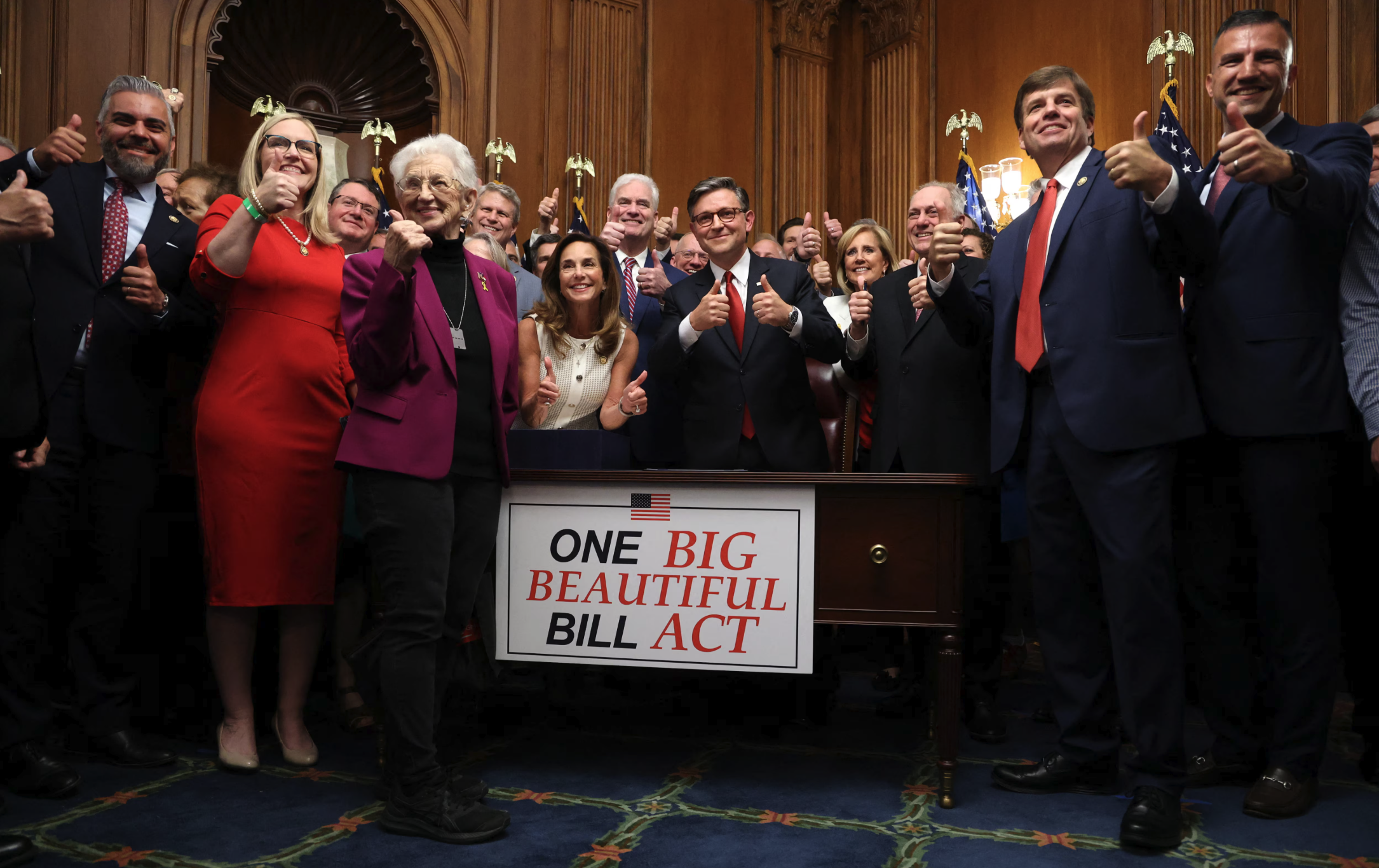
None of this has so far stopped the Trump administration from unilaterally cancelling hundreds of grant contracts tied to IRA programs, in line with the President’s early executive orders targeting “DEI.” The IRA tax credits—by far the biggest source of big green fiscal firepower—were caught up in the fight over renewing Trump’s 2017 tax cuts and the rest of the President’s domestic legislative agenda that played out over the first half of this year. Upwards of two dozen Republican members of Congress publicly articulated their desire to keep most or all of the tax credits in place. Their opposition to cutting the credits was backed by major business lobbies, unions, local elected officials, and more. But the combination of hard-line fiscal hawkery from the likes of the House Freedom Caucus, Trump’s own personal animus, the inclusion of many other things those same Republicans liked (not least, even bigger tax giveaways to the wealthiest Americans than the 2017 bill contained), and Trump’s iron hold over the entire GOP meant that all of those Republicans who would have liked to keep the IRA tax credits in place simply caved and voted for a bill that largely gutted them, even with the knowledge that the loss of the credits would inflict real economic pain on workers and businesses in their districts.
The decimation of the common sense
Starting in the closing weeks of the OBBB Act fight, when hardliners like Chip Roy teamed up with charlatans like Alex Epstein to mount an all-out attack on renewables, the erstwhile “all of the above” GOP energy consensus has been replaced with an all-out assault on everything related to climate, including a policy of active discrimination against solar and wind energy in particular. Backed by DOE Secretary Chris Wright, the Trump administration’s spurious yet official position is now that solar and wind power actively harm the power grid by requiring costly investment in transmission and backup power. Further, deploying clean energy is now argued to play to China’s sectoral dominance, thereby weakening the US position. In a move resembling a black mirror version of anti-pipeline activism, the Trump administration has revoked permits from offshore wind projects that are 80 percent complete.
Few meaningful counterpressures presently exist. The broad coalition of civil society, important sectors of capital, and the Democratic Party that came together to enact a large-scale program of public support for decarbonization has been, to date, unable to mount an effective response to this assault. Part of that failure to mobilize reflects the acute fear that Trump has instilled in all sorts of powerful actors, perhaps especially—and, most shockingly, seeing as this is still the United States of America we’re talking about—the leaders of major US and multinational corporations. Part of it reflects a shift in priorities among some actors that were formerly stalwarts of the coalition. Big tech, to take an important example, would still surely prefer federal support for cheaper clean energy. But Silicon Valley firms’ Net Zero commitments were already creating challenges for them as the AI boom sent their electricity demand into the stratosphere. As these firms face intensifying competition with Chinese companies, they are anxious to remain in the White House’s favor, and see no alternative to increasing their consumption of carbon-based electricity as their total electricity demand rises by a staggering 25 percent every single year. The NCCS is inevitably weakened when even those sections of capital seemingly most amenable to a post-carbon economy demonstrate through their investment and procurement decisions that the pace of decarbonization is unlikely to match their former goals.
At a deeper level, however, the actions taken by Trump and the GOP seem precisely calibrated to obliterate the new climate common sense itself. The US government now states confidently and proudly that the US will not decarbonize. US companies, states and localities, and foreign governments alike face open and economically injurious discrimination if their attitude towards carbon diverges from the White House’s view. How could this fail to convince many actors in the US and beyond that, at the very least, the pace of US decarbonization is going to be much, much slower than many had believed just a few short years ago? Confronted with those transformed views about how soon carbon is likely to be constrained, it is only to be expected that many actors will hedge. In those hedges lie a severe weakening of the climate coalition. Of course, the weaker the coalition, the more the NCCS will erode, as the negative feedback loops kick in.
Climate action whipsaw
In the present situation, we will see slower rates of decarbonization across sectors than we would have in a world where the 2024 policy status quo remained in place. We are already seeing projects cancelled—like Australian company Fortescue’s battery and hydrogen factory that, poignantly, was to be housed in the hulking Detroit ruin of the Fisher Body plant—and there are surely more to come. There will be fewer clean energy jobs, and, most likely, higher electricity prices.
The rollback of IRA tax credits means that everyone has to factor in the likelihood of continued whipsaw, undermining the feedback loops that solidified the new consensus. Shrunken domestic markets for low-carbon technology will make it harder for companies to lead in key sectors. And companies that were pursuing hedged decarbonization bargains will hedge further, especially amid a policy environment of hyperactive discrimination against clean energy. Further, firms in decarbonizable sectors may decide to make an outright bet on a carbon unconstrained future—particularly those not seeking sales outside the US market.
And in the states? The 2010s saw state-level climate action contribute to positive policy feedback loops. But the mid-2020s pullback of federal support for decarbonization will exacerbate existing pressures to retrench on climate goals. Withdrawn tax credits will lead utilities to push for less ambitious integrated resource plans, which will add yet more pressure on states to relax mandates. Catastrophic cuts to Medicaid and SNAP in the OBBB are likely to take precedence over filling in gaps from federal clean energy finance for Democratic state legislators. Just as ambitious state policy helped build the new climate common sense, a retreat, if it happens, will weaken it.
Further negative spirals may wait in the wings. For example, climate policy makers have increasingly looked to use carbon intensity in trade as a way to provide incentives for decarbonization. Europe’s Carbon Border Adjustment Mechanism (CBAM)—which is set to impose a fee on the carbon intensity of imports to match the costs European producers must pay for emissions certificates under their Emissions Trading System—is frequently cited as a reason why it is in the interest of US firms to decarbonize. In the recent US-EU trade “negotiations,” the US side pushed for exemptions from the CBAM for US producers, and appears to have won at least a rhetorical concession. Rather than utilizing trade as a vector for advancing decarbonization, the Trump administration is weaponizing trade against decarbonization. Already, the fortunes of US fossil fuel producers are being enlarged by Trump forcing energy purchases in trade agreements with Japan and the EU.
The IRA was enacted just past the peak of Democrats’ break from fiscal policy orthodoxy. The idea of using the fiscal firepower of the federal government for aggressive climate action was a point of remarkable consensus. Even prior to the enactment of OBBB, higher interest rates were making the fiscal cost of 6 percent of GDP annual budget deficits impossible to ignore. OBBB is almost certain to worsen that fiscal picture, ensuring higher interest rates into the future, and enormous pressure for fiscal consolidation on any future Democratic administration and Congress. Deploying fiscal firepower for decarbonization is likely to be a tougher sell in 2029 than it was in 2021. Those who need to place bets now on the future direction of policy will factor that in.
Even before the OBBB’s passage, parts of the Democratic foreign policy establishment called into question whether US power was actually served by decarbonization. Varun Sivaram, who worked under climate envoy John Kerry and was most recently in government affairs at Danish offshore wind giant Ørsted, authored a striking piece in Foreign Affairs called “Climate Realism,” and was quoted in the NY Times saying “The energy transition is actually very bad for the United States, because we cede geopolitical and economic ground to a rival in China.” The loss of the foreign policy establishment as part of the climate advocacy coalition may mean a weaker commitment to decarbonization in a future Democratic governing moment, and could further erode NCCS.
All of this is taking place as the Trump administration incinerates the credibility of the United States as a counterparty with which firms, countries, or even the US Congress can strike reliable agreements. The damage from the Trump administration’s governing-by-extortion is likely to be lasting, because, having elected Trump not once but twice, there are no actors in America who can credibly promise any counterparties that a future administration won’t do exactly the same thing all over again.
Decarbonizable sectors want the government to pay for as much of their decarbonization as possible. But it’s never cost-free for the firms. Firms want to partner with the US government because the terms are attractive and because of the NCCS—they see it as in their long-term, enlightened self-interest to decarbonize. But what happens when the US government starts not just whipsawing on policy but outright canceling cost-share agreements? Would these companies want to partner with the US government in the future? What level of subsidy and extent of guarantee would they demand for their participation, since, again, America as a whole cannot promise that we won’t elect Trump-like presidents in the future? Would our political system support the terms they might demand? Even if somehow NCCS wasn’t being eroded in all these other ways, Trump’s evisceration of US credibility vis-à-vis our own capitalists will increase the price of future decarbonization bargains, already more expensive due to fiscal constraints, smaller markets, and lost time. More expensive decarbonization bargains mean fewer decarbonization bargains, achieving less decarbonization. This is yet an additional way that NCCS erodes.
Broken terrain
The three years since 2022 have served to weaken beliefs about how carbon constrained the future will be, and thus how quickly decarbonization will proceed. For some firms and policy makers, the risk of being left behind in a carbon constrained world is now weighed against the risks of losing out in a world that decarbonizes much more slowly. The slower they move, the more they retain carbon assets, the less they stand to gain from further decarbonization policy, and the less supportive of climate action they become. These developments will constitute significant headwinds to a renewal of ambitious climate policy even if the present anti-climate common sense breaks in a few years. All of us who wish to see such a renewal need to devise strategies that are resilient to these headwinds.
There are, at the same time, some factors that may constitute tailwinds for a renewal of climate action. A brief stock-stake of these mitigating factors might suggest some paths forward.
First is cost: Clean energy is cheap. Gas is getting more expensive, especially as the US redoubles its commitment to liquified natural gas and turbine makers are reluctant to increase capacity. More expensive gas means wind and especially solar are more attractive to meet marginal energy demand, especially when paired with storage, for which tech neutral tax credits survived. Designing and selling climate policy with a strong focus on how it can address the high cost of living could retain or increase support for climate action. The cost of energy is also likely to be a pain point for the Trump administration, and may create openings for persuading the Trump administration to at least temper their policy of wanton discrimination.
Second is markets. Even as US policy kneecaps the growth of domestic markets for clean technologies, many American firms believe their long-term success depends on their ability to compete in the markets where the vast majority of future growth is expected to come from. In those markets, policy is not turning against clean energy, and Chinese firms look well positioned to run the tables. This reality is likely to limit the extent to which US automakers, for example, retreat from EVs.
Third is supply chains, whose vulnerability was a powerful impetus behind the IRA. To the extent that US actors believe that clean technologies have some role to play in the future energy mix, there is likely to continue to be an an interest in onshoring those supply chains. Any association of clean energy with manufacturing jobs will blunt efforts to penalize clean energy, and will limit the extent to which NCCS erodes. The fact that the 45X advanced manufacturing tax credit (which provides a per unit subsidy for domestically produced solar, wind, and battery components as well as critical minerals) mostly survived the IRA repeal effort is strong evidence for this assertion, and 45X’s survival will provide some succor to clean technology manufacturing for the foreseeable future.
Fourth is “clean firm.” The “tech neutral” clean energy tax credits mostly survived for everything besides solar and wind. If strong power demand and a weakening of solar’s cost advantage helps spur demand for “clean firm”—geothermal, nuclear, gas with CCS—then perhaps we will see emissions decline and some positive feedback loops for further climate action, especially if the US does manage to keep a technological edge in at least some of these power sources. There appears to be continued startup activity and venture backing for new energy technologies. If there is any potential for enlisting the current US government as a partner in carbon-free energy, it lies here.
Fifth is climate change itself, which does not care what common sense guides policy makers. Extreme weather events will happen more frequently and cause more damage. The reality and future likelihood of extreme weather events will only further reverberate through insurance markets, and through them into home prices, property taxes, local government services, and state budgets. (Of course, we can’t ever straightforwardly assume that experiencing the adverse effects of climate change will make people into stronger supporters of climate action. Whether it does or doesn’t is a political assumption—which the political right is fully prepared to contest.)
Sixth is industrial policy, whose return does not appear to be going away, even if the goals toward which it is being put are changing. The MP Materials deal, which made the Department of Defense (War?) the largest shareholder of the rare earths firm, is a strong indication that the US government will continue to utilize industrial policy tools in new and creative ways, some of which, perhaps, could be built on in the future.
Finally there is Trump himself. He is always smashing shibboleths. With his flamboyant jawboning around tariffs and prices, he may well have contributed to some price restraint and margin trimming by US companies. As in the MP Materials deal, and even more strikingly with Intel, he has broken norms surrounding public ownership. The “golden share” shoe will some day be on the other foot, and advocates for aggressive climate action may have tools they did not believe they had before for directing investment towards desired ends.
But these factors will be up against powerful centrifugal forces that threaten to cleave the coalition further. In particular, those of us looking for ways to slow and ultimately reverse the Trump era assault on climate action are likely to encounter trade-offs that big green fiscal mostly allowed us to defer in 2021–2022.
Cleavages in the NCCS
The loss of subsidies is going to significantly increase cost pressures on solar and wind developers and on clean tech manufacturers (since they will all be competing for smaller markets, and they’ll have lost provisions like the assembly and critical minerals requirements in the clean vehicles tax credits and the domestic content bonus in the clean electricity credits, which were designed to level the playing field for US producers). The final shape of a new tariff regime is still completely unknown, as are its effects on domestic prices. Tariffs may provide cushion from cost pressure for some manufacturers of clean technologies, but are likely to squeeze others.
In the face of cost pressures, companies can be expected to look for ways to cut back on job standards and limit unionization, push more aggressively for deregulation, and pull back from commitments to “community benefits.” A more cutthroat green capital sector delivering fewer co-benefits alongside decarbonization investments will heighten the anxiety many workers have that the transition will be bad for job quality, and the concern many communities have that economic development takes place at their expense. It will be a harder bargain to find unity between such a sector and the social and electoral coalition that won its subsidies.
Strains on the grid from data centers and other new sources of energy demand were already creating pressure to relax statutory clean energy goals at the state level. The loss of federal subsidies and federal regulations is likely to exacerbate those tensions, as utilities look to pass on the cost of more expensive solar and wind to ratepayers, and as industries seek relief from state-level cap-and-trade requirements. The previously discussed tightened state budgets will therefore increase the likelihood of “economy vs. environment”-type conflicts even in bastions of climate action, with ratepayers, blue collar workers, Medicaid recipients, and others pitted against climate spending in a struggle for scarce resources.
What is to be done?
Climate action is on track to be slower, less well equipped to deliver co-benefits, and more fraught with trade-offs and distributional conflicts. Each of these is a threat to future climate action and erodes the new climate common sense. It may be impossible for the climate community to prevent any of these developments from transpiring over the next several years; it is almost certainly impossible for the climate community to prevent all of them from transpiring.
We are going to be dealing with scarcity politics. In such an environment, minimizing cleavages within the coalition that forged the NCCS and broadening the base of political support for climate action is imperative. But doing so may mean acquiescing to a slower pace of climate action in some circumstances—which raises the task of ensuring that a slower pace of progress in the short term doesn’t translate into the sorts of hedging behavior that will make more ambitious action harder in the medium term. This may mean searching for focus and efficiency in our policy interventions. What policies deliver the biggest impact for the lowest cost? Are there certain climate-related investments that are especially popular or politically significant, around which rearguard action can be prioritized? Are there opportunities not just to entice capital, but to compel it to invest in certain ways? Can we get more creative about financing? Can we get better at embedding climate action in other areas of policy that are more salient for ordinary people (e.g. housing)? What opportunities exist for leveraging scale, through coordinated actions across climate aligned states? What sorts of transnational coordination can help to avert negative feedback loops from setting in (since many other countries are facing similar pressures)?
It is unlikely that the climate community will align around a single answer to all of these questions. But hopefully a shared analysis of the challenges we face can help to forge greater unity of purpose. Beyond policy design, it seems urgent to recommit to movement building as a precondition for climate action. What corporations and policy elites believe their interests to be is not given, but is rather shaped by movements and politics. The world has changed in many ways, but the need for people in the US and across the world to stand up for a future in which all people can thrive has never been greater.
The views presented here belong to the author alone and do not represent the BlueGreen Alliance or its partners.
Further Reading

What Was Bidenomics?
From Build Back Better to the national security synthesis
The Biden administration first embraced the slogan of “modern supply-side economics” six months before anyone uttered the phrase “Inflation Reduction Act.” Speaking before the World...

The Florida Frontier
Education, real estate, and the rise of the “anti-woke” American right
In the evolving lexicon of the 2024 US Presidential election, Florida has stood for the ultimate “weird” of American politics—a place where legislation and executive...
The Belt and Road 2.0
An interview with Mathias Larsen on China’s overseas clean-tech manufacturing investments
Chinese firms are going out. As the US withdraws from green tech industries and pressures its allies to follow suit, Chinese companies are stepping in...