November 20, 2025
Analysis
The Chainsaw and the Miracle
Milei's structural adjustment program.

On October 26, the right-populist president of Argentina, Javier Milei, won just over 40 percent of the vote in the country’s midterm elections. His party, La Libertad Avanza, increased its seats in the Chamber of Deputies and far outpaced the center-left Peronist opposition, which came away with only 34 percent. The results defied expectations amid a painful economic recession and an acute form of financial dependence on the United States. For Milei, they represent a clear mandate to continue his political experiment: turning Argentina into a laboratory for structural adjustment.
Twenty days before the election, Milei launched his new book, La construcción del milagro: el caso argentino (which translates literally as The Construction of the Miracle: The Argentine Case), to a packed concert stadium in Buenos Aires. Under bright floodlights, to the sound of electric guitars and religious slogans, the president sang a total of nine cover songs—most of them 1980s rock anthems—accompanied by a “presidential band” that included two sons of the famous neoliberal economist Alberto Benegas Lynch, plus a bass drum that bore the face of Ludwig Von Mises. In Milei’s universe, the free market is a sacred precept and fiscal discipline a moral virtue. His “Argentine miracle” relies on a particular kind of salvation story, in which individual sacrifices are necessary for the greater good.
This fits with a growing economic consensus that has taken hold since the pandemic, in Argentina and elsewhere, which views austerity as synonymous with stability. During the Covid-19 crisis, increased public spending was unavoidable; but the fiscal expansion that saved lives (and businesses) has since restricted governments’ room for maneuver, leaving them more indebted, under pressure from the markets, and less able to pursue distributive policies. The global recovery has been asymmetrical. Consumption, which was initially restrained but later surged, combined with an unprecedented amount of financial liquidity to produce an inflationary cycle that hit countries with less monetary sovereignty the hardest. Extreme poverty grew, wealth became even more concentrated, and no political project managed to offer effective redress.
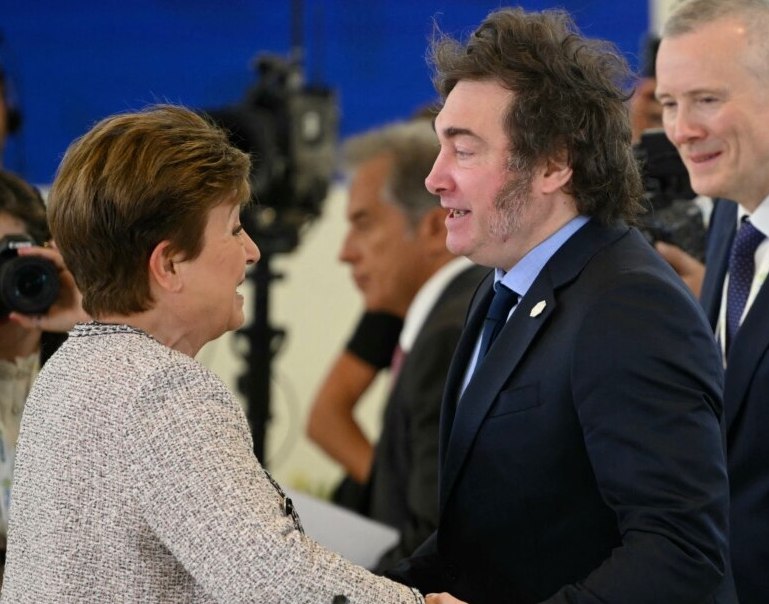
In this context, the pendulum began to swing erratically: the right became even more radicalized and emboldened, the left more moderate and defensive. As voters lost confidence in progressive policy solutions, the ideology of austerity-as-stability gained ground. Milei is just one of its iterations, yet he is distinguished by the scale of his ambitions and the extent of their international support. At the IMF’s Annual Meetings this year, President Kristalina Georgieva praised the results of his structural adjustment program—privatization, deep spending cuts, attempted dollarization—and stressed the need to “accompany[] the Argentine government on its difficult but necessary path.” At previous meetings Georgieva has even worn a lapel pin in the shape of a chainsaw: Milei’s signature emblem, representing his pledge to slash the public sector. The Argentine example is now being cited to prove that the IMF’s old doctrines are alive and well in 2025: state retrenchment, fiscal rectitude, unrestricted openness to financial flows.
Milei also has the firm backing of Donald Trump, who sees in this program an opportunity to expand US influence in Latin America and displace China from the regional stage. Under Secretary Scott Bessent, the US Treasury has become an operational actor in Argentine monetary policy: executing currency swaps, intervening in the foreign exchange market, and coordinating decisions with the Central Bank of Argentina (BCRA). This kind of direct interference is unprecedented, and has placed the country’s economy under foreign tutelage.
The “chainsaw” and the “miracle” have thus become metaphors for an emerging political order. One promises to destroy the state, the other to redeem it. Together they strike a precarious balance between ruination and hope, through which a new model of dependency is now being consolidated. By studying it closely, not just as a political emergency but as a reflection of broader global trends, we can better understand our present historical moment.
Monetarism reborn
For Argentines, inflation is more than just a metric; it is a trauma. The hyperinflation of 1989 fundamentally reshaped everyday life. Salaries melted away between morning and afternoon; shops raised their prices two or three times a day; families rushed to the supermarket as soon as they got paid only to find that their money was no good. In the space of just a few months, the currency ceased to fulfill its basic function as a measure of trust. Memories of the stacks of bills needed to buy bread, or of retirees standing in endless lines, have served as a warning to every government since.
Convertibility promised to end the chaos by fixing the peso to the dollar at a one-to-one ratio. For a while it seemed to work: prices stabilized, credit returned, and consumption grew. But the side-effects were devastating, as debt soared and industry was dismantled. The illusion of stability was finally punctured by the collapse of the fixed exchange rate regime in 2001. To stop a run on the banks, the government embarked on what became known as the “corralito,” freezing deposits and confiscating the savings of millions of people—who responded by flooding the streets, banging pots and pans to demand their money back. The unrest led to the most profound institutional collapse since the return of democracy: a total of five presidents in two weeks. An entire generation came to feel that the state could break down at any moment, that a lifetime of sacrifice and savings could be snatched away from them.
Milei built his political profile on that fear. His claim that the fiscal deficit is the root of all evil has allowed him to reinstate the most orthodox pillar of monetarism: the need to lower inflation at any cost. “The problem is not poverty,” he repeats ad infinitum, “but the deficit.” On that basis, he has already abolished several government ministries, ripped up regulations, and cut thousands of public-sector jobs, and he is now pressing ahead with plans for yet more fiscal contraction. The 2026 budget is billed as “the smallest in the last thirty years,” reducing social spending, salaries, and subsidies to the provinces. The effect on the currency has been stark. Monthly inflation, which had exceeded 25 percent at the end of 2023—as a result of the sharp devaluation carried out by Economy Minister Luis Caputo the day after he took office—fell dramatically in 2025, and is now at its lowest level in seven years. But the fallout is the destruction of purchasing power and productive paralysis: a deadly combination of recession, depressed wages, and the transfer of resources from labor to financial income.
Under Milei, Argentina’s artificially sustained exchange rate has provided yet another illusion of stability, as well as an incentive for speculation. Thanks to positive real interest rates, foreign funds have returned to the country to take advantage of the carry trade, turning quick profits in pesos that can then be dollarized, with banks advising clients on exactly when to enter and leave the market. At the same time, the Central Bank’s reserves have been depleted, even as the government has procured loans and encouraged activities like asset laundering. The result is the return of a familiar paradox: stability in the markets, instability in the country at large. For the President and his supporters, though, this is nothing less than a shining example of monetary discipline, as the costs of inflation have been covered by cuts to wages and pensions. The state has attained a surplus not by producing more, but simply by no longer fulfilling its obligations, shifting the deficit problem onto households. Their pain is now a measure of economic progress, a step on the road to redemption.
New dependency
Milei’s so-called miracle has two external architects: the IMF and the US Treasury. Both have found in him an exemplary student willing to follow to the letter a structural adjustment manual that most other leaders have tried to moderate. In April 2025, the IMF approved a new loan for Argentina well above its quota in the organization. The loan to President Mauricio Macri in 2018 had already reached a historic high, equivalent to 1,001% of the amount to which the country was officially entitled under the quota system. The new agreement, negotiated by the economy minister Luis Caputo, raised this figure to 1,500%, consolidating Argentina’s position as the country most indebted to the institution.
In the Fund’s jargon, this is considered “exceptional access:” loans that far exceed the limits permitted by regulations, but which can be approved if the IMF is satisfied that four basic conditions are met: sustainable debt, repayment capacity, low risk of contagion, and absence of political motivations. In this case the IMF described the loan as “accompanying a successful stabilization process.” In reality, though, the decision was clearly political. Several IMF directors warned that the Argentine economy—given its negative reserves and its lack of no growth or an approved budget—violated their criteria for exceptional access, and that the loan lacked adequate technical support. Yet these factors were seen as secondary, so long as the program could be used as a showcase for the IMF’s nueva austeridad.
Six months later, with the midterms campaign underway and a worrying run on the peso, Bessent announced a currency swap and US intervention in the Argentine foreign exchange market. Billed as a gesture of “support” for Milei, the move was actually much more than that: a transfer of monetary sovereignty from Buenos Aires to Washington. The latter bought pesos and influenced both interest rates and the exchange rate—trumpeting the supposed benefits of these policies in announcements that doubled as propaganda for Milei’s election campaign. Despite this, there are still no official reports or published conditions regarding this US support: a direct violation of Argentine debt law, which stipulates that all such agreements must pass through Congress.
Meanwhile, Trump himself was busy rejigging the global financial system. Crossing swords with Jerome Powell over control of the Federal Reserve, he installed Daniel Katz—Bessent’s former chief of staff—as deputy managing director of the IMF. With that, the Fund became aligned with the Treasury’s agenda, forging a close alliance between the two institutions and the Milei government, in which the former increasingly oversaw the decisions of the latter. Trump warned Argentine voters against turning to Peronism, insisting that if Milei lost the upcoming elections, US financial support would be cut off. The midterm results suggest that this threat resonated with the public.
Now, when the elected deputies and senators take office this December, the domestic political situation is set to be reconfigured. Milei has expanded his representation in Congress as well as his influence over the parliamentary agenda—not quite eradicating the opposition, but weakening its ability to impose limits on his program. This coincides with the new phase of the IMF agreement, with a raft of reforms planned for pensions, labor laws, and taxes. There are rumours that the retirement age will rise to 70, the working day will be lengthened, and VAT will be reduced in order to transfer the burden of tax collection onto the provinces, with destructive consequences for the smallest and poorest ones. If such measures come to pass, they could transform the current period of adjustment into a new political settlement.
Dynamics of adjustment
Structural adjustment is not just an economic tool but a technology of power. It works by distributing losses, deciding who must pay for stability. Since 2024, public spending in Argentina has fallen to unprecedented levels. Ministries have laid off more than 50,000 staff. Social programs have been reduced or eliminated altogether. Funding for the provinces has been frozen, while public works—roads, bridges, hospitals, schools—have come to a complete halt. In just a single year, the state has ceased to be an employer, a provider, or a guarantor of rights. It has become little more than an auditor of misery.
Pensioners were the first ones in the crosshairs: moratoriums were suspended, minimum pensions were reduced from their already low level, and pension spending fell by more than 30 percent in real terms, according to data from the Ministry of Economy. Next were women and young people. With the fall in consumption and the closure of small and medium-sized enterprises, low-wage jobs—in areas like retail, services, and care—either disappeared or became even more precarious. Domestic work, one of the main sources of employment for women, was one of the most affected sectors, depriving many households of their only source of income. Care policies were rolled back, and community spaces from soup kitchens to cafeterias were defunded. For most people under the age of 30, the only gateway to the labor market is delivery, transportation, or service platforms. Their workday is ruled by an algorithm and their income tied to the fluctuations of demand, with social security non-existent. Their educational opportunities have been further slashed by Milei’s chainsaw, as public universities have faced real-terms budget cuts of 35 percent, and disciplines like science, technology, and culture have been subsumed into the category of “unproductive spending.” Scholarships have been frozen, research projects halted, and academics forced to emigrate.
People with disabilities are yet another target. In August, the Disability Emergency Law—offering higher pensions and welfare entitlements to the disabled, and approved by a large majority in Congress—was vetoed by Milei, who made no attempt to conceal his preference for fiscal rules over social justice. The public response was overwhelming: large numbers of protesters mobilized for months on end to demand the instatement of the benefits, holding street demonstrations and ambushing senior politicians. Lawmakers were eventually forced to step in and override the President, who grudgingly allowed the bill to pass, but has paused its implementation.
Though Milei’s list of victims is long, they are barely noticed at international forums, where the only economy that is analyzed and debated is the financial one, with success measured in terms of inflation and country risk rather than jobs or industrial production. As GDP falls, the Merval index rises; as consumption plummets, Argentine bonds appreciate. The gap between macro and micro widens every month.
Real miracles
Argentina’s structural adjustment follows a logic of disconnection, in three important respects. First, there is a division between finance and everyday life, as the demands of one are secured through a slow, sometimes almost invisible deterioration of the other: wages lose purchasing power penny by penny, services increase a little more each month, projects are postponed, future prospects shrink. There is no sudden, spectacular crisis, but rather a continuous process of loss that gradually becomes naturalized, like a change in the weather.
Second, there is a disconnection between the two currencies that underpin this program, since the dollars that enter the country do not stay there; they are used to pay off debts, fuel the financial cycle, or finance the import of cheap trinkets that do nothing to expand local production or employment. Stability is therefore bought by external flows that could dry up at any moment if the mood of the market changes. This fragile peace is sustained by resources that do not stimulate the real economy, but rather buy time for the government.
The third disconnection is between external and domestic debt. What the state saves vis-à-vis the IMF is transferred from households to banks. Families resort to credit to pay for services, rent, or food. Small businesses use loans, formal or informal, to stay afloat. External debt becomes private debt, commitments to foreign creditors become commitments to the supermarket or the virtual wallet. And therein lies the real miracle: not that inflation has been curbed and finance reinvigorated, but that the Argentine economy somehow manages to keep going even as it destroys the social base on which it depends. This is a miracle of survival rather than development—a “recovery” built on the sweat and exhaustion of those who are forced to work harder, or produce more, or care for dependents who are neglected by the state. Milei’s model shows that contemporary capitalism no longer needs to produce in order to dominate. Its new lords—the techno-elite who shuttle between Silicon Valley and Wall Street, and who profit off the dependency of the South—do not compete for labor or land. Their role is simply to manage scarcity.
Further Reading
Argentina’s Debt Trap
Milei’s return to the IMF
After publicly endorsing Javier Milei’s economic achievements since coming to power in December 2023, the IMF has approved a new Argentine bailout package of $20...

100 Days of Milei
Austerity and adjustments in Argentina
Javier Milei’s election to the Argentine presidency in November sent shockwaves throughout the country. While the media personality was not altogether an outsider, his party...

Milei’s Argentina
An interview with Mercedes D’Alessandro
On December 10, the fortieth anniversary of Argentina’s redemocratization, Javier Milei was sworn in as the country’s new president. Milei—a far-right economist who calls himself...