September 18, 2025
Analysis
The Paradox of Reform
The limits of Colombia’s progressive pension law

Although Colombia’s landmark pension reform was signed into law on July 16, 2024, its validity remains in question more than a year after its approval. The country’s Constitutional Court is considering a lawsuit filed by opposition parties alleging procedural flaws in the bill’s legislative process, and pending a final decision on the lawsuit, the court has suspended the implementation of the law.
Earlier this year, President Gustavo Petro celebrated the reform’s approval in the House of Representatives as a victory for the left, fulfilling the promise of expanding the social safety net and combating poverty and inequality. “We have triumphed, long live the grandmothers and grandfathers of Colombia,” he wrote on Twitter, his social media of choice. News of the approval resounded throughout the region, marking the success of his social democratic agenda. But a closer examination of the law’s design gives room for pause. Why does the flagship reform of Petro’s progressive government adopt a typically neoliberal architecture for social welfare?
At its core, Petro’s pension reform seeks to correct a regressive, costly and segmented pension system.1Fundación Cisoe, Cecilia López Montaño and María Claudia Holstine, ‘La Reforma Pensional En Colombia. El Debate Pendiente. Lecciones de América Latina’ (Banco de la República de Colombia, 2019); Stefano Farné and Alejandro Nieto, ‘¿ A Quiénes y Cuánto Subsidia El Régimen Pensional de Prima Media En Colombia’, (<)em(>)Bogotá: Universidad Externado de Colombia(<)/em(>), 2017; Leonardo Villar and David Forero, ‘Elementos para una propuesta de reforma del sistema de protección económica para la vejez en Colombia’, Cuadernos de Fedesarrollo, no. 58 (2018): 82; Francisco Azuero, ‘El sistema de pensiones en Colombia: institucionalidad, gasto público y sostenibilidad financiera’, (<)em(>)CEPAL(<)/em(>), Macroeconomía del Desarrollo 206, 2020, 2020, 61; Juan Pablo Córdoba and Gabriel Piraquive, ‘Escenarios de ajuste al sistema pensional colombiano’, Documentos CEDE, 2019. But in a break from the demands of the left, the reform does not eliminate Colombia’s private pension system and instead retains the logic of Colombia’s neoliberal reforms of the 1990s. The reform maintains a multipillar system with several “solidarity” components, alongside a capitalization scheme managed by private funds.2Mitchell A Orenstein, (<)em(>)Privatizing Pensions: The Transnational Campaign for Social Security Reform ((<)/em(>)Princeton University Press, 2008).
The trajectory of the reform reflects both international and domestic political shifts. At the international level, over the last decade, pensions reforms in the global South have attempted reverse the fiscal consequences of the privatization wave of the 1990s. In Colombia, a particular balance of interests made a reform based on compromise the most likely to succeed. The reform led by the Petro government both expands the coverage of elderly Colombians while retaining the structure of a private pension market.
The new pension law demonstrates the limits of progressivism in fragmented political contexts. It also represents the latest iteration of an historic dispute around the form of the welfare state in the global South. By interrogating the concessions and successes of the reform, as well as the tensions that arose around its approval, we can begin to understand how the pension system offers a new vision of the Colombian state.
Pension reforms around the world
Over the last three decades, countries around the world have transformed their pension systems in response to demographic, economic, and institutional pressures.3OECD, (<)em(>)Pensions at a Glance 2023; OECD and G20 Indicators (<)/em(>)(Paris: OECD, 2023); OECD, (<)em(>)Pensions at a Glance 2015(<)/em(>), 2015, 2015, https://doi.org/10.1787/pension_glance-2015-en; Hervé Boulhol, Maciej Lis, and Monika Queisser, ‘Trends in Pension Reforms in OECD Countries 1’, in (<)em(>)The Routledge Handbook of the Economics of Ageing (<)/em(>)(Routledge, n.d.), 262-84. The trajectory of these reforms has not been uniform. In Europe and the global North, reforms have responded to the stresses caused by an aging population.4Boulhol, Lis, and Queisser, ‘Trends in Pension Reforms in OECD Countries 1’; Giuseppe Carone et al, ‘Pension Reforms in the EU since the Early 2000’s: Achievements and Challenges Ahead’, (<)em(>)European Economy Discussion Paper(<)/em(>), no. 042 (2016). In the global South, reforms have been sparked by the fiscal aftermath of the privatization wave of the 1990s, a persistently high level of labor informality that excludes most of the working population from social protection, and general poverty that afflicts the elderly population, who often require state welfare for subsistence.5Alberto Arenas de Mesa, (<)em(>)Pension Systems at the Crossroads. Desafíos para la sostenibilidad en América Latina(<)/em(>), Libros de la CEPAL 159 (CEPAL, 2019); Isabel Ortiz et al, ‘Reversing Pension Privatization: Rebuilding Public Pension Systems in Eastern European and Latin American Countries (2000-18)’, (<)em(>)Available at SSRN 3275228(<)/em(>), 2018.
Since the 1980s, pension systems in Latin America have undergone a wave of structural reforms following a neoliberal agenda, drawing from the notion that freedom and welfare are maximized when economic activity is organized on the basis of private property, competition, and the free movement of capital. State action should thus be limited to guaranteeing macroeconomic stability, protecting property rights, and creating markets where they do not exist.6Thorsen, ‘The Neoliberal Challenge. What Is Neoliberalism?’
When it came to the provision of public services, this agenda sought to restrict public pay-as-you-go pillars, instead opting for minimal welfare function supplemented by more dominant privately managed schemes. This shift channeled savings into financial markets and transferred investment and longevity risks onto workers.7Leokadia Oręziak, (<)em(>)Pension Fund Capitalism: The Privatization of Pensions in Developed and Developing Countries (<)/em(>)(Routledge, 2022); Mitchell A Orenstein, (<)em(>)Privatizing Pensions: The Transnational Campaign for Social Security Reform ((<)/em(>)Princeton University Press, 2008); Mitchell A Orenstein, ‘Pension Privatization in Crisis: Death or Rebirth of a Global Policy Trend?’, (<)em(>)International Social Security Review (<)/em(>)64, no. 3 (2011): 65-80; Mitchell A Orenstein, ‘Pension Privatization: Evolution of a Paradigm’, (<)em(>)Governance (<)/em(>)26, no. 2 (2013): 259-81. With these reforms, social security became structured according to the principles of profitability and financial accumulation, displacing its original foundation of intergenerational solidarity.8Robin Blackburn, (<)em(>)Banking on Death: Or, Investing in Life: The History and Future of Pensions (<)/em(>)(Verso Books, 2002).
Multilateral organizations led the charge towards structural reform.9Orenstein, (<)em(>)Privatizing Pensions: The Transnational Campaign for Social Security Reform(<)/em(>); Carmelo Mesa-Lago, (<)em(>)Evaluating Four Decades of Pension Privatization in Latin America (1980-2020): Promises and Realities(<)/em(>), Friedrich Ebert Stiftung (Mexico City: FES, 2020). With its seminal report Averting the Old Age Crisis (1994), the World Bank offered a so-called “multipillar” insurance structure that combines a basic public pillar of tax-financed social assistance, a mandatory capitalization pillar (collective or individual), and a voluntary pillar (also capitalization).10World Bank, (<)em(>)Averting the Old Age Crisis: Policies to Protect the Old and Promote Growth. Summary (<)/em(>)(The World Bank, 1994). Underlying the multipillar design is the idea that market solutions should occupy the core of the system, relegating the state to patch the gaps left over. The most extreme example of this design was the Chilean pension system implemented by the Pinochet dictatorship in 1981.
The 1994 World Bank report went on to be very influential,11Orenstein, (<)em(>)Privatizing Pensions: The Transnational Campaign for Social Security Reform(<)/em(>). and the multipillar typology reappeared in discussions on pension reforms in the world. Most international institutions adopted their own ‘pillar’ scheme,12International Labour Office, ‘The ILO Multi-Pillar Pension Model: Building Equitable and Sustainable Pension Systems’ (International Labour Conference, 2018). and as a result of conferences, technical assistance programs, and credit conditionalities from the World Bank, the architecture served as a conceptual basis for pension reforms over the following twenty years (see below).13Orenstein, (<)em(>)Privatizing Pensions: The Transnational Campaign for Social Security Reform(<)/em(>).
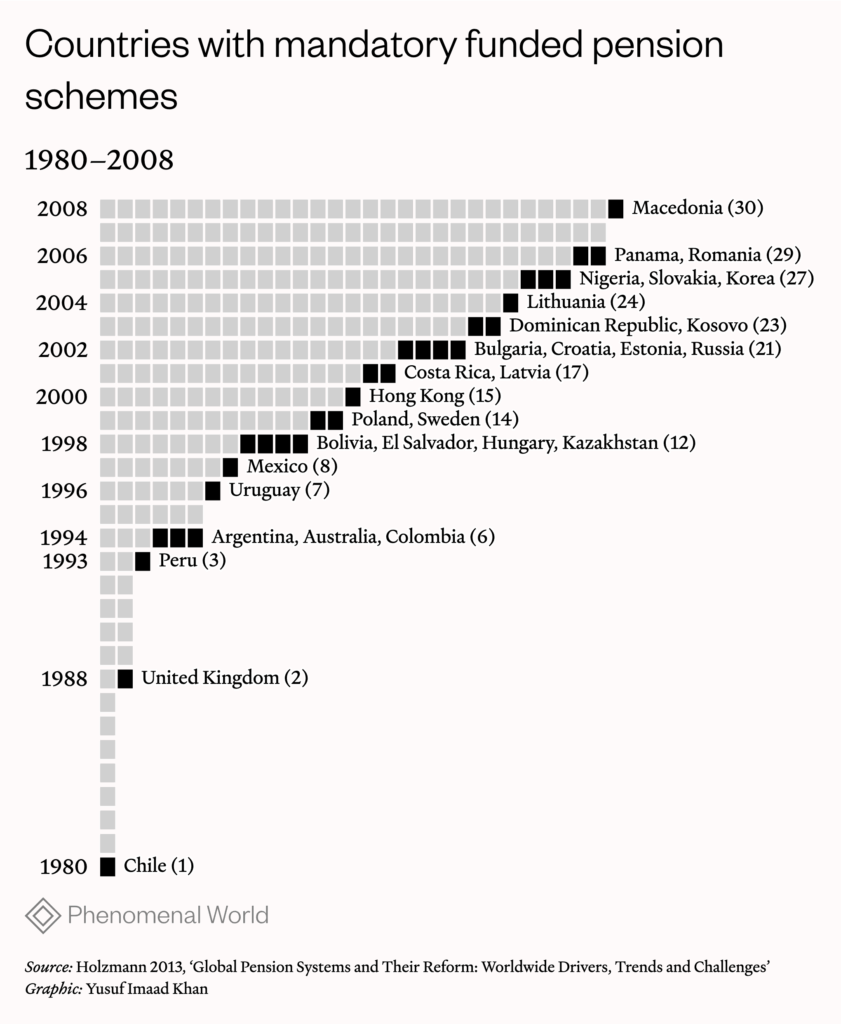
Almost all Eastern European countries introduced funded schemes in the late 1990s. In Latin America, Mexico, Argentina, and the Dominican Republic followed the same path.14Orenstein, (<)em(>)Privatizing Pensions: The Transnational Campaign for Social Security Reform(<)/em(>); Robert Holzmann, ‘Global Pension Systems and Their Reform: Worldwide Drivers, Trends and Challenges’, (<)em(>)International Social Security Review (<)/em(>)66, no. 2 (2013): 1-29. The Colombian and Peruvian cases are of particular interest. Although these countries also introduced funded systems, they did not entirely eliminate their public pension systems. Public systems remained in competition with private systems for basic old-age insurance. This gave rise to Colombia’s odd “parallel” pension scheme, the only one of its kind in the region.15Mesa-Lago, (<)em(>)Assessing Four Decades of Pension Privatization in Latin America (1980-2020): Promises and Realities(<)/em(>); Arenas de Mesa, (<)em(>)Pension Systems at the Crossroads. Challenges for Sustainability in Latin America(<)/em(>).
The premise of the 1990s pension was the same everywhere: private fund management, based on individual capitalization, would improve the efficiency and sustainability of the system.16Mesa-Lago, (<)em(>)Evaluation of Four Decades of Pension Privatization in Latin America (1980-2020): Promises and Realities(<)/em(>). Underlying this was the conviction that pay-as-you-go systems were doomed to fail because of their “political nature”—they were incapable of maintaining a transparent relationship between contributions and benefits. Only a system based on individual ownership of savings, operated in competition with private entities, could simultaneously guarantee personal freedom and collective prosperity.17Oręziak, (<)em(>)Pension Fund Capitalism: The Privatization of Pensions in Developed and Developing Countries(<)/em(>). Nikola Altiparmakov and Milan Nedeljković, ’25 Years of Averting the Old Age Crisis in Eastern Europe’, (<)em(>)Global Social Policy (<)/em(>)22, no. 1 (2022): 84-102; Marek Naczyk, ‘Agents of Privatization? Business Groups and the Rise of Pension Funds in Continental Europe’, (<)em(>)Socio-Economic Review (<)/em(>)11, no. 3 (1 July 2013): 441-69, https://doi.org/10.1093/ser/mws012; Carmelo Mesa-Lago, (<)em(>)Evaluating Four Decades of Pension Privatization in Latin America (1980-2020): Promises and Realities(<)/em(>), Friedrich Ebert Stiftung (Mexico City: FES, 2020). In Latin America and Eastern Europe, the advocates of this model suggested that privatizing pensions would help domestic savings, boost capital markets, increase economic growth, reduce tax evasion, eliminate fiscal deficits, improve administrative efficiency, and allow workers to tailor their pensions to their individual preferences through voluntary savings.18Mesa-Lago, (<)em(>)Evaluating Four Decades of Pension Privatization in Latin America (1980-2020): Promises and Realities(<)/em(>); Altiparmakov and Nedeljković, ’25 Years of Averting the Old Age Crisis in Eastern Europe.
With the turn of the century, criticism of the privatization agenda began to emerge more forcefully.19Peter R Orszag and Joseph E Stiglitz, ‘Rethinking Pension Reform: Ten Myths about Social Security Systems’, (<)em(>)New Ideas about Old Age Security(<)/em(>), 2001, 17-56. The reforms transferred significant and unjustified risks—investment, inflation and sustainability—from the state to the individual.20Orenstein, (<)em(>)Privatizing Pensions: The Transnational Campaign for Social Security Reform(<)/em(>); Oręziak, (<)em(>)Pension Fund Capitalism: The Privatization of Pensions in Developed and Developing Countries(<)/em(>). Policymakers began to reevaluate the enormous costs of pension privatization, which were not sufficiently estimated at the time of adoption.21 Orszag and Stiglitz.As a result of these discussions, the World Bank itself reconsidered the architecture of the original multipillar model, admitting the need to incorporate in its ideal architecture a “pay-as-you-go” pillar limited to basic redistributive functions.22Robert Holzmann, (<)em(>)Old-Age Income Support in the 21st Century: An International Perspective on Pension Systems and Reform (<)/em(>)(World Bank Publications, 2005).
In countries that reformed their pension systems, coverage rates failed to increase as expected, benefits were insufficient for large sectors of the population, transition costs were high, and evasion persisted.23Ortiz et al., ‘Reversing Pension Privatization: Rebuilding Public Pension Systems in Eastern European and Latin American Countries (2000-18)’; Mesa-Lago, (<)em(>)Evaluating Four Decades of Pension Privatization in Latin America (1980-2020): Promises and Realities(<)/em(>). The global financial crisis of 2008 was the final test, revealing the exposure of pensions to financial risks.24Mitchell A Orenstein, ‘Pension Privatization in Crisis: Death or Rebirth of a Global Policy Trend?’, (<)em(>)International Social Security Review (<)/em(>)64, no. 3 (2011): 65-80. This eroded the legitimacy of the multipillar model, spurring a second wave of pension reforms—namely reversals in privatization—around the world.
Reversals in at least partial privatization of pension systems
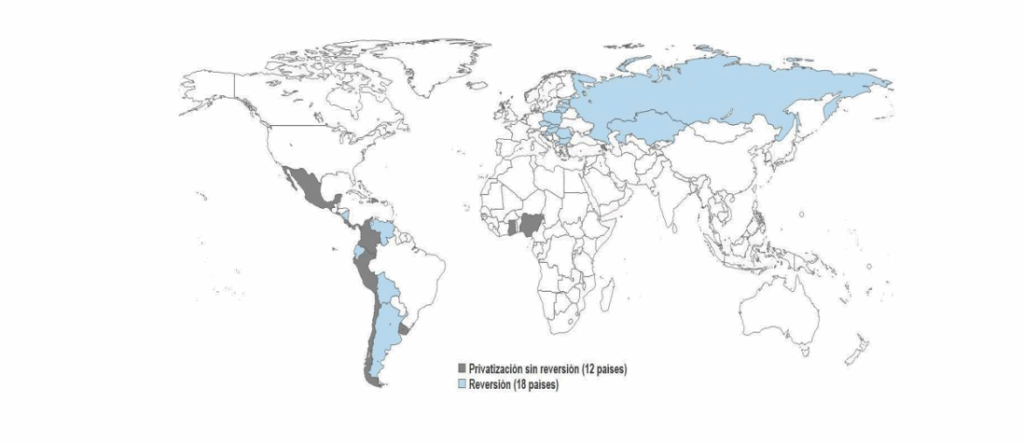
This second wave of reforms incorporated more non-contributory mechanisms, allowing pension systems to expand to older populations in informal labor markets, address elder poverty, and buttress low pensions.26Larry Willmore, ‘Universal Age Pensions in Developing Countries: The Example of Mauritius’, (<)em(>)International Social Security Review (<)/em(>)59, no. 4 (2006): 67-89; David E Bloom and Roddy McKinnon, ‘The Design and Implementation of Pension Systems in Developing Countries: Issues and Options’, in (<)em(>)International Handbook on Ageing and Public Policy (<)/em(>)(Edward Elgar Publishing, 2014), 108-30; Gibran Cruz-Martinez, ‘Older-age Social Pensions and Poverty: Revisiting Assumptions on Targeting and Universalism’, (<)em(>)Poverty & Public Policy (<)/em(>)11, no. 1-2 (2019): 31-56.; Cruz-Martinez, ‘Older-age Social Pensions and Poverty: Revisiting Assumptions on Targeting and Universalism’. In 2008, Chile pursued a policy change along these lines, a reform that served as a key example for President Petro’s pension reform proposal.27Mesa-Lago, (<)em(>)Evaluating Four Decades of Pension Privatization in Latin America (1980-2020): Promises and Realities(<)/em(>).(<)/p(>) (<)p class='wp-block-paragraph'(>)Petro’s proposal is thus a product of trends in pensions across the global South, in countries committed to reversing privatization and guaranteeing social assistance for the poorest older adults. But instead of dismantling Colombia’s private system, as had occurred in Argentina and other countries that eliminated their funded pension systems, he chose to reconfigure the balance in the system inherited by Colombia’s Law 100.(<)/p(>) (<)h3 class='wp-block-heading'(>)The failures of Law 100(<)/h3(>) (<)p class='wp-block-paragraph'(>)Law 100 of 1993, enacted during the liberal government of César Gaviria, was the policy that set forward the privatization of the Colombian pension system according to economic liberalization and market reform principles. The law “modernized” the country’s pension system, creating a single system to cover all public and private sector workers. Prior to 1993, public and private sector workers were fragmented into more than 900 pension subsystems, each with its own rules and requirements, making it virtually impossible to ensure their coordination and proper oversight.[fn]Ana María Muñoz Segura, (<)em(>)La Pensión de Vejez En Colombia. El Recorrido Histórico Entre La Exclusión y La Universalidad(<)/em(>), Historia y Materiales Del Derecho (Bogotá: Universidad de los Andes, 2019). In addition, Law 100 attempted to expand the coverage of affiliates and pensioners, which, at that time, barely reached 21 percent, and sought to guarantee the system’s financial sustainability.28Mauricio Santa María et al., ‘El Sistema Pensional En Colombia: Retos y Alternativas Para Aumentar La Cobertura’ (Fedesarrollo, n.d.), 7.
Law 100 was in part inspired by Pinochet’s 1981 pension reform in Chile. While the original bill proposed copying the Pinochet model and completely privatize the system, unions and public employees fought to establish a “parallel” or “dual” system that allowed for public and private options.29This dual system allowed workers a certain freedom of choice between regimes. However, several challenges followed. The first of these related to the financial education needed to make a good decision. When the first members of the new private system began to retire, they realized that the promises of funding did not translate into better pensions. In fact, their pensions ended up being much lower than those of the public system. This led to a series of reforms on the limits and guarantees to be able to choose which system was more convenient for each member. By 2024 there were more than 25,000 pending cases of people seeking to leave the private regime and return to the public pension system. For many workers, however, the public system guaranteed higher pensions.
By 2023, coverage under the system created by Law 100 barely rose by 10 percent. Today, less than one-third of the elderly receive a contributory old-age pension, and two-thirds remain unprotected. The system is not financially sustainable—imbalances represent a cost of 4 percent of annual GDP, equivalent to 30 percent of the country’s tax revenues.30Diego Alejandro Chaves Martínez et al., ‘Estudio Intersectorial. Reforma Pensional En Colombia: Antecedentes y Elementos Para Su Discusión’ (Contraloría General de la República, December 2023), 43; Oscar Becerra et al., ‘Regresivo, Excluyente e Ineficiente ¿Qué Hacer Con El Sistema de Pensiones?’ (Universidad de los Andes, 2022), 2. The presence of two different regimes and the competition to attract affiliates have generated incoordination, inequities, and high costs.31Azuero, ‘El sistema de pensiones en Colombia: institucionalidad, gasto público y sostenibilidad financiera’; Mesa-Lago, (<)em(>)Evaluación de cuatro décadas de privatización de pensiones en América Latina (1980-2020): Promesas y realidades(<)/em(>); Farné and Nieto, ‘¿A ¿A Quiénes y Cuánto Subsidia El Régimen Pensional de Prima Media En Colombia’; Cisoe, Montaño, and Holstine, ‘La Reforma Pensional En Colombia. The Pending Debate. Lessons from Latin America’.
While the public system faced a growing fiscal deficit, the private system failed to provide adequate pensions to all its affiliates.32Farné and Nieto, ‘¿ ¿A ¿Quién ¿And Cuánto Subsidia El Régimen Pensional de Prima Media En Colombia’. With these problems afflicting both the private and public systems, there has been some consensus around the need for reform.33Villar and Forero, ‘Elementos para una propuesta de reforma del sistema de protección económica para la vejez en Colombia’; Córdoba and Piraquive, ‘Escenarios de ajuste al sistema pensional colombiano’. Most countries in the West (Sweden, Belgium, the Netherlands, the United States, the United Kingdom) and Latin America (Uruguay, Costa Rica, Panama) structure their pensions with multipillar models,34Holzmann, (<)em(>)Old-Age Income Support in the 21st Century: An International Perspective on Pension Systems and Reform(<)/em(>); Mesa-Lago, (<)em(>)Evaluating Four Decades of Pension Privatization in Latin America (1980-2020): Promises and Realities(<)/em(>). usually with a robust public pillar that offers basic coverage for the entire population, complemented by a second pillar of mandatory savings (privately managed or mixed) for those with higher incomes, and finally a voluntary pillar.
Calculating possibilities
Petro’s reform builds on the work of previous commissions and proposals in Colombia. In 2015, the Ministry of Labor in Juan Manuel Santos’s government presented a reform bill that sought an expanded non-contributory social pension, a pillar system, and higher retirement ages. In Colombia, the retirement age is sixty-two for men and fifty-seven for women, significantly lower than the OECD average of sixty-four. While the bill failed in Congress, it offered a technical model for the multipillar system in Colombia, one supported even by the trade union movement.35Cisoe, Montaño, and Holstine, ‘La Reforma Pensional En Colombia. The Pending Debate. Lessons from Latin America’. Petro’s reform draws from this proposal but prioritizes integration and universal coverage and leaves the retirement age unchanged.
In 2008, under the government of Cristina Fernandez de Kirschner, Argentina nationalized all private pension funds, expropriating individual savings into public funds. This type of radical change was politically unfeasible and legally impossible in Colombia. The governing party barely held a relative majority in Congress, and the first governing coalition—which included the participation of centrists and managed to pass an ambitious tax reform—had already imploded. The Petro government attempted to pass a reform through a fragmented Congress, and thus opted for a moderate proposal, which did not eliminate private funds. The government also had to negotiate constitutional limits: Colombian jurisprudence protects acquired rights and ownership of pension savings, making a complete nationalization of the individual funds unconstitutional.
Petro and his team assumed a pragmatic position to promote a gradualist structural reform, one that could gather consensus and overcome political obstacles. This follows the course of other center-left governments in Latin America, whose pension reforms sought greater equity without eliminating private funds. Uruguay incorporated solidarity pillars and partially reversed the funded system in the 2000s. In 2020, Mexico significantly increased the employer’s contribution and expanded the minimum guaranteed pension, but maintained the individual accounts managed by the Afores.36Mesa-Lago, (<)em(>)Evaluating Four Decades of Pension Privatization in Latin America (1980-2020): Promises and Realities(<)/em(>).
The scope of the reform
In Colombia, only one-third of people over sixty receive a contributory pension, and in 2020, only 23 percent of older adults received pensions through contributory schemes.37Azuero. As a result, the elderly face high rates of poverty: In 2020, 45 percent of urban seniors lived below the poverty line and 18 percent lived in extreme poverty. Petro’s reform aimed to close this gap in social protection.
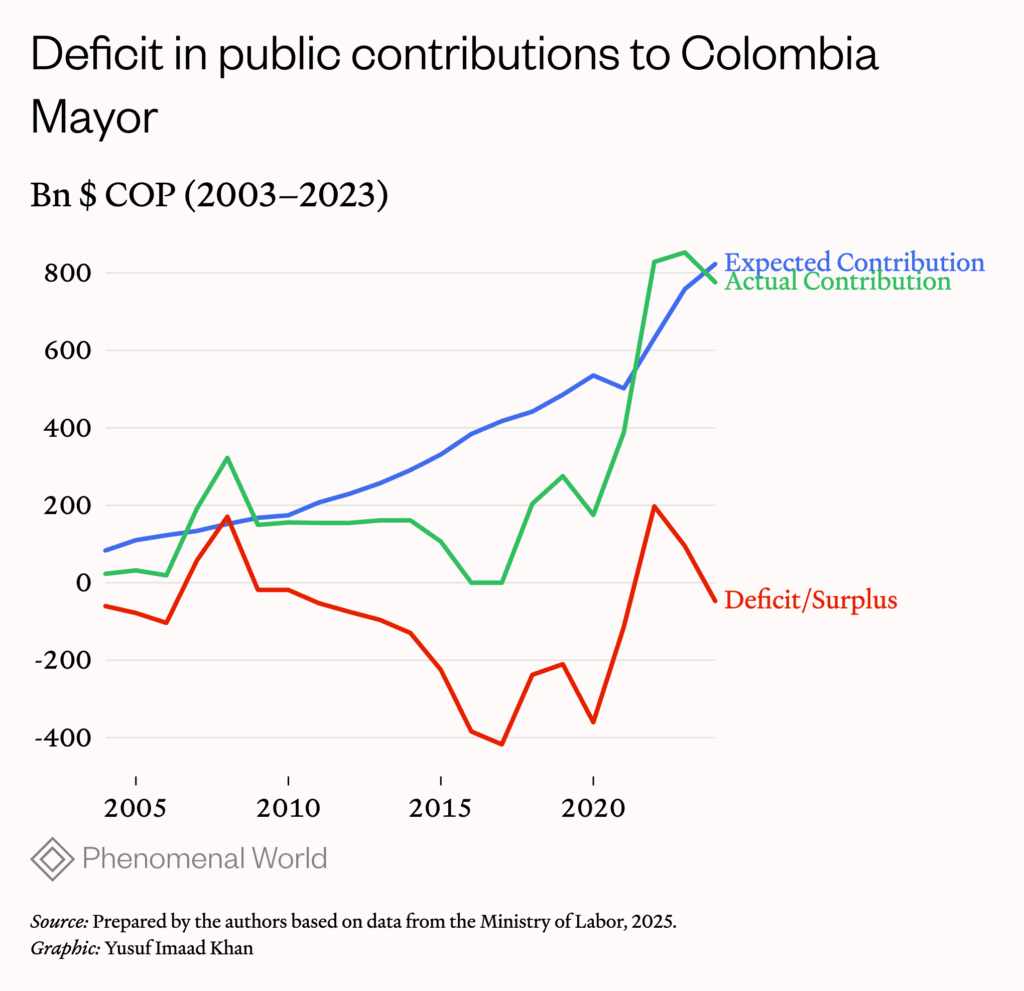
The new model incorporates a solidarity pillar aimed at guaranteeing a basic income to older adults without a pension.38The idea is that every person over 65 years of age in a condition of poverty, extreme poverty or vulnerability is entitled to a life annuity equivalent to the extreme poverty line. In 2024, that amount was set at $223,800 pesos per month (about $55 USD). This benefit, financed with fiscal resources, represents a significant improvement over previous programs: it raises the amount of the subsidy and extends its potential coverage to more than 2.5 million people. Although it represents only a quarter of the monthly minimum wage, the objective is to mitigate indigence among the elderly without income.But a right to a pension does not guarantee its fulfillment. The experience of Colombia Mayor, the previous old-age social assistance program, illustrates the risks of structuring these programs as flexible expenditures. Without budgetary security, transfers are subject to fiscal restrictions and the will of the president in office. For example, for more than half of the last twenty years, the state failed to fulfill its cofinancing commitments to Colombia Mayor, as shown below.
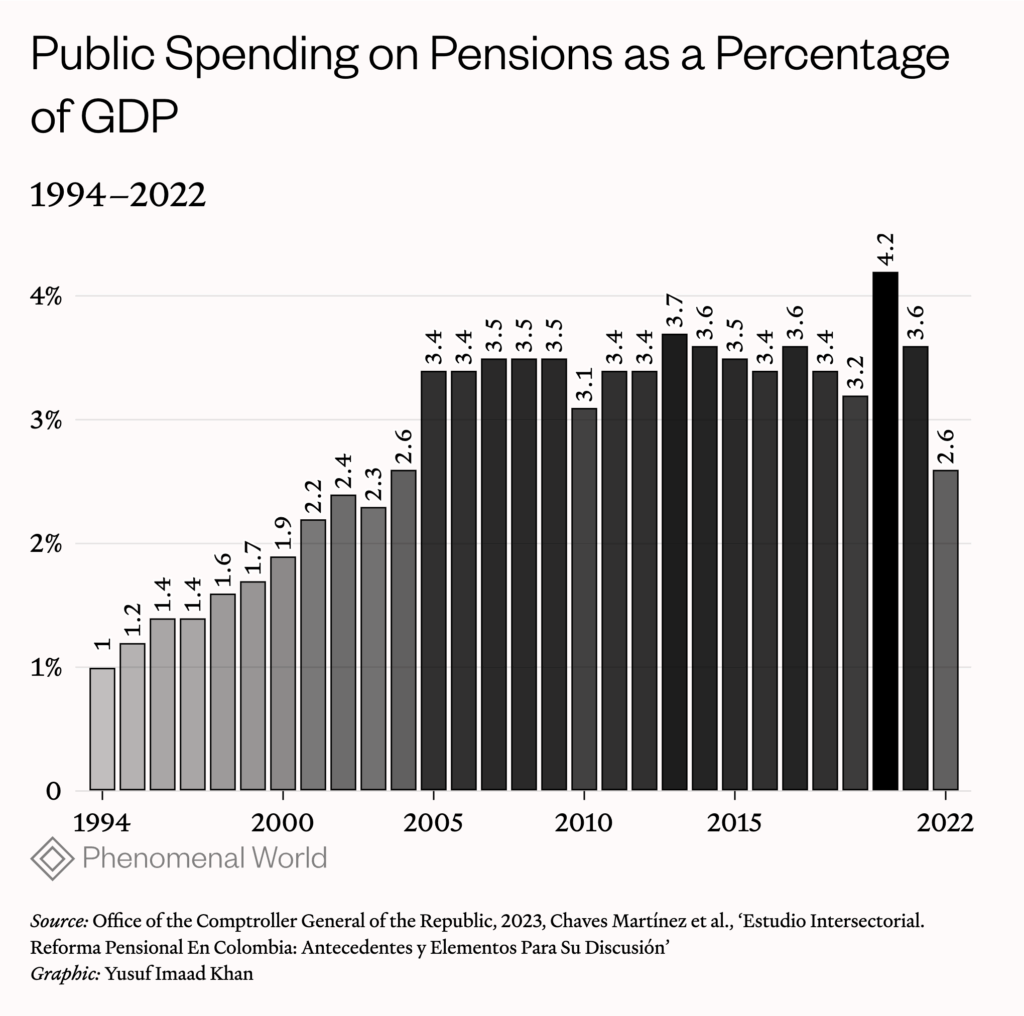
The reform’s second major objective is to reduce the state’s heavy fiscal burden and improve equity across the system. Public spending on pensions grew from 1.4 percent of GDP in 2000 to 4.5 percent in 2017, an explosive increase that led ECLAC to rank Colombia as the Latin American country with the fourth-highest level of fiscal pressure from pensions.39Arenas de Mesa, (<)em(>)Los sistemas de pensiones en la encrucijada. Challenges for sustainability in Latin America(<)/em(>). Moreover, these resources mainly benefited a small group of relatively higher-income pensioners—many of them former civil servants with high pensions—which made the scheme very regressive. In 2019, the richest 20 percent of households captured 75 percent of pension spending, while the poorest older adults received almost nothing.40Azuero, ‘El sistema de pensiones en Colombia: institucionalidad, gasto público y sostenibilidad financiera’. This situation was socially unjust and financially unsustainable.
The new law introduces a Contributory Pillar, in which part of the mandatory contributions are channeled to the public system to finance basic pensions, thus reducing the outflow of resources from the Treasury. The central element is the contribution threshold. Through the reform, Colpensiones, the public system, will receive all contributions on the portion of each member’s income up to 230 percent of the minimum wage, while the private pension funds will receive contributions on the portion of income exceeding 230 percent of the minimum wage.41In other words, each worker will contribute to the public system up to 2.3 times minimum wages (about 2.6 million pesos today) , thereby building the right to a pension in Colpensiones; only if he/she earns above that level, the surplus will go to his/her individual account in an AFP, to contribute to a complementary pension. According to official estimates, more than 80 percent of contributors earn less than 230 percent of the minimum wage. As a result of increased contributions, the Ministry of Finance estimates that the reform will save the state about 0.6 percent of GDP annually in the short term by reducing Colpensiones’ operating deficit.42Bill for the Reform of the Integral System for the Protection of the Elderly.
One of the main points of debate in the reform approval process was the power of private funds. In the previous system, private for-profit pension funds managed savings of some 18 million members—capital equivalent to approximately 26 percent of Colombia’s GDP. These resources made pension funds major economic players and crucial investors—approximately 34 percent of private pensions funds were invested in Colombian public debt and another 36 percent in foreign instruments. This allowed pension funds to weird strong political influence through their association, Asofondos.43Azuero.
The reform process thus faced significant pushback from the private sector. Petro publicly argued for raising the threshold for public contributions to four times the minimum wage, so that Colpensiones would receive more contributions and could guarantee basic pensions in the long term.44Initially, the Petro government proposed a relatively high threshold (the figure of 4 minimum wages was under discussion); this would have implied that only those earning more than 4 minimum wages would contribute to the AFPs, concentrating the vast majority of contributions in Colpensiones. According to data presented by the President, with a threshold of 4 minimum wages the public PAYGO fund would have projected solvency until 2074, while with lower thresholds the reserve would be exhausted earlier (until 2070 with a threshold of 3 minimum wages, and much earlier with 2 minimum wages). However, this proposal clashed with the interests of the financial sector. Congress members outside the governing coalition, form the Liberal Party and U Party, also rejected this proposal, and their votes were essential to the reform’s passage.45The AFPs and their supporters preferred a low threshold, such as 1 or 1.5 salaries, which would allow them to continue capturing a larger portion of mandatory contributions. A very high threshold, from their perspective, would bury their business, drastically reducing the funds they manage. In the end, a compromise was achieved. The Senate approved setting the threshold at 2.3 times the minimum wage, and although Petro later tried to raise it in the House, his own coalition dissuaded him so as not to jeopardize the vote.
The agreed threshold illustrates a delicate balance present throughout the design of the reform. Colpensiones will recover an important portion of contributors, but private funds will maintain contributions from higher earners. In exchange for losing some contributions, private funds are permitted to charge a commission on the accumulated balance of the funds they manage—up to 0.7 per annum. This new rule has generated controversy, as it would consolidate a stable and high source of income for private funds, independent of the number of new contributors. Asofondos calculated that they could collect an additional 1.3 trillion pesos a year in commissions thanks to this change (approx. $340 million). This is the fine print that led the financial sector to accept the reform.
The future of the reform
The current wave of global pension reforms can be read as a reversal of the privatization agenda of the 1990s, though it falls short of nationalization. Instead, the pension schemes supported by center-left governments have pursued a strong redistributive component and expanded welfare coverage while simultaneously guaranteeing a form of complementary capitalization.
With this new system, Colombia is moving closer to multipillar models adopted by Belgium, the United Kingdom, and Uruguay. The World Bank has recommended this reform structure, and in 2022 announced its support of Colombia’s pension reform process. Although the reform does not eliminate the private sector, it does reduce the private funds’ total control over social security. Thes state has recovered its role in guaranteeing a basic pension for all.
Several challenges lay ahead, however. First, the long-term sustainability of the system is still uncertain. The reform did not alter the retirement age nor the number of weeks required for a full pension (1,300), which are low when compared to the region.46(<)a id='_ftn1' href='#_ftnref1'(>)[1](<)/a(>) The reduction of the number of weeks in the case of women was the result of two rulings of the Constitutional Court. Ruling C-197 of 2023 and Ruling C-054 of 2024. Likewise, Colpensiones will have to incorporate millions of affiliates who currently contribute in private funds, especially those with lower incomes. This requires a profound operational transformation and robust technological development.47Cisoe, Montaño, and Holstine, ‘La Reforma Pensional En Colombia. The Pending Debate. Lessons from Latin America’. In its implementation, then, the new public system must be seen as legitimate. In Chile, the failures of a flawed individually funded system catalyzed nationwide protests. These movements show that with social legitimacy, any institutional architecture is doomed to fail.
Further Reading

A Progressive Tax Reform?
An interview with José Antonio Ocampo, Colombia’s former Minister of Finance
In 2022, Gustavo Petro, Colombia’s first left-wing president of the twenty-first century, emerged victorious alongside a coalition of liberal ministers experienced in the public sector...

Concentration Spiral
The growing power of Colombia’s banks
In Colombia, economic and political power is concentrated in the hands of a few major economic players. From 2000 to 2022, thirteen conglomerates have risen to...

Democratic Preconditions
Post-Communism and Poland’s recent elections
Poland’s parliamentary elections last Sunday have led to victory for Donald Tusk and his party, Koalicja Obywatelska (Civic Coalition). Although the ruling Prawo i Sprawiedliwość...