Analysis
Unstitching America
No private company is logistically capable of delivering the mail. So what does privatization of the US Postal Service mean?
In mid-March, the Postmaster General told Congress that the United States Postal Service would be unable to deliver mail within twelve months unless Congress lifted its debt limit. Shortly thereafter, in response to rising energy prices following the US war on Iran, USPS announced a fuel surcharge on packages, a first ever in its fifty-five year history as a government corporation. Around the same time, Amazon presented USPS with the double insult of cutting its contract (USPS’s largest) by 20 percent and, according to the logistics consulting and analytics firm ShipMatrix, surpassing it in parcel volume.
The clouds on the horizon for USPS have coincided with the revival of proposals for postal privatization, long a dream of conservatives and neoliberals. In 2018, the first Trump administration called for privatization of the USPS, and in 2019 the Treasury Department attempted to assume control of USPS business decisions. But with the second term the threat has become more concrete. Even before the inauguration, in December 2024 the president-elect reiterated that the agency was on the proverbial chopping block. “We didn’t finish the job in the first term,” Carey Mulligan, the chief economist of the President’s Council of Economic Advisers during the first Trump administration, said at the time, “but we should finish it now.” In February 2025, Wells Fargo’s Equity Research team, an arm of its investment banking business, answered the call by publishing a “framework” for postal privatization, further whetting the private sector’s appetite.
What would privatization entail? Will the current struggles of rising energy costs, imperilled congressional appropriations, continued growth of private competition, and decreasing revenue from Amazon give such machinations new life? For postal privatization to proceed, there would need to be congressional action to overturn the Postal Reorganization Act of 1970 (which established USPS in its current form), a vote that would no doubt make legislators on both sides of the aisle queasy. While this does not seem like an imminent possibility, just months after Wells Fargo published its privatization framework, the USPS Board of Governors elected David Steiner, a member of the FedEx board of directors, as Postmaster General. By 2028, all eight of the members of USPS’s Board of Governors will be Trump appointees.
The unfortunate predicament of the post office is not going away, and this administration seems intent on letting no crisis go to waste. Senator Bernie Sanders has rightly said that the privatization of the post office would be a disaster. Here I’d like to get concrete about precisely why and how.
Mail and parcels
With examples like the privatization of British Petroleum or Japanese National Railways in mind, one immediate question about the future of the US Postal Service is: why couldn’t private entities provide these services, or at least a market-inflected approximation?
In most accounts, the problem is the margins: much of what USPS does is unprofitable, USPS as a whole requires some federal subsidy, and so private companies simply wouldn’t want to provide its level of service. But Amazon is rapidly building out its rural delivery network, in recognition that rural customers buy plenty of things too. If it has found a way to make this work, along with plenty of other modern marvels, why not postal service?
The answer is quite simple: no private company has built logistical infrastructure even approximating the breadth and coverage of USPS. It’s not that private entities won’t deliver postal service; it’s that they quite literally can’t.
To see why, it’s worth diving into the basics of the Wells Fargo privatization framework, which has two essential components: first, sell or IPO the parcel business, the largest category of USPS revenue and the part that the big parcel carriers care most about. Second, continue to subsidize the remaining mail-only operation and pay for worker buyout packages, funding both by selling off USPS land—“unlocking $85 billion of real estate,” in their words.
This framework helps clarify, first and foremost, that no private entity wants any part of having to deliver the actual mail. USPS operates under what’s called a Universal Service Obligation (USO) to deliver mail to every address in the US, six days a week—“from remote Alaskan communities to the bottom of the Grand Canyon,” in the words of David Yao, Vice President of the Greater Seattle Area Local of the American Postal Workers Union (APWU). Such concepts of “universal service” are as old as regulated monopolies themselves on both sides of the North Atlantic, and since USPS became an independent government corporation in 1971 it has been under one.
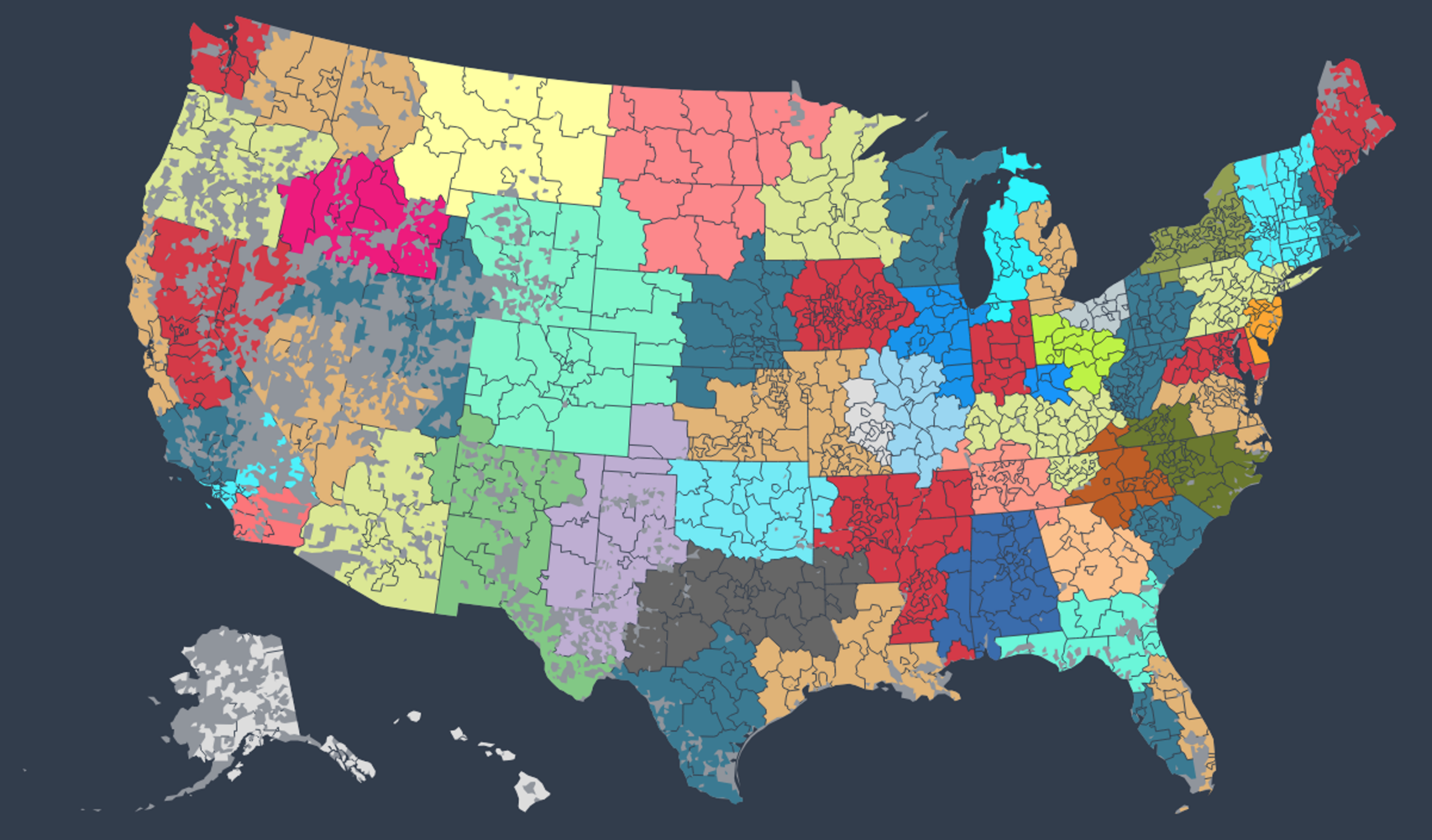
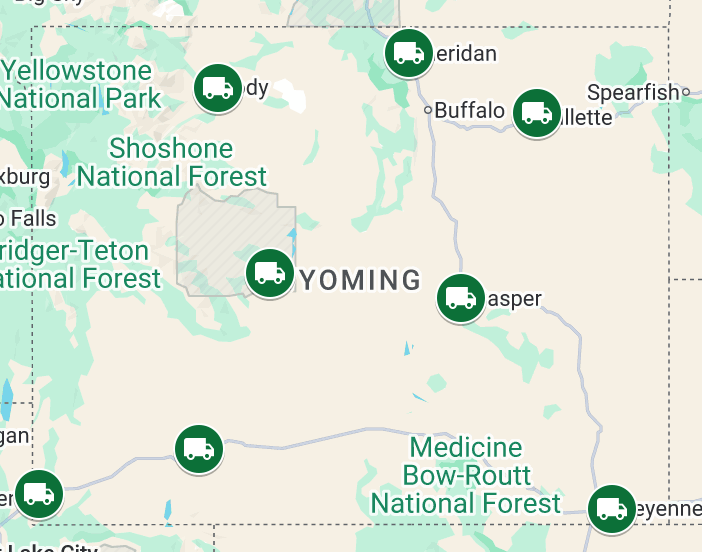
This commitment is not simply an “inefficiency” that any private company would rationalize. It is also something that is logistically impossible for any private corporation to fulfill. Take a sparsely-populated state like Wyoming. By my current count, UPS has nine last-mile delivery facilities, i.e., buildings from which delivery drivers pick up their loads for the day and set off to deliver packages; FedEx has eight, and Amazon two. USPS, by contrast, has seventy-seven. The last-mile facilities for these private companies are perfectly adequate for the purpose of package delivery (especially if they can send anything they don’t want to deal with to USPS), but to actually deliver on the USO, they would need an order of magnitude more in terms of last-mile capacity—both additional buildings as well as more carriers to drive and walk regular routes.



This is one of the glaring contradictions of the Wells Fargo framework: once parcels are hived off, they take it as obvious that USPS would sell off real estate to subsidize mail service, when mail service is only possible because of that real estate. They thus avoid the uncomfortable truth that their plan would inevitably eliminate the USO, making mail something that is delivered sporadically and only in more limited geographic areas. What they are proposing is nothing less than the end of mail service as Americans have known it.
As for parcels, Wells Fargo is clear about the purpose of privatization: “Postal Reform Provides Positive Optionality to FedEx and UPS.” The bank’s analysts calculate that a privatized service would raise existing USPS parcel prices between 30 and 140 percent across product lines, “which would be positive for FedEx and UPS.” (It’s worth noting that Wells Fargo’s Board of Directors includes private equity mogul Wayne Hewett, who also sits on the board of UPS.) Again, the corporate interest in privatization is straightforward: for their entire existences, these companies have had to compete with a public option, and they are sick of it. To gird their bottom lines, investment bankers are prepared to sacrifice one of the last public agencies that physically binds the United States together as a nation.
Amazon’s role
It’s worth a brief digression on Amazon’s particular role in the drama of postal privatization. Though they are not named in the Wells Fargo framework, recent developments in their distribution network indicate that they are very concerned with the fate of USPS.
Indeed, over the past few years, Amazon as a combined e-commerce and parcel delivery company has been doing the most of any part of corporate America to prepare for a world in which USPS no longer exists. The fastest growing category of distribution nodes in Amazon’s system are what it calls Sub-Same Day Centers and Rural-Super Rural (RSR) stations, the latter of which function as combined fulfillment and delivery operations in rural areas. The RSR network buildout is a significant departure from Amazon’s core parcel delivery strategy of building around population density, and no doubt the potential privatization of USPS, on whom it currently relies heavily for rural deliveries, is a significant motivation here.
Not that long ago, it would have been laughable to think Amazon could benefit from postal privatization in the same way that UPS or FedEx could. But now as the largest private parcel company and also USPS’s largest service contract, Amazon is in the driver’s seat. The corporation recently renewed its USPS contract at 20 percent less volume, but I have heard that they are eager to imminently wean themselves off of USPS completely. USPS’s recent solicitation of bids to access its last-mile network was met with great frustration by Amazon (who at which time that had not yet settled the new contract), and the e-commerce company appears ready to assert a long-threatened independence.
As is evident from the maps above, however, Amazon still lags behind its parcel competitors in terms of its rural buildout. Despite its recent troubles, a company like UPS still has a better infrastructural case to make that it could provide USPS-like service. However, even if it does not ultimately get a slice of the postal privatization pie, Amazon is still very concerned with this development because privatization would eliminate its low-cost rural delivery option. Either way, then, it’s clear that Amazon has a material stake in cutting its dependence on USPS as quickly as possible.
A senior staffer at APWU mentioned another reason, aside from no longer having a low cost parcel competitor/service provider, that Amazon would be interested in postal privatization.
When we look at the growth of e-commerce, it’s not just a story about Amazon. Many of us understand the role that Amazon plays in the country, but there are thousands of small and medium-sized businesses that have really flourished in this new e-commerce environment, and particularly the smaller ones rely almost exclusively on the Postal Service because of their cost advantage to ship their goods out to customers.
No other e-commerce company has built out the logistics network that Amazon has, and if postal service were privatized, Amazon would truly have its competitive moat.
The class politics of postal privatization
What would the end of mail as Americans have known it mean precisely? For the professional urban dweller, it might seem like postal privatization is a sad development in theory, but does not pose such a practical problem. Indeed, with email, digital fluency, and readily-available internet access, Amazon and UPS to deliver one’s packages, and an annoyance at the daily marketing mail that clutters a physical inbox, there’s a good argument that it simply doesn’t. The Danish postal service recently announced that it would be ending mail service at the end of the year due to the “increasing digitalisation” of Danish society. Our hypothetical American urbanite might read such a story and wonder, “If the Danes don’t need it, why do we?”
For one, 92.5 percent of Danish households have broadband access at home, compared to 78 percent of Americans. For US households with income of $30,000 or less, coverage falls to 54 percent. Denmark also made public digital services mandatory in 2015, meaning that all interactions with public services, from utilities to healthcare, must be digitally accessible. As a result, 82 percent of Danes “use public digital services at least once a week.” In the US, by contrast, less than a quarter of people regularly interact with government services digitally.
With underdeveloped digitization, USPS quite literally serves a socially integrative function that some urbanites might only take to be symbolic. According to Steve Hutkins, author of the remarkable blog, Save the Post Office, “the Postal Service’s vast infrastructure of 35,000 post offices and 230,000 delivery routes cover the entire country and really do bind the nation together.” This community binding is particularly evident in rural areas, which all commentators on postal privatization, from its champions to its critics, agree will be the hardest hit. As Jake (not a real name), a City Carrier Assistant who has worked in both rural and urban areas, told me, “Because carriers deliver the same routes, they form lasting relationships with the public and those on their regular route; people recognize when someone is walking around their neighborhood every day.”
The medical implications of postal privatization for rural residents are particularly concerning. Twenty percent of adults over 40 with chronic conditions get their prescriptions by mail, and veterans receive 84 percent of their prescriptions by mail. “When I delivered to a person in a relatively rural area who couldn’t leave their house due to their health, I put their medication in a slot in their door,” Jake related. “If this weren’t a service provided by the federal government, or this person had to pay extra for it, they would simply be left to die.”
However, while it would be easy to think that USPS privatization is primarily a geographic concern, many urban residents would also suffer given the range of social services in US cities that are still carried out by mail. As Jake continued:
Information about your SNAP benefits is distributed by mail. Many residents of public housing as well as tenants of private landlords pay rent by mail. Many people, especially the elderly and those in public housing, are paid by mail. Tax returns, and especially refunds, are often distributed by mail. Many medications are delivered by mail. Our immigration system distributes notices and can accept submissions by mail. A paper trail in physical rather than digital form is easier to use in, e.g., housing court; sections of New York housing law actually require certain notices to be sent by certified mail.
During the recent ICE raids in Minneapolis, postal workers delivered expedited passports in neighborhoods where many people weren’t leaving their homes, sometimes in harrowing conditions. “I deliver in a working-class immigrant community,” explained Tyler Vasseur, a city letter carrier in Minneapolis and a union steward with the National Association of Letter Carriers (NALC). “There was a period of time where for several weeks, every day or every other day, there were active ICE raids on my route.” This is obviously an extreme case, but one that speaks to the social constancy that USPS is obligated to provide. Whatever is happening in the country, even an ICE raid where “there’s tear gas getting shot off,” in Vasseur’s words, the postal service is there to deliver the mail.
Other paths forward
Critics of USPS like to point to twenty years of losses to justify the idea of privatization. The criticism rests on the assumption that USPS is a failing business—an unfair metric not only because it is a public service but also because it is subject to all manner of restrictions that actual private businesses are not. APWU’s senior staffer described USPS as in an “identity crisis created by Congress. They tell the Postal Service two conflicting things. We want you to be a public service, you’re going to have a lot of public service obligations, but we also want you to operate like a business. What the Postal Service ends up getting through law is the worst of both worlds.”
USPS’s financial crisis began in 2006 after the Postal Accountability and Enhancement Act, which required the agency “to calculate all of its likely pension costs over the next 75 years, and then sock away enough money between 2007 and 2016 to cover most of them”—something no corporation would ever do. USPS also has a limited line of credit, can only invest retirement funds in Treasury notes, and cannot ship alcohol. In no way are these the marks of a true “free enterprise,” and so it’s disingenuous to compare it to one.
At the same time, there is no shortage of ideas for generating new revenue streams. As Yao explained some of the ideas proposed by APWU:
There are other potential ways to raise postal revenue…, such as allowing post offices to handle some functions of state and local governments, like hunting and fishing licenses, driver’s license and vehicle tab renewals. There is a pilot program to have mail carriers, who know their communities in detail, to act as census agents, instead of hiring and training temporary workers every 10 years.
Jake was supportive of USPS’s recent solicitation of bids for access to its last-mile network: “Currently, we have only a few last-mile delivery contracts with a few large companies. If we were able to have more of these contracts, it would increase revenue and delivery coverage at the same time.” And there is also the long overdue proposal for postal banking, which would offer much needed financial services for the millions of Americans who don’t have bank accounts.
But all of these questions and proposals revolve around the idea that the postal service needs to be something more than it is, that it is fundamentally deficient in some way. USPS is, at root, a modern logistical marvel that should be a point of national pride. As Jonathan Smith, President of the APWU, relayed to me:
It is still a miracle that you can get a letter from New York to California for less than a buck. Challenge anyone to try and do that through any other means. It’s just a remarkable operation. The ubiquity of it is something really to be cherished. In moments of crisis, in the early days of COVID, or after hurricanes or earthquakes, you read news stories, and people will often say, “I saw the letter carrier going down the street, and I knew we were going to be okay.” The Postal Service is the first one back into a community after a disaster like that. You can count on the mail moving and getting to you wherever you are. It really is quite a marvel.
The business press is always giving Amazon its flowers for new efficiencies in warehousing and delivery, always eager to lightly edit and republish the company’s press releases. But Amazon (and any other private carrier) is logistically incapable of doing what the postal service does, and its executives know that if postal privatization were to pass, amid a feeding frenzy in the parcel segment, the mail and the socially integrative function involved in providing it would quickly wither.
Vasseur is one of the founders of a reform caucus at NALC called Building a Fighting NALC (BFN). When ICE used USPS parking lots to stage their operations in South Minneapolis, BFN members were there to protest. They will also be marching in Minneapolis’s May Day parade behind a banner that says, “Fund the Postal Service, Not War.” As Vasseur concluded:
We can work around the edges to find solutions to some parts of the financial issues facing USPS and other public services, but I don’t think that’ll fix everything. Now’s the time to go on the offensive and point out the hypocrisy that we see every day about where the money goes. For that reason, our reform caucus [wants] to push the union to take up the fight to call for the Postal Service to be publicly funded, period.
Further Reading

Who Owns the World Cup?
FIFA's commercial machine
This weekend the FIFA Men’s World Cup 2026 ends. Since its location was announced in 2018, this was set to be a tournament like no...
The Anti-Amazon
Costco's model and the future of retail
We are in a new age of logistical prowess, led by the dynamism of Amazon as it strives to carry out dizzyingly complex forms of...

Three Frontiers of Global China
Prospects for South–South development without dependency
What defines Global China today? China’s global power extends beyond infrastructural investments in the global South to entail normative and epistemic shifts as well, with...