July 16, 2025
Interviews
Experiments in American Unions
An interview with Ben Fong
What has become of the “hot labor summers” of the Biden years? Since Workers United publicly launched its organizing drive at Starbucks in August 2021, the union has won in 618 of the 727 stores where representation elections occurred. Since the Amazon Labor Union (ALU) won its election in April 2022, it has affiliated with the International Brotherhood of Teamsters, which claims 10,000 members at ten Amazon facilities across the US. In February 2024, United Auto Workers President Shawn Fain announced a $40 million, two-year organizing drive to expand the union’s presence among the predominately unorganized US auto assembly and parts makers clustered in the South, which led to the UAW winning elections at Volkswagen and GM-Ultium, both in Tennessee.
However, despite the apparent upsurge in labor militancy in recent years, the share of the US workforce represented by labor unions declined during the Biden administration—from 10.3 percent in 2021 to 9.9 percent in 2024. Starbucks has fired workers for their union sympathies at 120 stores, according to government filings by Workers United, and has repeatedly refused to bargain with the union. Amazon has fired leaders of the ALU and countless others across the country, and regularly threatened to do so where workers have sought legal recognition. Both Mercedes-Benz and Ford-BlueOval, the Kentucky battery factory joint venture, have responded to workers’ petitions for union representation by firing the leaders organizing the effort. Having mustered the conviction to engage in collective bargaining, American workers today habitually confront corporate offices committed to discriminatory retaliation in the form of firing, disciplinary action, threats, and refusals.
Correcting such “inequality of bargaining power” between workers and employers was the original purpose of the National Labor Relations Act (NLRA), sponsored by New York Senator Robert Wagner and passed by Congress in 1935. The language of that statute made it national policy to “encourag[e] the practice and procedure of collective bargaining.” Workers lacking “full freedom of association or actual liberty of contract,” the law’s preamble explained, impeded the public interest in economic progress “by depressing wage rates and the purchasing power of wage earners.” The entire history of labor’s decline from the 1950s through the period of neoliberalism—from the age of McCarthyism to Trump—can be understood through the fate of this statute.1The NLRA has been amended twice. The 1947 Taft-Hartley amendments restricted bargaining tactics such as secondary boycotts, expanded employer rights to fight against unions, and legalized state-level bans on union-shop contract language (so-called “right-to-work” laws.) The 1959 Landrum-Griffin amendments required unions to submit accounting statements to the Department of Labor and further regulated their internal governance. During the 1960s and 1970s, repealing Taft-Hartley and strengthening penalties against employers’ violations repeatedly produced high-profile legislative showdowns. During the 1990s and 2000s, attempts to revive the NLRA continued to be a central partisan issue, most recently with Obama’s campaign support for the Employee Free Choice Act (EFCA) and Biden’s campaign support for the Protecting the Right to Organize (PRO) Act.
For decades since, it has been pro forma, a “best practice” of the corporate HR Department, to violate the Act on the assumption that delaying any hearings and appealing any decisions that result will maintain the status quo of unilateral managerial control. In the second Trump administration, this trend has reached its local terminus in the five-month hiatus at the National Labor Relations Board (NLRB) without quorum. In March, the White House nominated for the position of NLRB General Counsel, the agency’s staff director, Crystal Carey, a partner at the management-side labor law firm Morgan Lewis whose clients include Amazon, Apple, SpaceX, and Trader Joes. In July, the US Chamber of Commerce prematurely announced, before the White House itself, the administration’s nominations for the empty NLRB seats—one a career agency official and the other chief counsel for labor relations at Boeing, a company whose nonunion growth has had infamous consequences for airline safety.
At a moment when all national political rhetoric is uttered in reference to “the working class,” the actual institutions that embody workers’ organized power have become incongruously absent from the journalistic scene. As the old New Deal system affords workers a narrowing sliver of opportunity for collective bargaining, many of the big fights today are taking place outside the NLRB process, in labor-led legislative struggles, among worker centers in alliance with unions, or in state-level public sectors. To discuss this situation, and what workers have been doing in the new age of working-class politics, Phenomenal World spoke with Benjamin Fong, the Associate Director for the Center for Work and Democracy at Arizona State University, which earlier this year published a comprehensive report on alternative organizing strategies beyond the NLRB.
An interview with Ben Fong
ANDREW ELROD: The National Labor Relations Board was created by the National Labor Relations Act to enforce labor law in the private sector—receive and investigate charges of alleged violations, issue complaints, and certify unions. What is the status of the NLRB today and its role as a regulator in capital-labor conflict? How did it transform under the Biden administration?
BEN FONG: Though it is still formally available to most workers, the NLRB has been hugely skewed by the anti-union practices of corporate America. Employers campaign aggressively against the union, illegally fire or threaten to fire workers, and litigate who is eligible to participate in the election, thereby manipulating the size and scope of the bargaining unit. The chances of successfully seeking an election and bargaining a contract without a strike are in reality really slim.
Take the example of Amazon: a highly publicized election took place at one of its fulfillment centers in 2022 in Staten Island. It was a remarkable campaign, but the company has still not recognized the union and is nowhere near bargaining. Instead, Amazon’s legal team actively delays the process until momentum dies and the workers fragment. Though originally intended to protect workers’ ability to undertake collective action, today’s NLRA primarily benefits employers.
Another obstacle for unions is the sheer cost required for Board certification, which is how workers can use the law to obligate an employer to recognize their union. Some estimate that the cost of organizing a single worker through the NLRB election process is something like $3,000. If a union’s got a strong organizing department, it might be closer to $1,000 per worker—that’s the per-worker cost of a union recognition campaign: organizers’ salaries, printed and digital materials, office rent, etc. With a labor force of 145 million workers in the US, increasing union density by just 1 percent would require organizing roughly a million and a half new workers, not accounting for labor market growth. Even taking the lower estimate, that puts the cost of a 1 percent union density increase at a billion and a half dollars.
Biden’s NLRB made a number of changes that were great for labor. It processed elections far quicker and therefore benefited trade unions. It passed the Cemex decision and the various joint employer decisions.2Issued in August 2023, the Board’s decision in (<)em(>)Cemex Construction Materials Pacific, LLC(<)/em(>) obligates employers to either commence bargaining immediately or promptly petition for an election when a union demonstrates majority support for representation. If the employer commits an unfair labor practice during the resulting election, the Board will dispense with the election and order the employer to recognize and bargain with the union. The Board’s joint-employer rules extend NLRA obligations over companies that control subcontractors to the employees of those subcontractors. The NLRB issued a notice of proposed rulemaking on joint employer status in September 2022, issued the final rule in October 2023, only for the Eastern District of Texas to strike it down in March 2024. The NLRB issued two joint-employer complaints against Amazon in August and September 2024, with hearings and subsequent complaints scheduled for March and August. In September 2024, Amazon, represented by the law firm Hunton Andrews Kurth, sued the NLRB in the Eastern District of Texas alleging it to be an unconstitutional agency. But even under Biden, numbers from the Bureau of Labor Statistics reflect union density decline. This means that labor’s problems are not only partisan—the existing system harms labor even under a friendly administration and will do so especially under a hostile Republican one.
The impracticality of organizing through the NLRB should lead us to consider two things. First, the scale of existing organizing commitments is nowhere near what it would take to actually address labor’s issues. For example, after a remarkable strike in 2023 the new UAW administration announced a commitment of $40 million for organizing over two years. This is a real transformation of the UAW, but it is hardly enough to keep up with labor market growth—remember, a conservative estimate is $1 billion annually. In 2022, AFL-CIO President Liz Shuler set an organizing target of one million members over ten years. That’s a goal that, if met, simply assures labor’s continued decline.
In addition to putting existing commitments in a different light, I think what the resource question also shows is that labor needs to find new avenues of possibility in organizing, because it does take a tremendous commitment of resources—much more than is being committed right now. That money also needs to be used in smarter ways that render greater gains given the financial outlay.
AE: How have workers begun to organize around the constraints of the NLRB?
BF: In our report we review five strategies, each with a representative case study or two. There’s an additional section on what we call “promising innovations”—fairly unique experiments in worker empowerment that don’t fit neatly into any existing strategy. The first strategy we review is sectoral bargaining backed by legislation, which has been pioneered most prominently in recent years by the Service Employees International Union (SEIU). This refers to instances where an existing union has enough political power, or builds enough political power, to successfully lobby for a legal framework that allows the union to represent some new category of workers. A more recent example of this is California’s Fast Food Wage Board, which is an extension of SEIU’s decade-old Fight for $15 campaign.
Fight for $15 grew out of a broader SEIU initiative called the Fight for a Fair Economy, which was part of a renewed attempt within SEIU to devise new organizing efforts in the aftermath of the financial crisis. As the name implies, the Fight for $15 campaign was an effort to get local $15 minimum wage ordinances widely passed. Fast food was a key target of the campaign from the beginning. In 2021 and 2022, SEIU led a push in the California legislature for AB 257, which was successful in creating a Fast Food Council. The powers of the board, as enacted in AB 257, were pretty sweeping: to issue, amend, or repeal any rules and regulations necessary to establish minimum fast food working standards. In the entire state of California it affected more than half a million workers. The industry mobilized against this while SEIU was pushing for further legislation to hold corporate and franchise owners jointly liable for workplace abuses (at the moment, the parent company is often not responsible for what happens in franchise cases). This would have been a huge blow to the power of major corporations in the fast food industry. But in 2023 SEIU drew back that bill in exchange for an immediate wage bump.
In the political back and forth, the replacement legislation kept the Fast Food Council. This is an agency that exists in California. There are two fast-food worker representatives on it and two SEIU staff members, as well as business representatives and government officials. This is a classic corporatist arrangement, wherein representatives of government, business, and labor all sit on a common board and try to negotiate industry standards. Certain left labor elements have raised concerns around similar kinds of sectoral arrangements in other industries. While SEIU is very good at novel campaigns, they have been criticized for failing to involve their rank and file at a decision-making level. Political deals at that level almost by necessity cannot not involve the 500,000 people who are not already organized into a union.
But the vociferous reaction against AB 257 by the restaurant industry suggests that the union had identified a real point of leverage within the industry. The resulting board is not necessarily aimed at winning a union on the front end, but leveraging the Fast Food Council to create something like a really large, semi-public sector unit on the back end. So this campaign wasn’t just successful at raising the minimum wage for fast food workers in California to $20 an hour—it also opened the way for leveraging that Council to create some kind of actual union apparatus. Because under the current NLRA, and without a joint-employer law, there’s no legal framework wherein you could create something like a large fast food workers union within the entire state of California.
AE: In the report, you suggest that the Fast Food Council was partially inspired by a very different industry—long-term home care, which is largely Medicaid-financed home health aides, often family members, reimbursed by the state. How did that earlier experience in representing long-term healthcare workers inform the union’s strategies?
BF: Home care work is an interesting case, because it’s a non-congregate workplace, and oftentimes people’s direct employers are individual patients. It is also semi-public in nature, given the predominance of Medicaid reimbursements for home care workers. SEIU looked at this in the late-90s and early 2000s, when it was reconsidering national organizing strategies. From a traditional union organizing perspective, it doesn’t make much sense to target individuals as employers. But given the predominance of public funds that goes to this workforce, SEIU concluded that the state could bargain directly with the entire sector of workers to improve their working conditions.
The first place they successfully executed this was on the West Coast, with legislation in California, Oregon, and then Washington. It was a slow process. When the home care union in Washington, SEIU 775, first formed, it was a couple thousand people. But it eventually grew to represent something like 95 percent plus of the home care sector in the state. That was a huge win. Through these laws granting bargaining rights to these quasi public-sector unions, lots and lots of home care workers have unionized with SEIU. Home care union membership today is 75,000 in California, 50,000 in Oregon, and 50,000 in Washington.
During the Andy Stern years of SEIU, home care worker organizing accounted for most of the gains in the union. The key point of leverage lay in creating some kind of state infrastructure whereby you might imagine the possible formation of a union through means other than an NLRB election. Here they expanded the public sector bargaining framework as it stands for existing unions to a new class of workers. And I think the hope with the Fast Food Council is that it can create a similar kind of state infrastructure also leveraged for the creation of a large quasi-public sector union.
AE: What about areas where these legislative approaches to sectoral bargaining are not possible? What if the employers are already organized on paper but not bargaining centrally?
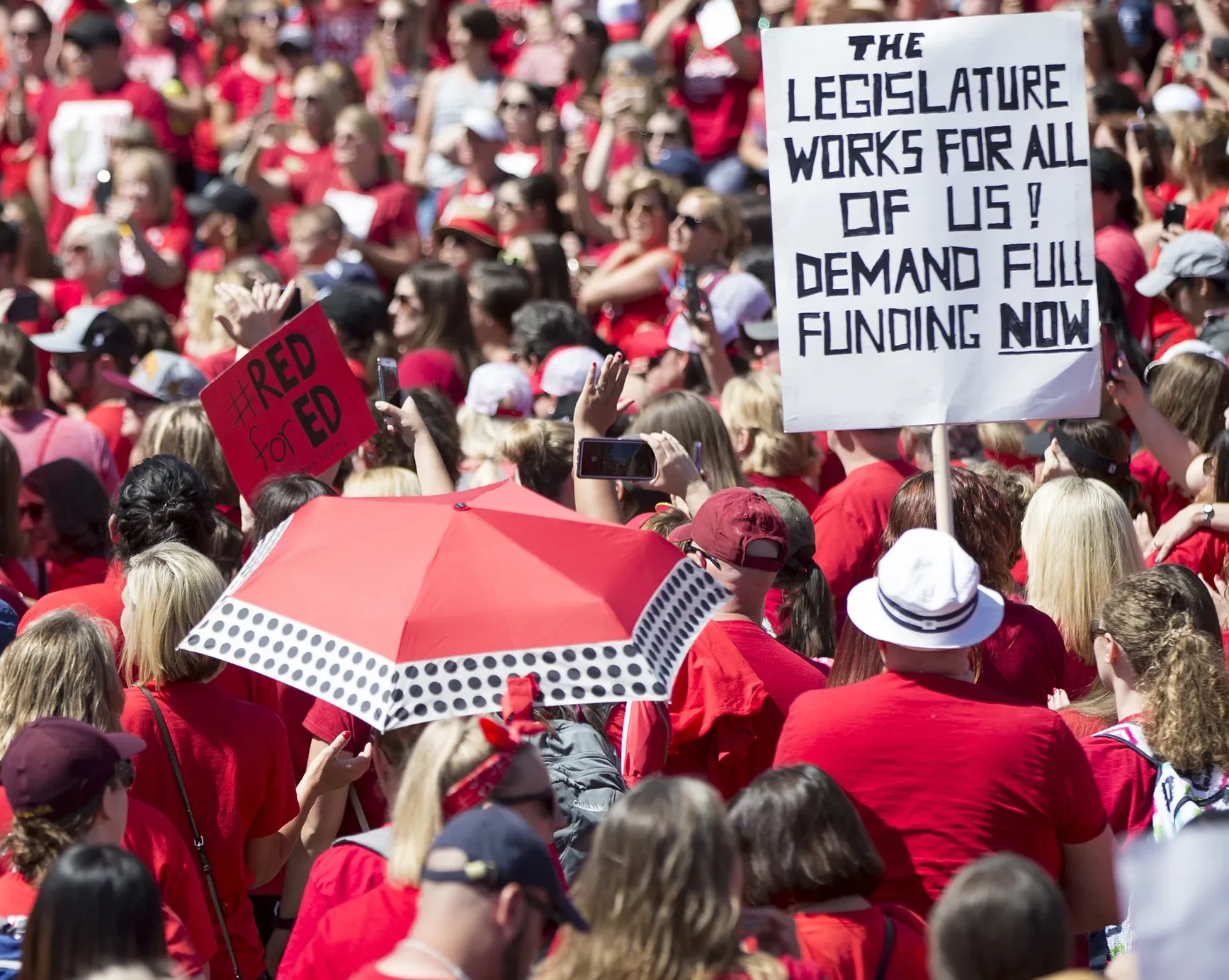
BF: Legislation to create sectoral bargaining arrangements is only practicable in blue states and municipalities like New York and California. There’s certainly less experimentation on behalf of workers who don’t live in those areas, but you do see some unique and powerful examples. One that we spotlight in the report is Arizona Educators United, AEU—the driving force behind the 2018 teacher strike in that state, which was the last teachers strike to occur during that wave of momentum in 2018, before the Red for Ed movement shifted to blue cities. The sequence was West Virginia, Oklahoma, and then Arizona that year.
The actual teachers union in Arizona is the Arizona Education Association, the AEA, which traditionally holds the lobbying relationship with the State of Arizona. The AEU was a parallel teachers group that started on Facebook and went on to create an external grassroots structure which undertook a remarkable organizing drive. In the space of eight weeks, AEU won a strike authorization vote from 57,000 educators. This was at a time when a majority of Arizona teachers weren’t members of the union—just 20,000 out of 60,000 total teachers in the state. But basically everyone in the industry voted in the strike authorization. The strike itself lasted six work days. Before the strike, the state wasn’t willing to consider anything more than a 1 percent pay increase, and afterwards, they won a 20 percent pay increase.
What we found interesting about AEU is that it was, on the one hand, a clear example of what happens when you have very smart, dedicated rank-and-file leaders interested in organizing people around very immediate fights. On the other hand, it didn’t really fit the classic model of the rank-and file-strategy as it’s been articulated by many different left labor commentators. The classic articulations of the rank-and-file strategy are about fixing representation gaps within unions, with a dedicated core of rank-and-file organizers leading their union to be more militant. While the AEA was supportive of the drive from the beginning, that support was a very secondary consideration in the action.
So we think the AEU mobilization presents a kind of interesting test case for rank and file theorists: it brought a whole bunch of people that weren’t in the union into the process of strike preparation, rather than attempt new organizing on the back of a successful contract campaign or an internal election win. How does that happen? We argue it speaks to the power of rank-and-file mobilization in the kind of unconstrained spaces where organized labor is traditionally very weak.
It was interesting to look at membership bumps in years after the 2018 teachers strike wave. In Arizona, you saw a 10 percent membership bump the next year. I don’t think that’s lasted, but a lot has happened in the meantime that can’t be pinned on the effects of the 2018 strike. So as inspiring as the Arizona teacher strike was, it also presents something of a cautionary tale. After the settlement, the energy of the teacher’s strike sort of went in two ways. The first was that AEU started a national organization, National Educators United, which was an attempt to maintain that external grassroots structure outside of formal union governance. This didn’t really grow beyond its original Arizona members. The other, more successful way was toward a ballot initiative, Prop 208, which was an initiative to tax the rich to fund public education. This was the union’s preferred path. I remember Joe Thomas, who was the president of the union at the time, saying “Okay, we did this now let’s go get some signatures for this ballot initiative.” They had that in their back pocket from the beginning. It was successful in 2020, and the teachers won a tax increase of 3.5 percent on income above $250,000.
But the Arizona Supreme Court struck down the initiative and reversed the victory. The ballot campaign was successful, but demonstrations of rank-and-file power and legislative maneuvering through ballot initiatives are two different processes. At the end of the day, Arizona teachers didn’t control the latter, and so, thanks to the legislature and the courts, the practical gains that were won through those means have essentially been reversed.
AE: The construction industry seems to sit interestingly between these two poles—the completely open-shop fast food industry on one end and on the other, K–12 public education, where collective bargaining has been legally protected in many places. Construction is one of the oldest unionized industries but, unlike many traditional labor strongholds, it’s an industry that today has more employment than ever. There has been no job loss due to “de-industrialization” in construction.
At the same time, most of the growth of construction employment has been outside of the unions. The building trades today are islands of collective bargaining, centered on large commercial and government projects, surrounded by an ocean of individual bargaining in private residential projects. That nonunion market is characterized by often-fraudulent employment arrangements and a real race to the bottom in terms of wages and standards. And it’s begun to flood into commercial projects where unions survive.
BF: Construction is an industry that highlights yet another important development in national labor strategy: the cooperative relationship between trade unions and workers’ centers. Take the example of Minneapolis. As in many cities, Minneapolis’s construction workforce is bifurcated: the downtown urban development projects are largely unionized while the suburban and exurban smaller projects are a lot of fly-by-night contractors employing a predominantly immigrant workforce. The industry is divided and the building trades understandably don’t really know how to organize in the latter context. Many of these construction contractors are deeply unreliable.
This is where worker centers can potentially play a role. The particular construction industry case study we looked at was Centro de Trabajadores Unidos en La Lucha (CTUL), a worker center founded in 2007 in Minneapolis. Traditionally, worker centers are thought to engage the vulnerable workers that unions either don’t or can’t organize.
What’s interesting about CTUL is the relationship they’ve built with the area’s labor unions and the organizing niche they’ve filled to bridge the different labor markets dividing union from nonunion employers. To do this, they borrowed from a campaign by the Coalition of Immokalee Workers to organize tomato pickers in Florida. This is the strategy of “worker-driven social responsibility,” which consists of developing industry codes of conduct. The name “worker-driven social responsibility” has become common to distinguish these projects from “corporate social responsibility” campaigns where the employers develop the codes without workers’ independent participation.
In Minneapolis, CTUL has developed industry codes for the area’s construction industry through a separate organization, the Building Dignity and Respect Standards Council, which is a membership organization for developers in the Twin Cities. The BDR Standards Council drafts priorities for the construction industry, working with both nonunion workers and with the unions. They get developers to agree to certain standards that are then enforced through monitoring and compliance organizations. Many of the standards are simply the law, but the monitoring and compliance allows the BDR Standards Council to bring violations to the city, which can then enforce the law where previously these parts of the industry were invisible to the authorities.
AE: How do they get the agreement? I could envision a worker center in a very different place, Houston for example, where there’s no desire on the part of an employer to acquiesce to any standard, much less voluntary monitoring by a potential whistle blower.
BF: Looking back to the classic iterations of these social responsibility campaigns, such as the tomato pickers in Immokalee, Florida, it’s primarily a brand image problem. For the tomato pickers, the brands were some of the biggest grocery and food service companies—Kroger, Walmart, Taco Bell, et cetera. The campaign was successful through attempting to tarnish the brand images of these big corporations and getting them to agree to industry standards that are pennies for these big corporations. In the case of Immokalee, it was literally a penny a pound extra that the companies agreed to pay. Dairy farm workers who supply Ben and Jerry’s had a similar tactic: they got Ben and Jerry’s to agree to sourcing standards. You attack the brand until they recognize their ethical responsibilities.
But as your question implies, this is also the essential problem with worker-driven social responsibility. You can only get so much from tarnishing a company’s brand at the end of the day. In Florida’s tomato fields, it did absolutely raise working conditions. But it didn’t give the workers a union. The gains were pretty minimal and limited. A similar thing is happening with the BDR Standards Council in Minneapolis. In construction, people don’t relate to real-estate developers in the same way that they do to Taco Bell, right? The leverage of the “corporate campaign” is pretty minimal and the amount of possible change even more limited.
The interesting innovation here is not the standards themselves, but how those standards help consolidate an industry to make it organizable. The level of competition is so low in some of these exurban and suburban construction developments that the trade-off for getting in trouble with the city for workplace abuses is enough that the construction companies are willing to sign these agreements. It effectively edges out the worst low-road contractors and brings standards up in the unorganized parts of the construction market. But importantly for our study, the marginal improvements under the codes also make it more possible for unions to consider organizing in that part of the market.
To understand how this works, it helps to know a little bit of Minneapolis’s recent labor history. One of CTUL’s early campaigns was a corporate campaign against large retailers for their janitorial subcontracting standards. They had a campaign on Target, which was contracting with something like twenty-six different janitorial services. This was a nightmare from a union organizer’s perspective—this is why large corporations pursue such workplace fissuring in the first place, to keep out unions and drive down labor costs. As a worker center, CTUL could go after parent companies in the way that unions can’t, given the ban on secondary boycotts and all the constrictions of the NLRA. You see these kinds of things in a lot of cities: NGO-driven worker centers organizing corporate campaigns to raise the floor for certain sets of workers or industries. That’s nothing new. This is what CTUL did in getting Target, among other companies, to sign certain contracts around working standards for their janitorial staff.
The codes themselves aren’t anything revolutionary. But what CTUL saw after they got Target to agree to contracting standards for their janitorial companies was that the set of twenty-six subcontractors had whittled down to just four companies. The codes drove out the worst fly-by-night janitorial contractors, and at this point, SEIU Local 26, with whom CTUL has a solid relationship, decided to go in and try to unionize the janitors. They did, and they were successful in organizing those janitors into the local.
Creating the same dynamic is one goal of the BDR Standards Council. Industry codes of conduct aren’t providing much leverage at the end of the day. What they do provide enough leverage to do, however, is to get out some of the worst low road contractors so as to provide a situation where a workforce is potentially more organizable. You could say it’s an attempt to use local state capacity around enforcement to create better conditions for unionization. And in that sense, it’s similar to SEIU’s sectoral bargaining efforts in California.
CTUL is pretty unique among worker centers for having developed really good relationships with unions. They’re constantly talking to the building trades, as they have with SEIU Local 26. There’s a partnership there that allows a kind of leverage for unions. And it speaks to the kind of possibilities that a diverse organizational ecosystem in certain municipalities can produce.
AE: Thinking across all of these examples, those that resulted in the growth of durable workers’ power are ultimately those where workers were able to organize themselves and conduct strikes. But reminding us of this truth doesn’t quite help us understand how to make mass collective action happen. And in suggesting other approaches—worker-driven social responsibility or corporatist political deals or minority unionism—we lose sight of the kind of power that can actually arrest our drift into the kind of anarchy that defines much of the American economy these days.
BF: One important thing to emphasize is that this is a survey of existing practices, of what unions or worker organizations are attempting to do to empower workers outside of just running more NLRB recognition campaigns. None of the strategies currently being employed by unions or workers offer the single key to labor revitalization, and none of them is wholly promising on its own. There are always conditions. The home care worker organizing that the SEIU did in the nineties and early aughts was remarkably successful in one sense, but it was limited to the West Coast—it was rebuffed in Ohio, Wisconsin, and Michigan.
Nevertheless, it is important to understand the sort of strategies being developed on the ground and the creative ways in which the floor on labor organizing is being raised for certain groups of workers who were until recently unorganized. If you look at the case of the CWA’s tech worker organizing project, which we do, you could say that they were successful in organizing Zenimax (a Microsoft contractor) workers because they were adequately prepared for a strike. That’s true. But that project, through the Alphabet Workers Union, also had 1 percent of the salaries of Google employees to help fund the Zenimax organizing. That’s an interesting set of conditions made possible by tweaking the minority union form a bit. Something new was possible where it wasn’t before.
The hope in pointing to these things is to start a larger strategic conversation about labor’s impasse. So much of the discussion about organized labor’s problems concerns traditional tactics: how to organize better or worse, given existing constraints of employer retaliation and repression. That’s one very important part of the conversation, but it’s not the only part of the conversation. Labor’s been playing a losing game, arguably for forty years now. And the hope is to entertain strategic reconsiderations that aren’t so much highlighted in academic and popular labor discussions. What we hope to do in each case is not to hold them up as a shining example that we ought to follow. It is to say that under certain conditions this works and to understand those conditions. What are the conditions under which it might be possible to scale and what are the conditions under which it might become something sustainable over time so that it can endure during fallow periods?
Further Reading
The Runaway Shop
An interview with Jeffrey Hermanson on labor unionism and manufacturing under NAFTA and USMCA
Pay Equity at Kroger
Wage inequality through occupational segregation
Supermarket Economics
An interview with John Marshall of the United Food and Commercial Workers, Locals 324 & 3000
Further Reading
The Runaway Shop
An interview with Jeffrey Hermanson on labor unionism and manufacturing under NAFTA and USMCA
In the early years of NAFTA, the maquiladora system undermined national manufacturing and unions in Mexico across industrial sectors, drawing workers around the country into...
Pay Equity at Kroger
Wage inequality through occupational segregation
After the Southern California supermarket strike of 2003–2004, Kroger Co. and the UFCW compromised on a two-tier provision preserving current employee benefits and pay, but...

Supermarket Economics
An interview with John Marshall of the United Food and Commercial Workers, Locals 324 & 3000
Behind the retail grocery industry’s image of public routine churns an incredible and evolving feat of collective enterprise. The companies that own and operate grocery...